The Eight Men Of Moidart
Scottish Country Dance Instruction
THE EIGHT MEN OF MOIDART (R8x32) 4C set Neil Stewart (1760s) RSCDS Book 31- 8 All couples set twice, cross passing RSh
9-16 All couples set twice again and cross back passing RSh
17-24 All couples facing up advance and retire and then give hands to turn partners RH
25-32 1s set, cast to 2nd place (2s step up) and turn RH
Repeat with 1s in 2nd place (all 4 couples dance bars 1-24 of each time through)
(MINICRIB. Dance crib compiled by Charles Upton, Deeside Caledonian Society, and his successors)
Keith Rose's Crib Diagram

Dance Information
The Eight Men of Moidart is generally known as a Scottish pipe march, often played in the context of Jacobite-themed repertoire, but the tune itself does not appear in eighteenth-century sources.There is no printed or manuscript evidence that it is contemporary with the 1745 Jacobite Rising. Instead, the earliest secure appearances of the melody are nineteenth-century, when many pipe marches were being standardised, titled, and published. This places the tune firmly in the period when Scottish musical nationalism and Jacobite memorial tradition were both very active, and when many supposedly older titles were being coined for already-existing melodies.
The title refers to Moidart, a district in the western Highlands historically associated with Clanranald and with the landing of Charles Edward Stuart in 1745. Historical accounts from the eighteenth century describe several Highland gentlemen who were present at the Prince's arrival, but neither the phrase "Eight Men of Moidart", nor a fixed list of eight, appears in contemporary documents. The number became standard only much later, especially after the planting of the famous group of memorial trees near Glenfinnan in the nineteenth century. This strongly suggests that the title of the tune belongs to the later memorial tradition rather than to the events of 1745 themselves.
Musically, the piece became part of the mainstream piping repertoire once nineteenth-century and early twentieth-century pipe collections began to stabilise commonly played marches. It is regularly found in printed pipe music books from that period onward, usually as a 2/4 march. Like many marches with Jacobite titles, it is not possible to prove who composed it, and no composer is credited in early printings. Its association with Jacobite history rests entirely on the later naming, not on documentary evidence linking the melody to the period.
Willie Wastle - Poem was written by Robert Burns in 1792 for Johnson's Museum, and in later tradition it was adapted to be sung to the tune of The Eight Men of Moidart.
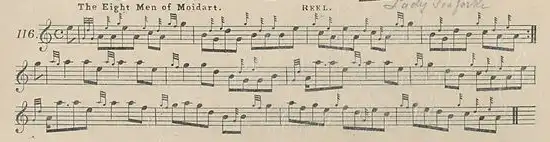
The Eight Men Of Moidart, From Glen Collection Of Printed Music, Piper's Assistant, Page 70, c. 1854
This page uses content under the Creative Commons Attribution-ShareAlike 4.0 International License, along with original copyrighted content and excerpts from Wikipedia and other sources. See our Copyright and Reuse Policy for details.
Text from this original Willie Wastle article on Wikisource.
Image from (cropped) National Library Of Scotland, licensed under Creative Commons BY-SA 4.0.
Additional search terms: 8 Men.
Back to the top of this Scottish Country Dancing Instructions 'The Eight Men Of Moidart' page