The Engagement Ring
Scottish Country Dance Instruction
THE ENGAGEMENT RING (S3x32) 3C Set Wouter and Liebet Joubert Fields Of Gold1- 4 1s dance LSh round each other and cast to 2nd place own side (2s step up bars 3-4)
5- 8 1s lead down crossing over, 1M dances above partner while 1L turns under his R arm. 1s cast up round 3s to 2nd place on opposite sides. 2(1)3
9-16 1s dance ½ diagonal R&L (1M up, 1L down), 1s dance ½ diagonal R&L (1M up, 1L down) (3)(1)(2)
17-20 1s dance ½ diagonal RSh reel of 4 with 3rd corners, 1s pass RSh to face 4th corners
21-24 1s dance ½ diagonal RSh reel of 4 with 4th corners. 213
25-32 2s+1s+3s dance the knot. 312
(MINICRIB. Dance crib compiled by Charles Upton, Deeside Caledonian Society, and his successors)
Keith Rose's Crib Diagram

Dance Information
An engagement ring is a ring given as part of a marriage proposal or exchanged upon an agreement to marry.In many countries it is traditionally worn on the ring finger of the left hand, although customs vary between regions and cultures. Engagement rings are commonly made from precious metals such as gold, platinum, palladium or silver and may contain gemstones.
The use of rings as symbols of betrothal dates back to antiquity. Rings were used in the Roman Empire as tokens of an agreement to marry. A gold ring was sometimes worn in public while an iron ring was worn within the home. Written evidence from the Roman period records the giving of rings during betrothal arrangements.
The earliest known reference to a diamond engagement ring dates from 1477, when Archduke Maximilian of Austria gave a diamond ring to Mary of Burgundy. During subsequent centuries, engagement rings were worn mainly among aristocratic and wealthy families. The wider availability of diamonds during the nineteenth century increased their use in jewellery.
In Western countries, engagement rings became more common during the twentieth century. In 1947, the advertising slogan "A Diamond Is Forever" was introduced by De Beers as part of a marketing campaign promoting diamond engagement rings. During the second half of the twentieth century, diamond-set rings became the most common style of engagement ring in many English-speaking countries.
A solitaire ring, consisting of a single gemstone mounted on a band, is one of the most widespread engagement ring designs. Other styles include rings with multiple stones, cluster settings, pavé settings and three-stone arrangements. Diamonds are the most frequently used gemstone, although sapphires, rubies, emeralds and other gemstones are also used. Modern diamonds may be natural or laboratory-grown.
In the United Kingdom, Ireland, Australia, New Zealand, Canada and the United States, engagement rings are commonly worn on the fourth finger of the left hand. In several European countries, including Germany, Poland and Russia, engagement rings are traditionally worn on the right hand.
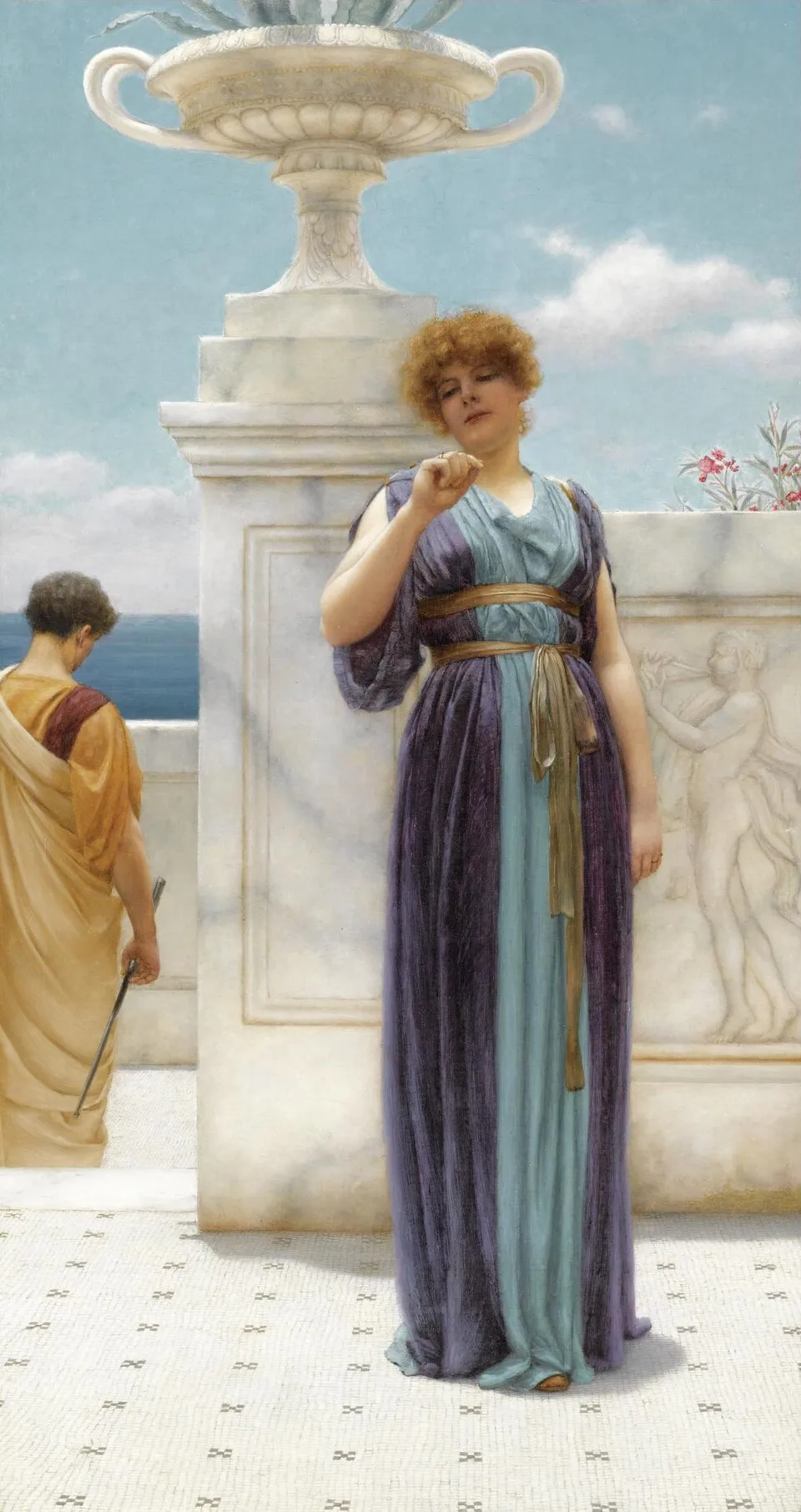
"The Engagement Ring", John William Godward (1861–1922), Oil On Canvas, c. 1891
This page uses content under the Creative Commons Attribution-ShareAlike 4.0 International License, along with original copyrighted content and excerpts from Wikipedia and other sources.
Text from this original Engagement Ring article on Wikipedia.
Image from John William Godward, Public domain, via Wikimedia Commons.

Back to the top of this Scottish Country Dancing Instructions 'The Engagement Ring' page