Full Circle
Scottish Country Dance Instruction
FULL CIRCLE (J4x32) 4C set Roy Goldring A Reel For Alice1- 8 1s+3s cross RH; 1M+3L change places LH; 1L+3M change places RH; 2s cross RH to face out/down
9-16 Mirror reels of 3 on sides (1s cross up, 2s out/down, 3s in/down to start) 3(2)(1)
17-20 1s cross RH, cast up 2 places (3s+2s step down 19-20) 13(2)
21-24 2s repeat bars 17-20 (1s+3s step down 23-24) 213
25-28 1L+2s also 1M+3s dance RH across, 1s dance towards each other ready for...
29-32 1s touch hands, cast 2 places (3s+4s step up 31-32) 2341
(MINICRIB. Dance crib compiled by Charles Upton, Deeside Caledonian Society, and his successors)
Keith Rose's Crib Diagram

Dance Information
The expression "full circle" is used to describe a situation that has returned to its starting point after a series of changes or developments.It conveys the idea of completion, where events or circumstances eventually lead back to where they began. The phrase is often applied to cycles in life, history, or processes that end by reconnecting with their origins.
The earliest recorded use of "full circle" in English comes from William Shakespeare's play King Lear, written around 1605-1606. In Act V, Scene III, the line "The wheel is come full circle" is spoken by Edmund, meaning that fortune has turned completely and returned to its beginning. Shakespeare's use of the phrase established its figurative meaning, linking it to the turning of a wheel and the cyclical nature of fate.
The word "circle" itself derives from the Latin circulus, meaning a ring or round figure, and has long been associated with cycles, repetition, and wholeness. By combining "full" with "circle", the phrase emphasises the completion of a cycle without interruption. Over time, it became a common idiom in English, used in both literary and everyday contexts to describe outcomes that bring events back to their origin.
In modern usage, "full circle" retains this figurative sense of returning to the beginning. It is frequently employed to describe personal journeys, historical events, or processes that conclude by revisiting their starting point.
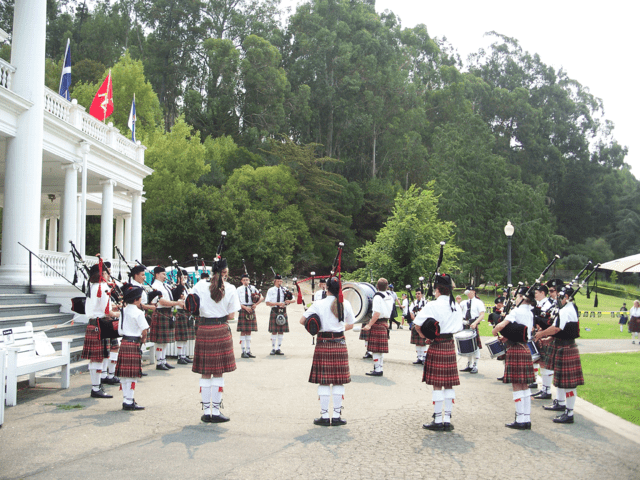
Highland Pipe Band Competition Full Circle
Image copyright Patrick Muse, CC BY 3.0, via Wikimedia Commons.

This page uses content under the Creative Commons Attribution-ShareAlike 4.0 International License, along with original copyrighted content and excerpts from Wikipedia and other sources. See our Copyright and Reuse Policy for details.
Text from this original King Lear article on Wikipedia.
Back to the top of this Scottish Country Dancing Instructions 'Full Circle' page