The Isle Of St Kilda
Scottish Country Dance Instruction
THE ISLE OF ST KILDA (J8x32) 3C (4C set) Anne Thorn Magic of Music1- 8 2s followed by 1s slip step down for 4 steps, set (starting on foot nearest top) and back to top, 1s cast to 2nd place. 213
9-12 1s turn 3s on sides (Men RH, Ladies LH)
13-16 1s turn 2s (Ladies RH, Men LH), 1s finish facing 1st corner
17-20 1s dance ½ RSh reel of 4 with 1st corners, 1s pass RSh to face 2nd corners
21-24 1s dance ½ RSh reel of 4 with 2nd corners to finish in 2nd place on opposite sides
25-32 3s+1s+2s dance set and link for 3. 213
(MINICRIB. Dance crib compiled by Charles Upton, Deeside Caledonian Society, and his successors)
Dance Information
St Kilda is an archipelago (a group of islands) in the North Atlantic, about 40 miles west of the Outer Hebrides and 100 miles west of mainland Scotland.The group comprises the islands of Hirta, Dùn, Soay and Boreray, together with several sea stacks. Hirta is the largest island and was the site of the permanent settlement at Village Bay.
The islands are the remains of volcanic formations altered by erosion and glaciation. Conachair, on Hirta, reaches 430 metres above sea level, and cliffs rise directly from the Atlantic around much of the archipelago. Stac an Armin, north of Boreray, reaches 196 metres above sea level.
Evidence of human occupation on St Kilda extends over at least 2,000 years. The inhabitants kept sheep, cultivated land and collected seabirds and their eggs. Hundreds of stone storage structures known as cleitean were built across Hirta for drying and storing food, peat and other materials.
The population declined during the nineteenth and early twentieth centuries. In 1930, the remaining 36 islanders requested evacuation, and they left Hirta for mainland Scotland on 29 August. St Kilda has had no permanent civilian population since the evacuation.
The National Trust for Scotland has owned St Kilda since 1957. A Ministry of Defence installation has operated on Hirta since the 1950s, and personnel continue to work on the island.
St Kilda supports breeding colonies of seabirds, including northern gannets, fulmars and Atlantic puffins. The archipelago also has its own subspecies of wren and field mouse. Soay sheep live on Hirta and Soay and descend from a primitive domestic sheep population.
St Kilda was inscribed on the UNESCO World Heritage List for its natural features in 1986. The designation was extended to include the surrounding marine environment in 2004 and cultural criteria in 2005. It is the United Kingdom's only World Heritage Site inscribed for both natural and cultural criteria.
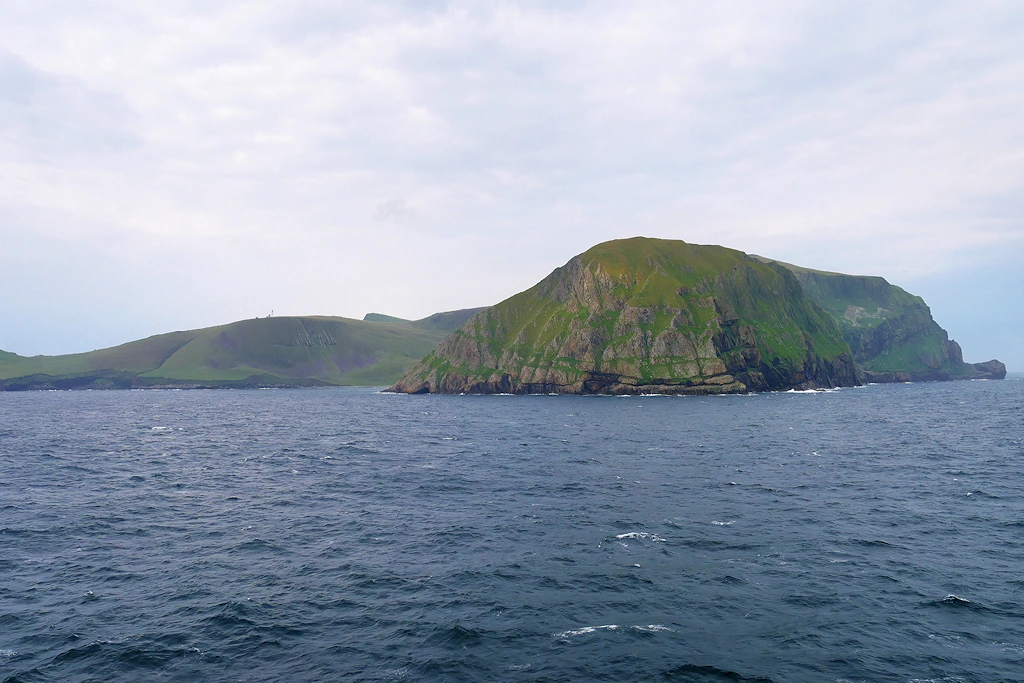
Hirta, The Largest Island In The St Kilda Archipelago
This page uses content under the Creative Commons Attribution-ShareAlike 4.0 International License, along with original copyrighted content and excerpts from Wikipedia and other sources. See our Copyright and Reuse Policy for details.
Text from this original St Kilda, Scotland article on Wikipedia.
Image copyright David Dixon under this Creative Commons Licence 2.0.
Back to the top of this Scottish Country Dancing Instructions 'The Isle Of St Kilda' page