The Mathematician
Scottish Country Dance Instruction
THE MATHEMATICIAN (S4x32) 4C set John Roby 2006 Houston and District 30th Anniversary Collection1- 8 All dance ½ Grand Chain (2 bars per hand) to end in diagonally opposite positions
9-16 All set Highland Schottische, all turn 2H 1¼ times to end in centre with Ladies facing down and Men up
17-24 4s+3s also 2s+1s, dance Highland Schottische Poussette and end final turn by joining hands in 2 circles
25-32 All circle 4H round; 2s dance up to 1st place as 3s, 4s and 1s step down on bars 31-32. End 2341
(MINICRIB. Dance crib compiled by Charles Upton, Deeside Caledonian Society, and his successors)
Keith Rose's Crib Diagram

Dance Instruction Videos
The Mathematician - Scottish Country Dancing Instruction VideoDance Information
Also see the dance The Mathematicians by Alex Gray.A mathematician is a professional who specialises in the study of mathematics, using their expertise to explore abstract concepts such as numbers, quantities, shapes, and patterns.
This study forms the foundation for addressing both theoretical questions and practical problems across various disciplines, including physics, engineering, computer science, and economics. Mathematicians engage in activities such as creating proofs, developing models, and solving equations, which can lead to breakthroughs in understanding and innovation.
Historically, the term "mathematician" has evolved alongside mathematics itself. In ancient times, mathematicians often combined their work with other disciplines like philosophy and astronomy. Renowned figures such as Euclid, known for his contributions to geometry, and Archimedes, famous for his work on mechanics and calculus precursors, exemplify the rich heritage of this profession. Over time, mathematics became more specialised, dividing into areas such as pure mathematics, which focuses on abstract theory, and applied mathematics, which directly addresses real-world issues.
In modern times, mathematicians play a crucial role in advancing technology and scientific research. Their work is indispensable in designing algorithms for computing, analysing data for artificial intelligence, and modelling climate change, among other applications. The field has become increasingly collaborative, with mathematicians working in interdisciplinary teams to solve complex global challenges.
The profession requires not only logical and analytical thinking but also creativity and persistence, as mathematicians often explore uncharted intellectual territories. While some pursue academic careers, others work in industries such as finance, healthcare, and technology, demonstrating the vast applicability of mathematics in the contemporary world.
Isaac Newton (1643-1727)
Newton is often considered one of the greatest mathematicians and scientists in history. His development of calculus (independently discovered alongside Leibniz), laws of motion, and universal gravitation fundamentally shaped physics and mathematics. His work in Philosophiæ Naturalis Principia Mathematica remains a cornerstone of classical mechanics.
Euclid (circa 300 BCE)
Known as the "Father of Geometry", Euclid's Elements is one of the most influential works in the history of mathematics. It systematically presented geometry and set the standard for logical rigor, impacting mathematics for over two millennia.
Pythagoras (circa 570-495 BCE)
Pythagoras is renowned for the Pythagorean theorem, a fundamental principle in geometry. Though his life is shrouded in legend, his influence on mathematics, philosophy, and mysticism is significant.
Leonhard Euler (1707-1783)
Euler made groundbreaking contributions across multiple areas of mathematics, including calculus, graph theory, topology, and number theory. He introduced many notations still used today, such as
𝑒 for the base of natural logarithms and 𝑖 for the square root of -1.
Alan Turing (1912-1954)
Turing's work on computation and his role in breaking the German Enigma code during World War II have made him a household name. As a pioneer of computer science and artificial intelligence, his impact extends far beyond mathematics.
Carl Friedrich Gauss (1777-1855)
Often called the "Prince of Mathematicians", Gauss made significant contributions to number theory, algebra, statistics, and more. His work in Disquisitiones Arithmeticae revolutionised number theory and influenced generations of mathematicians.
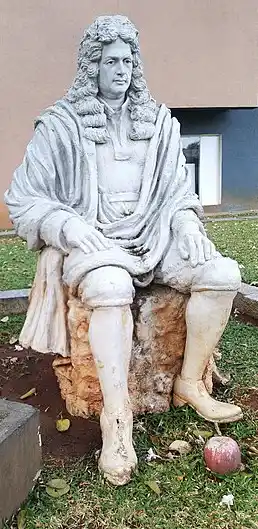
Statue Of Isaac Newton In Inter-University Centre For Astronomy And Astrophysics, India
With The Representation Of The Iconic Apple That Fell From The Tree
This page uses content under the Creative Commons Attribution-ShareAlike 4.0 International License, along with original copyrighted content and excerpts from Wikipedia and other sources.
Text from this original Mathematician article on Wikipedia.
Image copyright (cropped) DesiBoy101, CC BY 4.0, via Wikimedia Commons.

Back to the top of this Scottish Country Dancing Instructions 'The Mathematician' page