Petronella
Scottish Country Dance Instruction
PETRONELLA (R8x32) 2C (4C set) RSCDS Book 11-16 1s dance full petronella back to places
17-24 1s lead down the middle and back again
25-32 1s+2s dance Poussette
(MINICRIB. Dance crib compiled by Charles Upton, Deeside Caledonian Society, and his successors)
Keith Rose's Crib Diagram

Dance Instruction Videos
Petronella - Scottish Country Dancing Instruction VideoDance Information
Petronella is a traditional Scottish Country Dance devised by Nathaniel Gow in about 1820. It was collected in the first book published by the RSCDS in 1924 for RSCDS Book 1.(Dance information copyright, reproduced here with the kind permission of George Williams)
Written variously as 'Petronelle' 'Paternally' 'Paternella', the name's origin is unknown. The tune is an old Scottish measure probably originating in the early 19th century.
The origin of the name "Petronella" is uncertain, although it is an established female given name derived from Latin and used throughout Europe since medieval times.
The dance appeared in later editions of The Dancing Master, the famous collection of English country dances first published by John Playford in 1651. The work became one of the most important surviving sources for country dancing in Britain and remained in print for many decades.
Within Scottish country dancing, the name "Petronella" became especially associated with the travelling turning movement now known as the "Petronella Turn" or "Petronella Figure". The movement remains widely used in modern Scottish country dances.
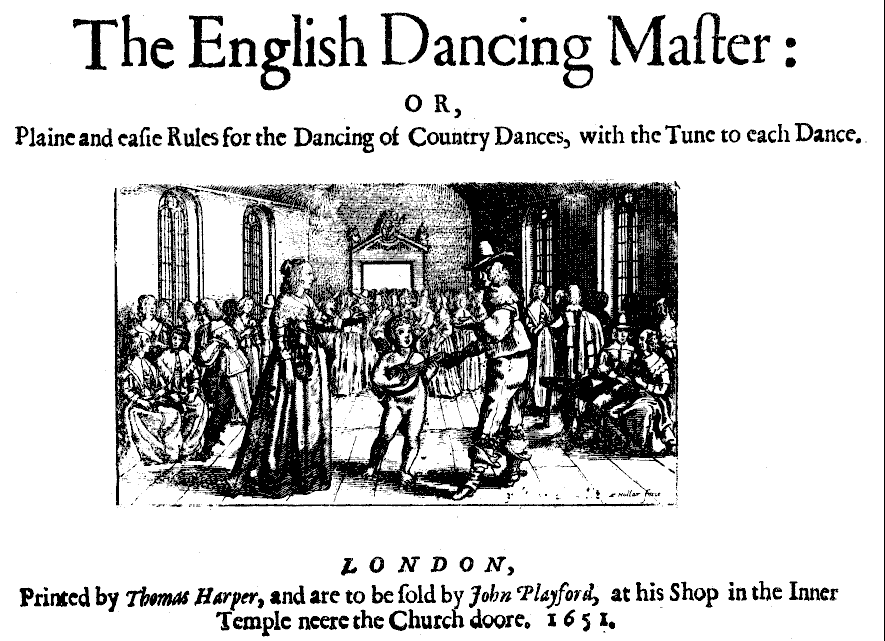
The Dancing Master, 1st Edition, Title Page, c. 1651
This page uses content under the Creative Commons Attribution-ShareAlike 4.0 International License, along with original copyrighted content and excerpts from Wikipedia and other sources. See our Copyright and Reuse Policy for details.
Text from this original The Dancing Master article on Wikipedia.
Image from See page for author, Public domain, via Wikimedia Commons.

Back to the top of this Scottish Country Dancing Instructions 'Petronella' page