Woo'd And Married And A'
Scottish Poem By Alexander Ross
Woo'd And Married And A' (also known as The Bride Cam' Out O' The Byre) is an old Scottish song sung to a Scottish air of the same name. The words have sometimes been attributed to the Scottish poet Alexander Ross (1699–1784), although other sources give the author as unknown.Woo'd And Married And A' has a complicated history, with different sets of verses appearing under the title. The version beginning "The bride cam' out o' the byre" was included in David Herd's collection of 1776, although it was already considered to be considerably older.
Alexander Ross was born to a farming family in Aberdeenshire and educated at Marischal College, Aberdeen. After working as a tutor and teacher, he became schoolmaster at Lochlee in Angus in 1732 and remained there until his death in 1784. At the suggestion of James Beattie, he published The Fortunate Shepherdess in 1768.
Joanna Baillie (1762–1851) later wrote her own version of Woo'd And Married And A'. Baillie's version was first published in George Thomson's collection of National Melodies and was subsequently included in her Fugitive Verses in 1840 and Alexander Whitelaw's The Book of Scottish Song in 1843.
Joanna Baillie was a Scottish poet and dramatist whose works include Plays on the Passions and Fugitive Verses. She spent much of her later life at Hampstead and was acquainted with writers including Sir Walter Scott, Anna Laetitia Barbauld and Lucy Aikin.
Related Scottish Country Dances
Proud And SaucyWoo'd And Married And A'
Woo'd And Married And A' By Alexander Ross
The bride cam' out o' the byre,
And, O, as she dighted her cheeks!
Sirs, I'm to be married the night,
And have neither blankets nor sheets;
Have neither blankets nor sheets,
Nor scarce a coverlet too,
The bride that has a' thing to borrow,
Has e'en right muckle ado.
Chorus
Woo'd and married, and a',
Married, and woo'd, and a'!
And was she nae very weel off,
That was woo'd, and married and a'?
Out spake the bride's father,
As he cam' in frae the pleugh,
O, haud your tongue, my dochter,
And ye'se get gear eneugh;
The stirk stands i' th' tether,
And our bra' bawsint yade,
Will carry ye hame your corn-
What wad ye be at, ye jade?
Out spake the bride's mither,
What deil needs a' this pride?
I had nae a plack in my pouch
That night I was a bride;
My gown was linsy-woolsy,
And ne'er a sark ava;
And ye ha'e ribbons and buskins,
Mae than ane or twa.
What's the matter, quo' Willie;
Though we be scant o' claes,
We'll creep the closer thegither,
And we'll smoor a' the fleas:
Simmer is coming on,
And we'll get taits o' woo;
And we'll get a lass o' our ain,
And she'll spin claiths anew.
Out spake the bride's brither,
As he came in wi' the kye;
Poor Willie wad ne'er ha'e ta'en ye,
Had he kent ye as weel as I;
For ye're baith proud and saucy,
And no for a poor man's wife;
Gin I canna get a better,
I'se ne'er tak' ane i' my life.
Out spake the bride's sister,
As she came in frae the byre;
O gin I were but married,
It's a' that I desire:
But we poor folk maun live single,
And do the best that we can;
I dinna care what I shou'd want
If I cou'd get but a man.
Woo'd And Married And A' By Joanna Baillie
Her hair it is snooded sae sleek,
And faithful and kind is her Johnnie,
Yet fast fa' the tears on her cheek.
New pearlings are cause o' her sorrow,
New pearlings and plenishing too;
The bride that has a' to borrow,
Has e'en right meikle ado.
Woo'd and married and a',
Woo'd and married and a',
And is na she very weel aff
To be woo'd and married and a'?
Her mother then hastily spak':
"The lassie is glaiket wi' pride;
In my poaches I hadna a plack
The day that I was a bride.
E'en tak' to your wheel and be clever,
And draw out your thread in the sun,
The gear that is gifted, it never
Will last like the gear that is won.
Woo'd an' married an' a',
Tocher and havings sae sma'
I think ye are very weel aff,
To be woo'd and married an' a',"
"Toot, toot!" quo' the grey-headed father,
"She's less of a bride than a bairn,
She's ta'en like a cowt frae the heather,
Wi' sense and discretion to learn.
Half husband, I trow, and half daddy,
As humour inconstantly leans;
A chiel may be constant and steady
That yokes wi' a mate in her teens.
'Kerchief to cover so neat,
Locks the winds used to blaw,
I'm baith like to laugh and to creet,
When I think o' her married at a'".
Then out spak' the wily bridegroom,
Weel waled were his wordies I ween;
"I'm rich, though my coffer be toom,
Wi' the blinks o' your bonnie blue een;
I'm prouder o' thee by my side,
Though thy ruffles or ribbons be few,
Than if Kate o' the craft were my bride,
Wi' purples and pearlings enew.
Dear and dearest of ony,
Ye're woo'd and bookit and a',
And do ye think scorn o' your Johnnie,
And grieve to be married at a'".
She turn'd, and she blush'd, and she smil'd,
And she lookit sae bashfully down;
The pride o' her heart was beguil'd,
And she play'd wi' the sleeve o' her gown;
She twirl'd the tag o' her lace,
And she nippet her boddice sae blue,
Syne blinket sae sweet in his face,
And aff like a mawkin she flew.
Woo'd and married and a',
Married and carried awa';
She thinks hersel' very weel aff,
To be woo'd and married and a'.
Woo'd And Married And A' Song Video
Woo'd And Married And A' Song - Information Video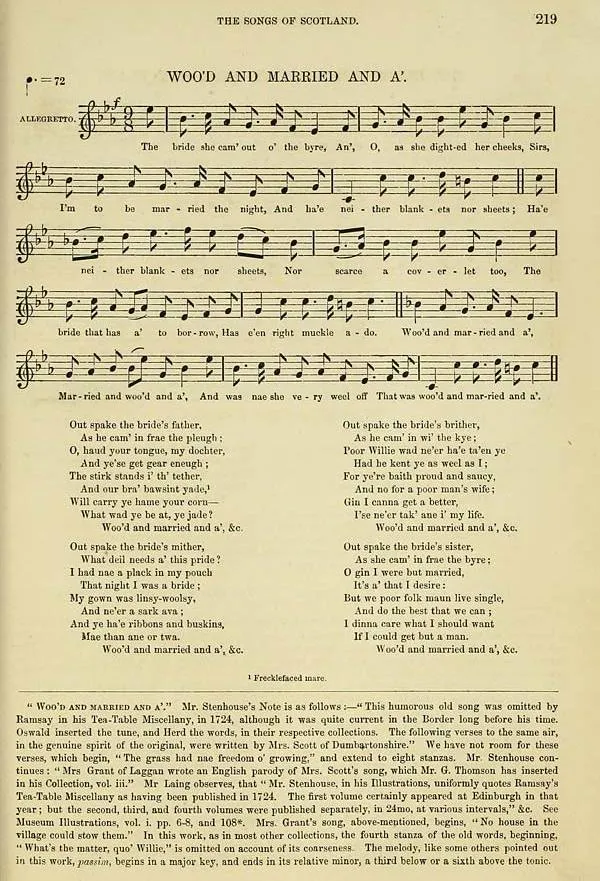
Woo'd And Married And A', From Wood's Edition Of The Songs Of Scotland, Printed Music
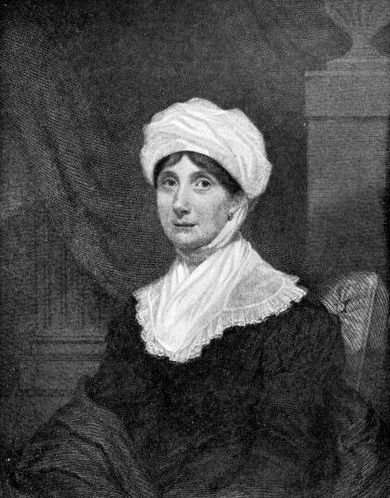
Portrait Of Joanna Baillie (1762-1851), Engraving By H. Robinson After A Portrait By Sir William Newton, c. Before 1851
The Online Scots Dictionary Translate Scots To English.
This page uses content under the Creative Commons Attribution-ShareAlike 4.0 International License, along with original copyrighted content and excerpts from Wikipedia and other sources. See our Copyright and Reuse Policy for details.
Text from this original The Bride Cam' Out O' The Byre article on Wikisource.
Text from this original Woo'd And Married And A' article on Wikisource.
Text from this original Alexander Ross (Poet) article on Wikipedia.
Text from this original Joanna Baillie article on Wikipedia.
Upper image from National Library of Scotland, licensed under Creative Commons BY-SA 4.0.
Lower image from (cropped) Stich von H. Robinson nach einem Portrait von Sir William Newton, public domain, via Wikimedia Commons.

Back to the top of this 'Woo'd And Married And A' Song' page