The Abbot Of Unreason
Scottish Country Dance Instruction
THE ABBOT OF UNREASON (J8x32) 3C (4C set) Milton Levy Tin Woodman1- 8 1s dance down, 1L dances under 1M arm as he dances round below her and dance up to 2nd place BtoB in the middle facing opposite sides
9-16 1s set (as in Double Triangles), turn 1st corner RH, set again in Double Triangles and turn 2nd corners LH
17-24 1s reel of 3 on the sides giving RSh to 1st corners and cross to 2nd place own sides
25-32 All set 1 (pas-de-basque on R foot) and circle 6H round to left, all set (pas-de-basque on L foot) and circle 6H round to right
(MINICRIB. Dance crib compiled by Charles Upton, Deeside Caledonian Society, and his successors)
Keith Rose's Crib Diagram

Dance Instruction Videos
The Abbot Of Unreason - Scottish Country Dancing Instruction VideoDance Information
The Abbot of Unreason was a figure appointed in Scotland to preside over seasonal festivities, particularly during the Christmas and New Year period.The office was the Scottish equivalent of the Lord of Misrule in England. Individuals appointed to the role organised public entertainments, processions and festive gatherings in which normal social conventions were temporarily relaxed.
Records of Abbots of Unreason appear in Scotland during the late medieval period and the early sixteenth century. The title was used in towns, royal households and other communities where organised festive celebrations took place. Similar customs existed elsewhere in Europe, including the Lord of Misrule in England and the Prince des Sots in France.
The Abbot of Unreason directed revels that could include feasts, entertainments, performances and ceremonial processions. The role was temporary and existed only for the duration of the celebrations. Contemporary Scottish and English records describe comparable officials who were chosen to oversee Christmas festivities and other seasonal amusements.
During the sixteenth century, opposition to such festivities increased. In 1555, the Scottish Parliament passed legislation suppressing the Abbot of Unreason and related celebrations. The prohibition formed part of wider efforts to regulate public festivities before the Scottish Reformation. Although some customs survived for a time after the ban, the formal office disappeared during the later sixteenth century.
The Abbot of Unreason is recorded in Scottish historical sources as one of several medieval festive offices that temporarily placed authority in the hands of a symbolic leader for the duration of a celebration. References to the office survive in legislation, civic records and later historical accounts describing seasonal customs in pre-Reformation Scotland.
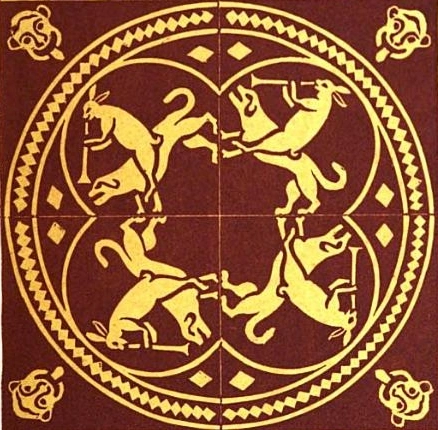
"Hare Chasing, Riding A Dog. Medieval Tile Found At The Friary Derby", Llewellynn Jewitt (1816–1886), c. 1862
This page uses content under the Creative Commons Attribution-ShareAlike 4.0 International License, along with original copyrighted content and excerpts from Wikipedia and other sources.
Text from this original Lord of Misrule article on Wikipedia.
Image from Llewellynn Jewitt, Public domain, via Wikimedia Commons.

Back to the top of this Scottish Country Dancing Instructions 'The Abbot Of Unreason' page