Abbotsford Lassies
Scottish Country Dance Instruction
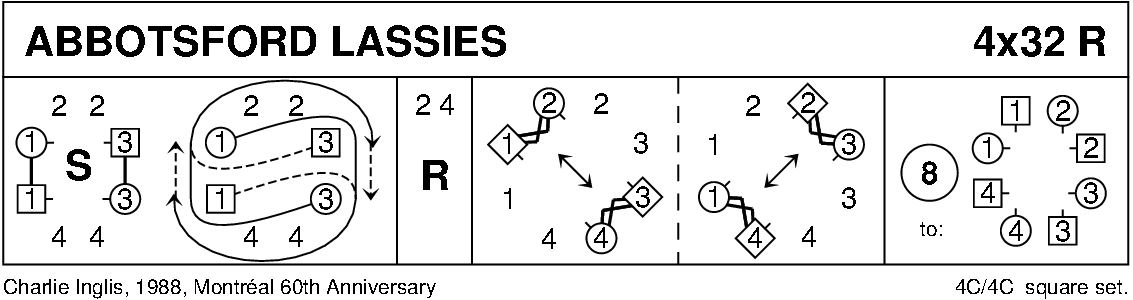
ABBOTSFORD LASSIES (R4x32) Sq.Set Charlie Inglis1- 8 1s+3s set and change places RH (up/down), dance clockwise round the outside of the set back to places (ending in partner's place)
9-16 2s+4s repeat
17-24 1L+2M and 3L+4M (taking nearer hands) advance and retire diagonally, 2L+3M and 4L+1M repeat
25-32 All circle 8H round and back ending with Men in original places with new partner
(MINICRIB. Dance crib compiled by Charles Upton, Deeside Caledonian Society, and his successors)
Keith Rose's Crib Diagram
Dance Instruction Videos
Abbotsford Lassies - Scottish Country Dancing Instruction VideoDance Information
Situated near Galashiels in the Scottish Borders, Abbotsford House was the residence of Sir Walter Scott, a renowned 19th-century novelist and poet.In 1811, Scott acquired a 100-acre farm known as Cartleyhole, colloquially called "Clarty Hole" due to its muddy terrain. He renamed the estate "Abbotsford" in homage to a nearby river crossing historically used by monks from Melrose Abbey.
Scott transformed the modest farmhouse into a grand mansion between 1817 and 1825, collaborating with architects William Atkinson and Edward Blore. The design pioneered the Scottish Baronial architectural style, featuring turrets, battlements, and asymmetrical layouts. Scott referred to his creation as "a sort of romance in architecture" and "a kind of Conundrum Castle". The house incorporated historical relics, including the doorway from Edinburgh's old Tolbooth and elements from the city's 15th-century Mercat Cross.
Inside, Abbotsford housed Scott's extensive library of over 7,000 volumes, alongside collections of antique furniture, weaponry, and artefacts significant to Scottish history. Notable items included the Celtic Torrs Pony-cap and Horns and the Woodwrae Stone, now preserved in the Museum of Scotland.
Following Scott's death in 1832, Abbotsford remained in his family's possession until 2004. His descendants, particularly Dame Jean Maxwell-Scott, played a crucial role in maintaining the estate, opening it to the public to fund its upkeep. The house was equipped with electricity only in 1962. After Dame Jean's passing, the Abbotsford Trust was established to safeguard the property's future.
A significant restoration project culminated in 2013, with the house reopening to the public following a £12 million refurbishment. The initiative included the construction of a new visitor centre, designed by LDN Architects, featuring a café, gift shop, and exhibition space. The restoration earned the European Union Prize for Cultural Heritage/Europa Nostra Award in 2014.
Abbotsford House continues to attract visitors worldwide, offering insights into Scott's life and the architectural innovation he championed.
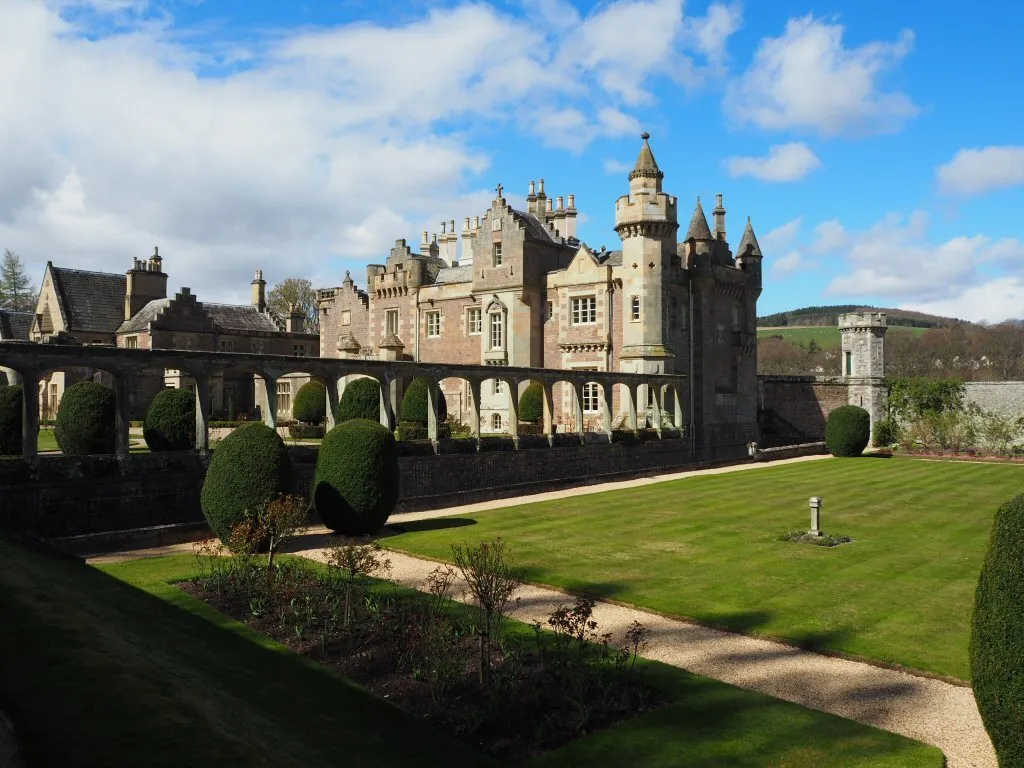
Abbotsford House
This page uses content under the Creative Commons Attribution-ShareAlike 4.0 International License, along with original copyrighted content and excerpts from Wikipedia and other sources. See our Copyright and Reuse Policy for details.
Text from this original Abbotsford, Scottish Borders article on Wikipedia.
Image copyright David Haynes, reproduced here with kind permission, 2016.
Back to the top of this Scottish Country Dancing Instructions 'Abbotsford Lassies' page