The Beltane Strathspey
Scottish Country Dance Instruction
The Beltane Strathspey (S3x32) 3C (3C set) 32 Bar Strathspey For 3 Couples In A 3 Couple Set Rod Downey The Piwakawaka Collection1- 4 First and second couples dance 4 hands across, finish with 1C facing 2C on the sides.
5- 8 1L and 2L, 1M and 2M set on the sides twice.
9-16 1C, 2C, and 3C dances RS reels on the side, finish with 1L facing out.
17-20 1L with 2L, 1M with 2M turn RH 1½ times to change places.
21-24 1L with 3L, 1M with 3M turn LH 1½ times to change places.
25-32 6 Hands round and back.
Repeat from new positions.
(Dance crib compiled by the deviser Rod Downey, Johnsonville SCD Club Tutor)
Dance Instruction Videos
The Beltane Strathspey - Scottish Country Dancing Instruction VideoDance Information
Devised 18 April 2024 as a teaching dance for parallel reels on the sides in Strathspey time, as there seemed no simple appropriate dance.Since we were having a Ceilidh-style Beltane themed night two weeks after this teaching night, I could also re-use the dance for that night.
Beltane is one of the four main Celtic seasonal festivals along with Samhain, Imbolc, and Lughnasadh.
Recommended music is "Campbletown Kiltie Ball" by P/M John McLellan, and I used Frank Reid's recording of "The Wind on Loch Fyne".
(Dance information by the deviser, Rod Downey, Johnsonville SCD Club Tutor)
Beltane is a traditional Gaelic festival that marks the beginning of summer. It is usually observed on 1 May, roughly halfway between the spring equinox and the summer solstice.
Historically, it was celebrated throughout Ireland, Scotland and the Isle of Man, and is one of the oldest seasonal festivals recorded in Gaelic culture. Beltane is mentioned in early Irish literature and is associated with a number of events in Irish mythology.
The festival was closely linked to farming and the seasonal movement of livestock. Cattle were traditionally driven to summer grazing grounds at this time of year, and various customs were carried out to protect animals, crops and people. Large bonfires formed an important part of the celebrations. The fire, smoke and ashes were believed to provide protection and good fortune, and in some areas cattle were driven between two fires before being taken to pasture.
Many traditional Beltane practices declined during the nineteenth and twentieth centuries, although some survived in local communities. The festival has also inspired modern cultural events, including organised celebrations held in several parts of Scotland and Ireland.
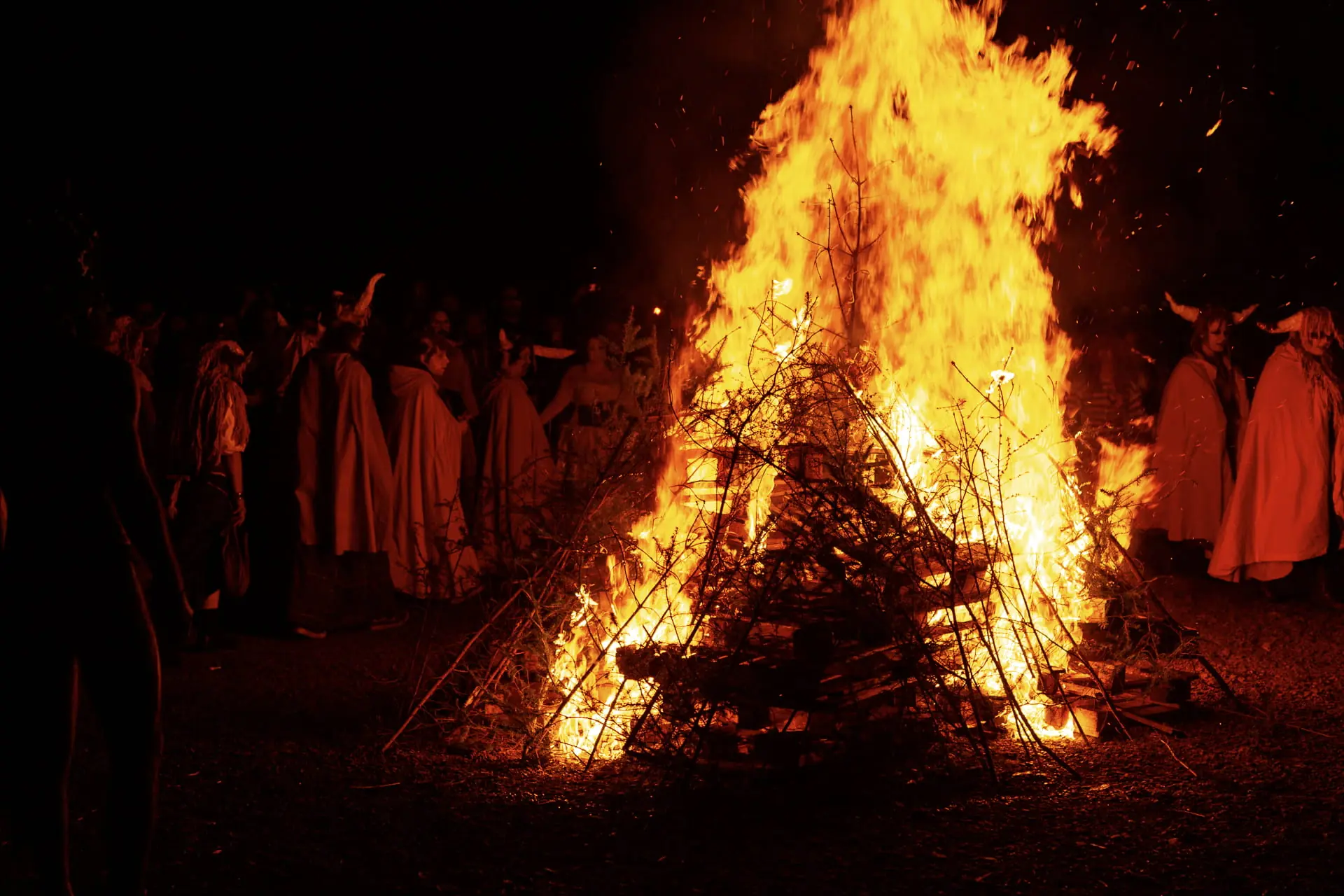
Running The Cattle Through The Fire Ritual, Beltane Fire Festival, Edinburgh, 2019
Published in The Piwakawaka Collection, reproduced here with the kind permission of the deviser, Rod Downey.
Published in https://homepages.ecs.vuw.ac.nz/~downey/dances/book6.pdf
This page uses content under the Creative Commons Attribution-ShareAlike 4.0 International License, along with original copyrighted content and excerpts from Wikipedia and other sources. See our Copyright and Reuse Policy for details.
Text from this original Beltane article on Wikipedia.
Image from Beltane1, CC0, via Wikimedia Commons.

Back to the top of this Scottish Country Dancing Instructions 'The Beltane Strathspey' page