Binary Stars
Scottish Country Dance Instruction
Binary Stars (J4x32) A 32 bar jig for four couples in a longwise set Murrough Landon, 2014.The dance starts with two chords: on the second chord 2nd and 4th couples cross over to the opposite side.
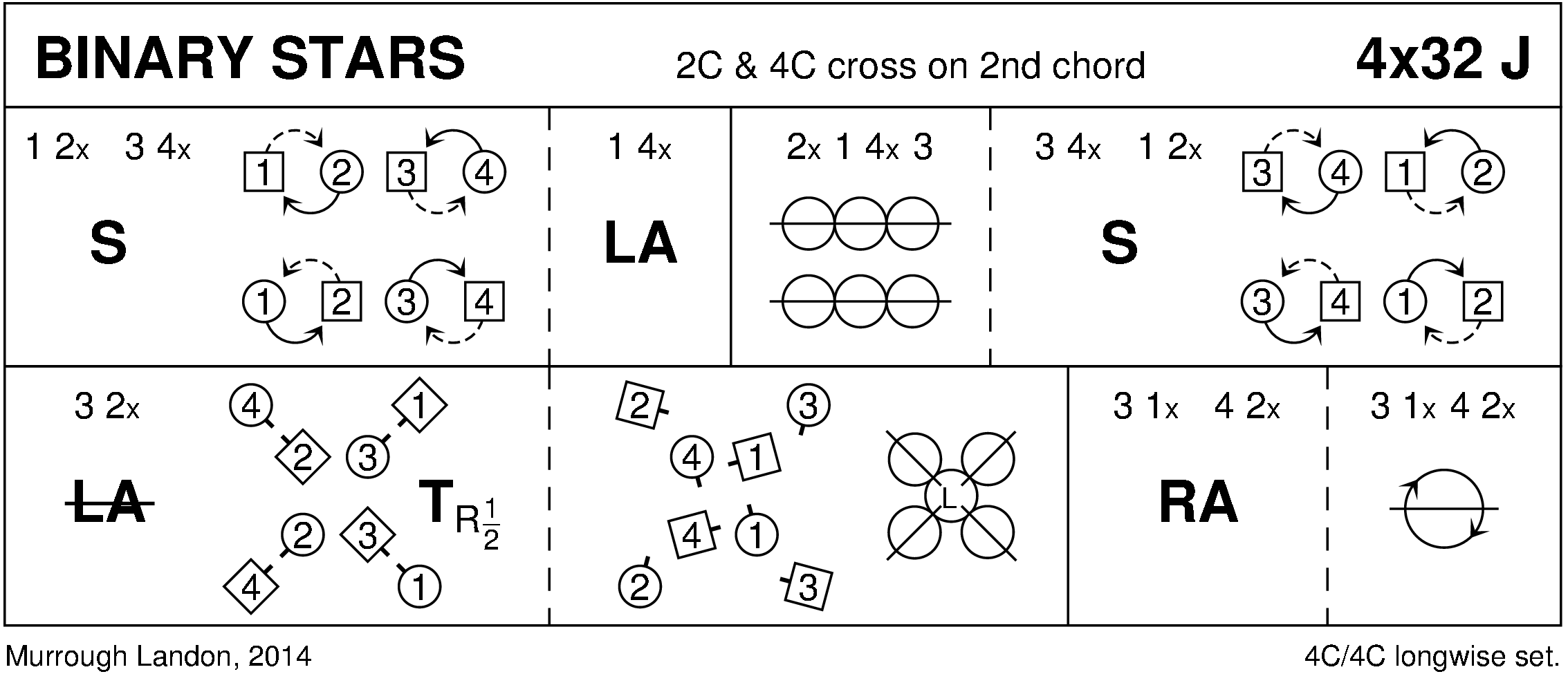
1- 4 1st with 2nd couples, and 3rd with 4th couples, each dance mirror set and link for two couples. The inner couples (2nd and 3rd) dance up or down through the centre to the ends, curving into place, as the outer couples (1st and 4th) cast inwards.
The order is now 2,1,4,3 with 2nd and 4th couples still on the opposite sides.
5- 8 1st and 4th couples dance a complete left hands across and face the end couples.
9-12 All dance half a right shoulder reel of four on the sides.
13-16 All repeat the mirror set and link figure of bars 1-4 from their new places to end in the order 4,3,2,1 with 4th and 2nd couples on the opposite sides.
17-18 3rd and 2nd couples dance half left hands across and face the corners on the diagonals.
19-20 3rd and 2nd couples turn the opposite corners (1st and 4th couples respectively) almost once round by the right hand and face in. 4th and 1st couples end in the corners facing clockwise.
21-24 All dance 4 bars of intersecting diagonal reels of four. 3rd and 2nd couples start dancing in for half left hands across in the centre on bars 21-22 then dance out to the opposite corner and curve to their right. 1st and 4th couple, curving their right, dance in passing 2nd and 3rd couples right shoulder, then dance half left hands across on bars 23-34.
25-28 3rd and 1st couples, also 4th and 2nd couples, each dance a complete right hands across and all face clockwise.
29-32 All flow into a chase half way round clockwise. The final order is 2,4,1,3 with 4th and 3rd couples on the opposite side.
(Dance crib compiled by the deviser, Murrough Landon, CC BY-SA September 2014 (revised 2024-5))
Keith Rose's Crib Diagram
Dance Instruction Videos
Binary Stars - Scottish Country Dancing Instruction VideoDance Information
Recommended music: Suggested tune: Margaret Manson (Ian Burns).Suitable recording: A Shetland Welcome (Glencraig Scottish Dance Band: Scottish Country Dances Ah'm Askin').
(Dance information by the deviser, Murrough Landon, CC BY-SA September 2014 (revised 2024-5))
Binary stars are systems in which two stars are bound together by gravity and orbit a common centre of mass.
They are common throughout the Milky Way and other galaxies, and many stars are thought to exist in binary or multiple-star systems rather than alone.
The two stars in a binary system may differ greatly in mass, size and temperature. Their orbital periods can range from a few hours to many thousands of years, depending on the distance between them. Some binaries can be seen directly through telescopes, while others are identified by changes in brightness or by shifts in their spectra caused by their orbital motion.
Eclipsing binary stars are systems in which one star passes in front of the other as seen from Earth, causing regular variations in brightness. These changes allow astronomers to measure important properties such as the stars' sizes and orbital periods. Spectroscopic binaries are detected through periodic changes in the wavelengths of their light, produced by the Doppler effect as the stars move towards and away from Earth.
Binary stars are of great importance in astronomy because they provide one of the most reliable methods of determining stellar masses. By studying the motion of the two stars, astronomers can apply the laws of gravity to calculate their masses with high accuracy. These measurements have played a major role in understanding how stars form, evolve and eventually end their lives.
Some binary systems contain compact objects such as white dwarfs, neutron stars or black holes. In certain cases, material can flow from one star to the other, producing powerful X-rays or explosive events such as novae. Binary systems are also the source of many of the gravitational waves detected by modern observatories when pairs of neutron stars or black holes spiral together and merge.
Alpha Centauri is the nearest known stellar system to Earth, located about 4.37 light-years away. Its two brightest stars, Alpha Centauri A and Alpha Centauri B, form a binary pair, orbiting a common centre of mass.

Binary Stars, Alpha Centauri A And B
Published in Binary Stars, reproduced here with the kind permission of the deviser, Murrough Landon. Licensed under CC BY-SA.
This page uses content under the Creative Commons Attribution-ShareAlike 4.0 International License, along with original copyrighted content and excerpts from Wikipedia and other sources.
Text from this original Binary Star article on Wikipedia.
Image copyright ESA/Hubble, CC BY 4.0, via Wikimedia Commons.

Back to the top of this Scottish Country Dancing Instructions 'Binary Stars' page