The Celtic Anniversary Reel
Scottish Country Dance Instruction
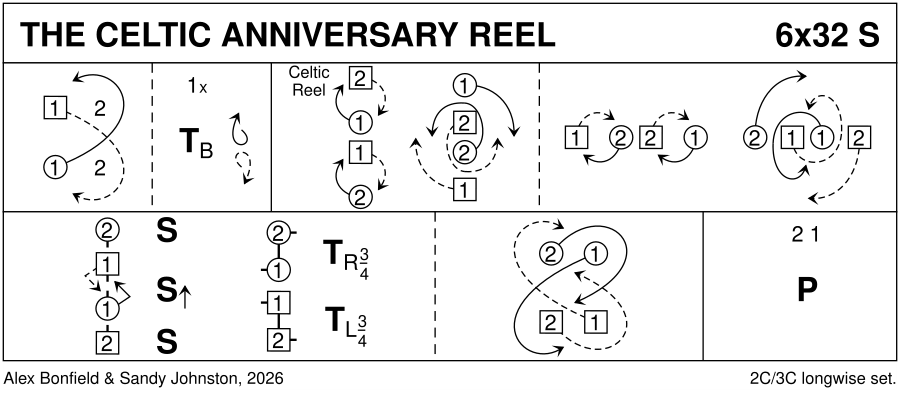
THE CELTIC ANNIVERSARY REEL (S6x32) 2C (3C set) Alex Bonfield and Sandy Johnston, 20261- 8 1s dance ½ Fig of 8 round 2s; 1s turn 2H, pull back RSh to face opposite side (2s step up 7-8)
9-16 1s+2s dance ½ Celtic Reel:
9-10 1s+2s pass partner RSh
11-12 1M+2L dance clockwise ¼ round, while 1L+2M dance ¾ round each other LSh to face partners in a line across
13-14 1s+2s pass partner RSh
15-16 1L+2M dance clockwise ¼ round, while 1M+2L dance ¾ round each other LSh to face partners in a line across the set
17-20 2s set while 1s set advancing, pass LSh to face opposite sides. 2M+1M turn ¾ RH while 2L+1L turn ¾ LH. (1)(2)
21-24 1s+2s dance ½ Double Fig of 8 (1s cross up to start)
25-32 2s+1s dance Poussette. End 2 1
(MINICRIB. Dance crib compiled by Charles Upton, Deeside Caledonian Society, and his successors)
Keith Rose's Crib Diagram
Dance Instruction Videos
The Celtic Anniversary Reel - Scottish Country Dancing Instruction VideoDance Information
This dance was devised in 2026 by Celtic dance teachers Alex Bonfield and Sandy Johnston to celebrate the society's 230th Anniversary.The Celtic Society at the University of St Andrews is one of the oldest student organisations associated with a university in Scotland. It was founded in 1796 by students with an interest in Scottish Gaelic language and culture.
Societies of this type were created during a wider revival of interest in Gaelic literature, language, and Highland traditions which developed in the late eighteenth and early nineteenth centuries. Their purpose was to encourage the study and practical use of Gaelic and to promote aspects of Scottish cultural heritage among university students.
From its beginning the society functioned as a student-run organisation within the university community. Historical records show that its meetings and written minutes were conducted in the Gaelic language for many years, demonstrating the importance placed on maintaining Gaelic as a living language within the society. Surviving archival material includes minute books and other documents dating from the nineteenth century onward, which record the activities and membership of the organisation.
During the nineteenth century similar Gaelic or Highland societies were established at several of the ancient Scottish universities. These organisations encouraged academic interest in Gaelic studies and contributed to campaigns for the creation of university teaching in the subject. As Gaelic began to be offered formally as an academic discipline at other institutions, students particularly interested in Gaelic scholarship increasingly chose to study at those universities.
As a result, the role of the St Andrews society gradually changed. Instead of concentrating mainly on academic Gaelic study, it developed a stronger emphasis on social and cultural activities connected with Scottish traditions. In modern times the society promotes Scottish culture through organised events such as Scottish country dancing and Gaelic language classes, activities that are open to members of the university community. Its country dancing activities are linked with the Royal Scottish Country Dance Society.
The society has operated continuously since its foundation in the eighteenth century and remains recognised as the oldest student society at the University of St Andrews. Through its events and classes it continues to encourage interest in Scottish traditions among students and the wider local community.
This page uses content under the Creative Commons Attribution-ShareAlike 4.0 International License, along with original copyrighted content and excerpts from Wikipedia and other sources.
Text from this original Celtic Society article on Wikipedia.
Back to the top of this Scottish Country Dancing Instructions 'The Celtic Anniversary Reel' page