The Champagne Reel
Scottish Country Dance Instruction
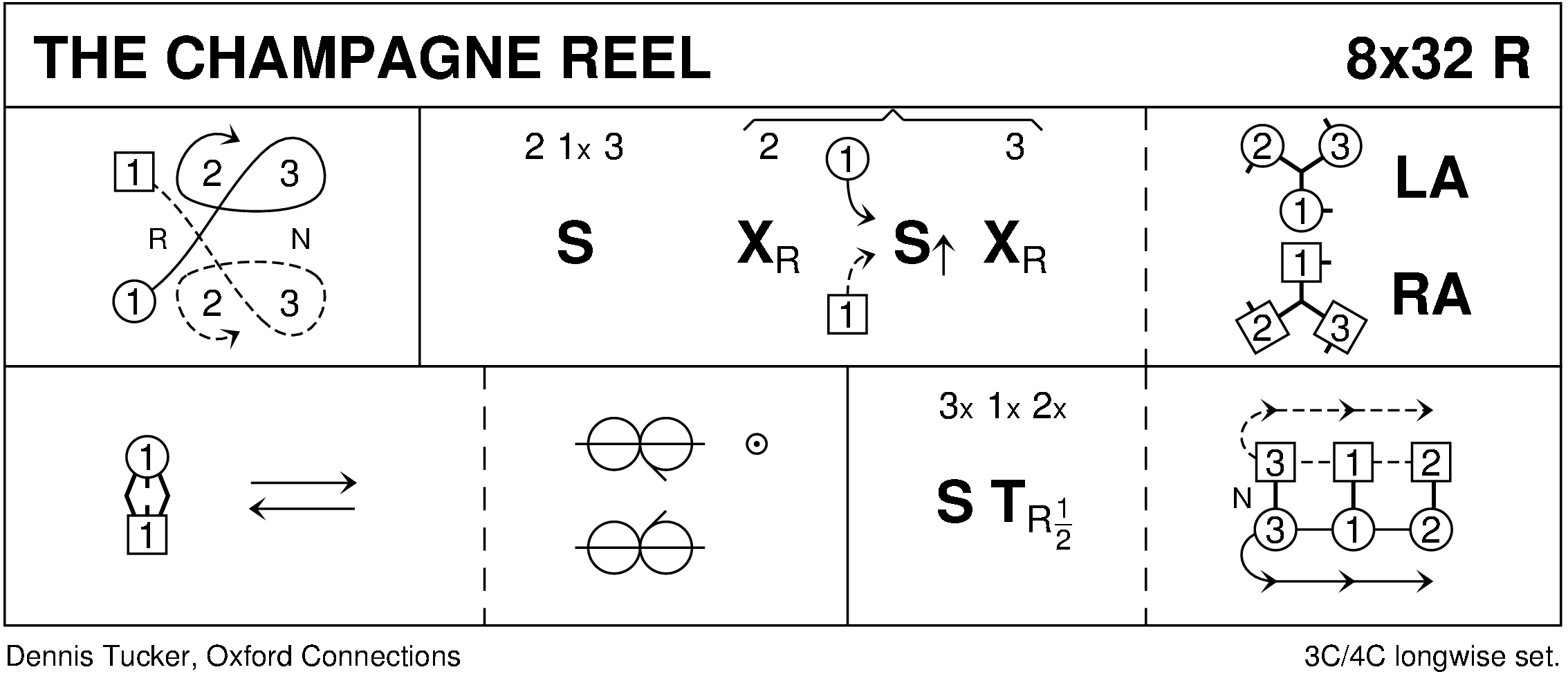
CHAMPAGNE REEL (R8x32) 3C (4C set) Dennis Tucker Oxford Silver Jubilee1- 8 1s cross down and cast behind 3s, 1s dance up middle and cast to 2nd places opposite sides (2s step up 7-8)
9-12 All set. 1s set advancing to face down side by side (1M pulls back LSh, 1L RSh) while 2s and 3s cross RH
13-16 1L dances RH across with 2L+3L (Men's side) as 1M dances LH across with 2M+3M. 1s end in centre
17-24 1s slip step down for 4 steps and up to 2nd place opposite sides facing out; ½ reflection reels of 3 on sides, 1s out/up, 2s in/down, 3s in/up. (3)(1)(2)
25-32 All set and ½ turn RH to face up, all dance up and cast into places. 213
At end of 2nd turn (bars 29-32):
3s cast to bottom and dance up to 2nd place
1s dance up to top and cast to bottom
2s dance up to top and cast into 1st place
(MINICRIB. Dance crib compiled by Charles Upton, Deeside Caledonian Society, and his successors)
Keith Rose's Crib Diagram
Dance Instruction Videos
The Champagne Reel - Scottish Country Dancing Instruction VideoDance Information
The Champagne Reel was devised by Dennis Tucker in 1993 as a celebratory dance, particularly suited to anniversaries, birthdays and other occasions calling for a glass of champagne.Champagne takes its name from the Champagne region of northeastern France, where wine has been produced since Roman times. The region was originally better known for still wines, with sparkling Champagne developing during the seventeenth century as winemakers learned to understand and control the secondary fermentation which produces its bubbles.
The Benedictine monk Dom Pérignon (1638–1715), cellar master at the Abbey of Hautvillers, is closely associated with the history of Champagne. Although the familiar story that he invented sparkling Champagne is not true, he did much to improve the making and blending of wines in the region.
During the eighteenth century, Champagne houses were established and the sparkling wine became fashionable among royalty and the wealthy. Stronger bottles, better corks and improved methods of controlling fermentation made production more reliable, while nineteenth-century developments in removing the yeast sediment gave Champagne the clear appearance we know today.
Over time, Champagne became the drink traditionally brought out for a celebration. Bottles are opened for weddings, anniversaries, birthdays, victories and other special events, usually accompanied by a toast. It is this familiar use of Champagne for marking a happy occasion that gives The Champagne Reel its name.

Champagne Celebration
"Hip, Hip, Hurrah!" Peder Severin Krøyer (1851-1909), Oil On Canvas, c. 1888
This page uses content under the Creative Commons Attribution-ShareAlike 4.0 International License, along with original copyrighted content and excerpts from Wikipedia and other sources. See our Copyright and Reuse Policy for details.
Text from this original Champagne article on Wikipedia.
Image from Peder Severin Krøyer, public domain, via Wikimedia Commons.

Back to the top of this Scottish Country Dancing Instructions 'The Champagne Reel' page