Christmas Candy
Scottish Country Dance Instruction
Christmas Candy 8x32 Strathspey for 3C by Sue McKinnell1- 8 1C set, dance down the set to below 3C and cast up behind 3C to 2nd place on own sides. 2C step up on bars 3-4.
9-12 1C dance a half diagonal reel of 4 with 1st corners while 2nd corners chase CW halfway to diagonally opposite positions. 1C end passing RS to face 2nd corner positions.
13-16 1C dance a half diagonal reel of 4 with 2nd corners while 1st corners chase CW halfway to original positions. 1C end passing RS to end in the center, 1W facing down and 1M facing up.
17-24 1C dance figures of 8, 1W down around 3C and 1M up around 2C. 1C dance out the ends and turn left to begin then end where they started the figures of 8.
25-32 1W and 3C, 1M and 2C circle once round to the left. 1C end pulling RS back to face partner. 1C set then dance a petronella turn to 2nd place on own sides.
Repeat.
(Dance crib compiled by the deviser Sue McKinnell, 2019)
Keith Rose's Crib Diagram

Dance Instruction Videos
Christmas Candy - Scottish Country Dancing Instruction VideoDance Information
This is a dance I wrote for the upcoming Christmas season.Suggested music: Mr Robert H Mackay from Cairngorms.
(Dance information by the deviser, Sue McKinnell)
Christmas candy is a central part of festive celebrations, with traditions stretching back centuries and evolving into the familiar sweets enjoyed today.
The association between sweet foods and Christmas can be traced to medieval Europe, when sugar was a rare and costly commodity reserved for the wealthy and for special occasions. Honey was more widely available and often used to sweeten festive dishes. As sugar became more accessible in later centuries, it was increasingly incorporated into seasonal treats, laying the foundation for the wide variety of Christmas sweets now recognised.
One of the most iconic examples is the candy cane, which originated in Germany in the seventeenth century. A choirmaster is said to have shaped simple sugar sticks into the form of a shepherd's crook to keep children quiet during church services, linking the sweet to the nativity story. Over time, the candy cane gained its distinctive red and white stripes and peppermint flavour, becoming a symbol of Christmas across Europe and North America.
Victorian Britain played a significant role in shaping modern Christmas traditions, including the popularity of sweets. Queen Victoria herself recorded enjoying figurines filled with bonbons and paper tubes containing confectionery, precursors to the crackers still used today. Chocolates in decorated boxes also became fashionable during the nineteenth century, and the practice of giving sweets as gifts was firmly established.
By the twentieth century, Christmas candy had become commercialised, with advent calendars filled with chocolate, selection boxes, and mass-produced treats appearing on shop shelves. These items were designed not only for indulgence but also as part of family rituals, such as placing chocolates in stockings or using candy to decorate Christmas trees. Gingerbread houses, biscuits, and other confections also became widespread, blending older European traditions with modern festive customs.
Today, Christmas candy encompasses a wide range of products, from traditional peppermint sticks and marzipan fruits to modern chocolate assortments and novelty sweets. It is used for decoration, gift-giving, and celebration, and remains a key feature of seasonal gatherings. The popularity of these confections reflects both their historical roots and their role in contemporary culture, where sweets continue to symbolise generosity, festivity, and shared enjoyment during the holiday season.
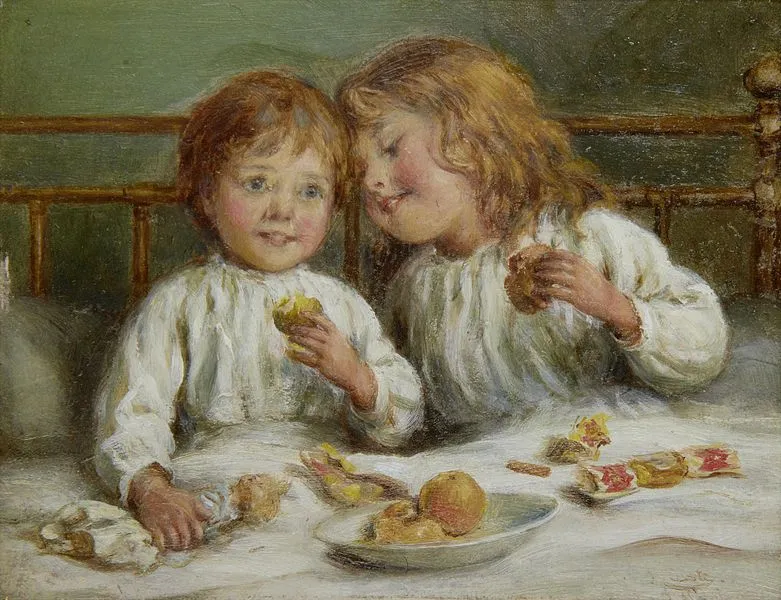
"Christmas Morning" Joseph Clarke (1834-1926), Oil On Board, c. 1926
Image from Joseph Clark, public domain, via Wikimedia Commons.

Back to the top of this Scottish Country Dancing Instructions 'Christmas Candy' page