City Of Glasgow Strathspey
Scottish Country Dance Instruction
CITY OF GLASGOW STRATHSPEY (S4x40) Sq.Set Anne Thorn Magic Of Music 21- 8 All Ladies dance RH across for 4 steps and dance out to 1 place anticlockwise (2L+1M, 3L+2M, 4L+3M, 1L+4M). All set to new partner and turn RH
9-16 All Men dance LH across for 4 steps and dance out to 1 place clockwise (3L+1M, 4L+2M, 1L+3M, 2L+4M). All set to new partner and turn LH to finish opposite original partner (Men with new partner on left)
17-20 1s+3s set (2nd and 4th positions), 1s+3s advance into centre with Ladies finishing RSh to RSh facing clockwise while their original partner dances towards them, pulling back LSh to finish in promenade hold
21-24 1s+3s promenade clockwise round the middle of the set to finish 1s in 4th place and 3s in 2nd place
25-32 2s+4s (1st and 3rd positions), repeat bars 17-24 to finish 2s in 1st place and 4s in 3rd place. 2341
33-40 All dance 8H round and back
(MINICRIB. Dance crib compiled by Charles Upton, Deeside Caledonian Society, and his successors)
Dance Information
Glasgow is the largest city in Scotland and is situated on the River Clyde in the west-central part of the country. The city forms one of Scotland's 32 council areas and had an estimated population of about 650,000 in 2024. More than one million people live within the wider Greater Glasgow urban area.The city developed from a religious settlement centred on a church established by Saint Mungo during the 6th century. Glasgow became a burgh in the medieval period and the foundation of the University of Glasgow in 1451 made it one of Scotland's principal centres of learning. The city expanded during the 17th and 18th centuries through trade with North America and the Caribbean.
During the Industrial Revolution, Glasgow became one of the leading manufacturing and shipbuilding centres in Britain. Shipyards along the River Clyde produced merchant vessels, naval ships and passenger liners. Engineering, locomotive construction, chemicals and heavy industry employed large numbers of workers during the 19th and early 20th centuries. The city's population exceeded one million during the first half of the 20th century.
Large-scale housing redevelopment took place after the Second World War. Many residents moved to new towns including East Kilbride, Cumbernauld and Livingston, and to housing estates on the outskirts of the city. Changes to local government boundaries and population movement reduced the city's population during the second half of the 20th century.
Glasgow contains a number of nationally significant institutions, including the University of Glasgow, the University of Strathclyde, and the Glasgow Caledonian University. The city is also home to major museums and galleries, including the Kelvingrove Art Gallery and Museum and the Riverside Museum.
Road, rail and air transport links connect Glasgow with the rest of Scotland and the United Kingdom. The city is served by the Glasgow Subway, which opened in 1896 and is the third-oldest underground railway system in the world.
Several major sporting venues are located in Glasgow, including Hampden Park, Scotland's national football stadium. The city hosted the 2014 Commonwealth Games and was one of the host cities for the UEFA European Championship in 2020.
Glasgow remains (2026) Scotland's most populous city and the largest urban centre in the country.
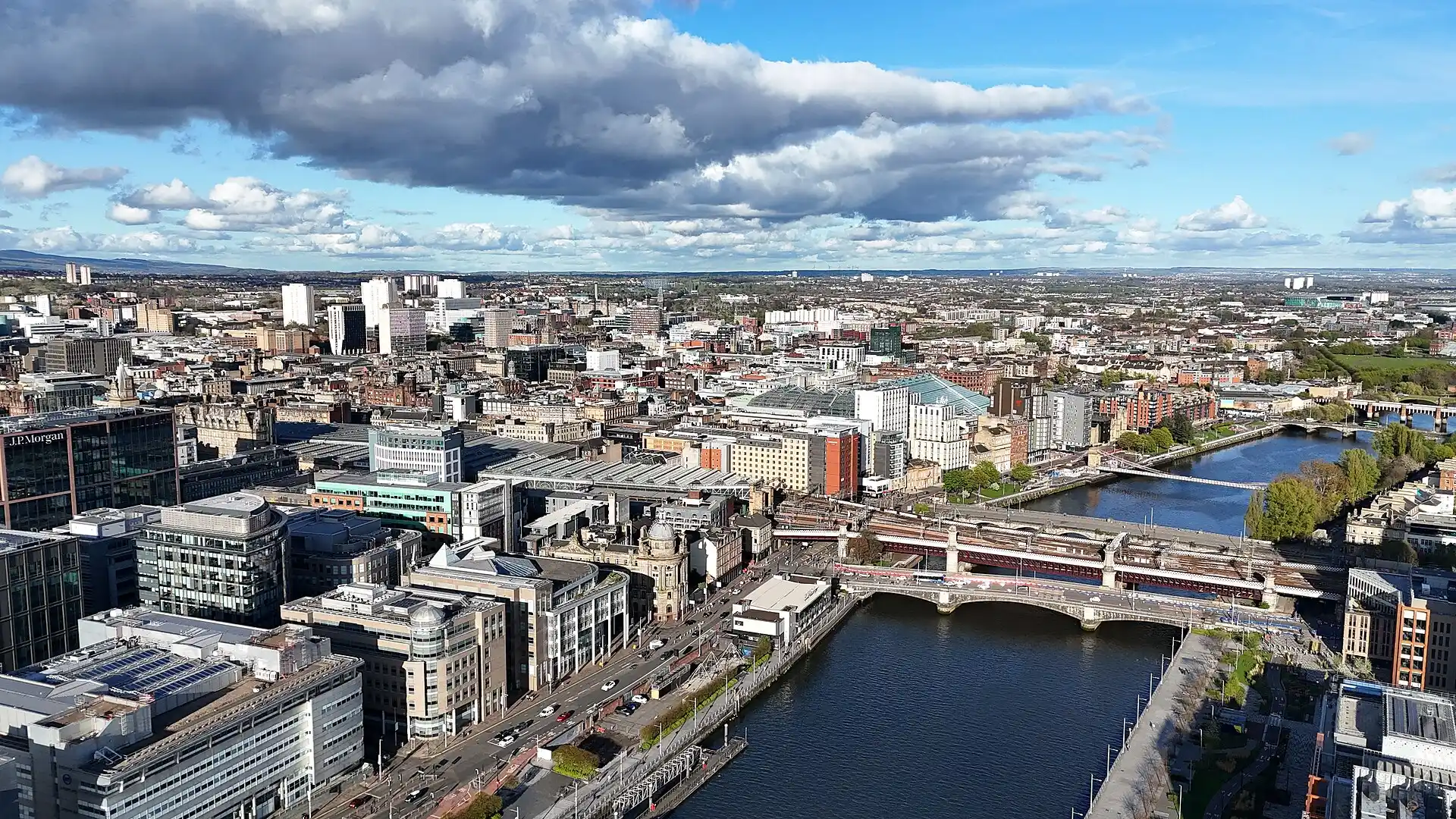
Glasgow City Centre, Scotland
This page uses content under the Creative Commons Attribution-ShareAlike 4.0 International License, along with original copyrighted content and excerpts from Wikipedia and other sources. See our Copyright and Reuse Policy for details.
Text from this original Glasgow article on Wikipedia.
Image copyright 瑞丽江的河水, CC BY-SA 4.0, via Wikimedia Commons.

Back to the top of this Scottish Country Dancing Instructions 'City Of Glasgow Strathspey' page