The Darvel Weaver
Scottish Country Dance Instruction
THE DARVEL WEAVER (R8x32) 3C (4C set) Jeremy Marshall Ox2K1- 8 1s turn RH, cast (2s step up); 1s cross RH and cast to right (1M down, 1L up) to end 1L between 2s facing down, 1M between 3s facing up
9-16 All set in lines of 3 across and change places RH up/down with person opposite; 1s cast to right (1M down, 1L up) to 2nd place opposite sides while 2s+3s set to partners and change places LH. (2)(1)(3)
17-24 All set on sides and cross RH with partner; 1s cast to right (1M up, 1L down) to end 1M between 2s facing down, 1L between 3s facing up while 2s+3s set and change places LH up/down with person opposite
25-32 Reels of 3 on sides (1s RSh to 1st corner to start), Bars 30-32 1s dance across to 2nd place own side while 2s+3s finish reel. 213
(MINICRIB. Dance crib compiled by Charles Upton, Deeside Caledonian Society, and his successors)
Keith Rose's Crib Diagram

Dance Instruction Videos
The Darvel Weaver - Scottish Country Dancing Instruction VideoDance Information
The Darvel Weaver is a reference to Darvel, a town in the Irvine Valley in East Ayrshire, Scotland, where weaving was a principal occupation during the eighteenth and nineteenth centuries.Local weavers worked on handlooms, often housed in workshops forming part of their cottages, producing cotton fabrics for merchants in Glasgow and other markets. In 1865, Darvel had 259 weavers operating 453 handlooms.
One of Darvel's weavers was Alexander Morton (1844–1923), who began learning the trade at twelve and purchased his own loom at fifteen. He subsequently became a textile merchant and manufacturer, establishing Alexander Morton and Company in 1875. He introduced mechanical lace-making machinery to Darvel, with the first machine-made cloth produced in February 1876. His business expanded into lace curtains, muslin and other furnishings, employing around 600 people by the 1890s.
The introduction of powered machinery led to the construction of textile factories in Darvel and neighbouring Newmilns. Handloom weaving gradually declined, although some specialised fabrics continued to be woven by hand into the early twentieth century. Darvel and Newmilns continued manufacturing lace using mechanical looms, with some Victorian machinery remaining in use into the twenty-first century.
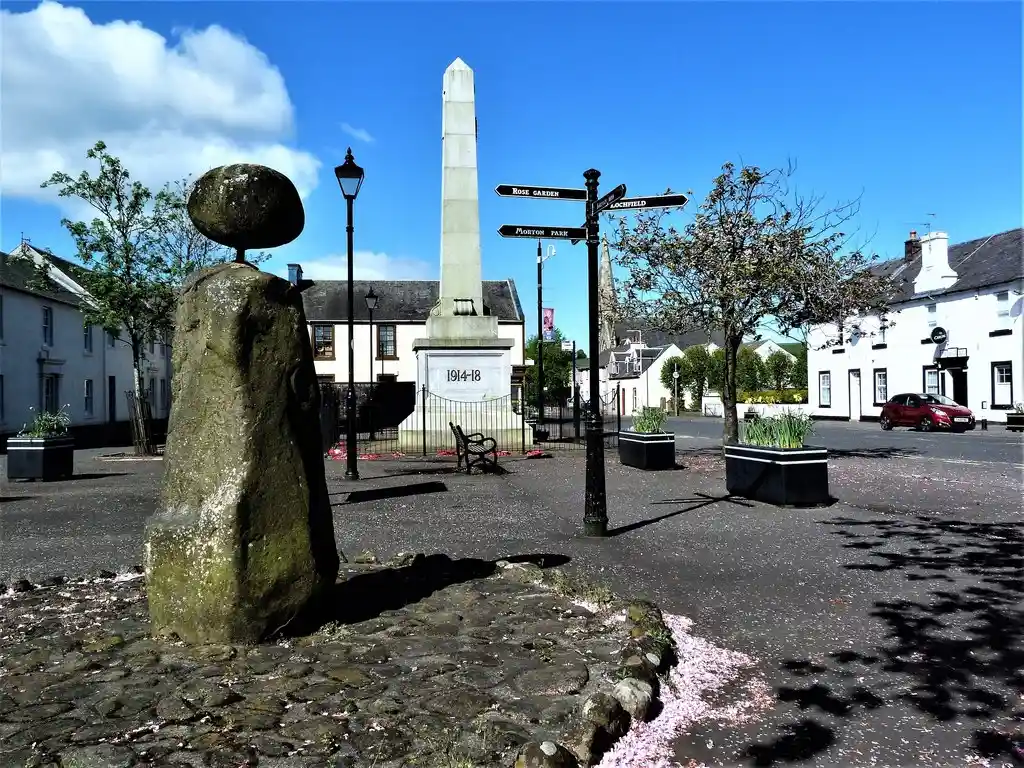
Hastings Square, Darvel, East Ayrshire, Scotland
This page uses content under the Creative Commons Attribution-ShareAlike 4.0 International License, along with original copyrighted content and excerpts from Wikipedia and other sources. See our Copyright and Reuse Policy for details.
Text from this original Darvel article on Wikipedia.
Text from this original Alexander Morton Manufacturer article on Wikipedia.
Image copyright Raibeart MacAoidh under this Creative Commons Licence 2.0.
Back to the top of this Scottish Country Dancing Instructions 'The Darvel Weaver' page