Deb's Christmas Cracker
Scottish Country Dance Instruction
DEB'S CHRISTMAS CRACKER (J4x32) 4C set Kevin Lees Dunedin Dances Book 61- 4 1s and 4s set, cross down/up (no hands) to 2nd/3rd place and face out (2s and 3s step down/up bars 3-4)
5- 8 1s cast up and 4s cast down through ends, meet partner and dance towards centre nearer hands joined
9-12 1s+4s dance RH across to face corners while 2s+3s chase anticlockwise ½ round
13-16 1s and 4s turn corner LH, pass LSh to end BtoB in centre facing diagonal opposite corner
17-24 2s+3s dance diagonal reel of 4 (LH across in centre) while
1s+4s dance ½ diagonal reel round corner, pass LSh, dance RSh round next anticlockwise corner. End 4L between 3s at top, 1M between 2s at bottom, 1L and 4M on own side in middle
25-32 1s+4s set advancing and dance ½ RH across to opposite sides facing partner, (3)(1)(4)(2); All set and cross RH to own side. 3142
(MINICRIB. Dance crib compiled by Charles Upton, Deeside Caledonian Society, and his successors)
Keith Rose's Crib Diagram

Dance Instruction Videos
Deb's Christmas Cracker - Scottish Country Dancing Instruction VideoDance Information
The Christmas cracker is a festive item first created in the mid nineteenth century by London confectioner Tom Smith.Inspired by the French practice of wrapping sugared almonds in paper, Smith developed a novelty that would open with a small explosive sound when pulled apart. His early versions contained sweets and mottos, and by the 1860s the design had evolved into the recognisable cracker with a cardboard tube wrapped in decorative paper, a strip of chemically treated card to produce the snap, and small gifts inside.
By the late Victorian period, crackers had become a popular feature of Christmas celebrations in Britain, often including paper hats, toys, and jokes. The tradition spread to other countries, particularly those influenced by British customs, and remains a familiar part of seasonal dining.
Modern crackers continue to use the same basic mechanism, with contents ranging from novelty items to more elaborate gifts, while the paper crown and printed joke have become standard features.
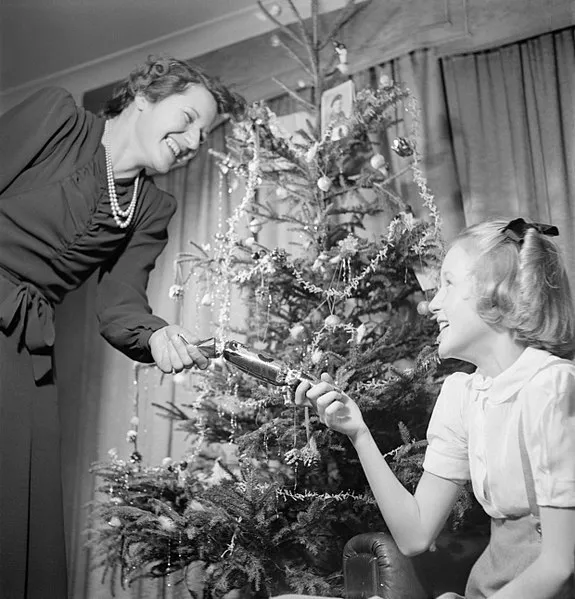
Christmas Cracker, c. 1944
Image from Ministry of Information Photo Division Photographer, public domain, via Wikimedia Commons.

Back to the top of this Scottish Country Dancing Instructions 'Deb's Christmas Cracker' page