Diagonal Symmetry
Scottish Country Dance Instruction
DIAGONAL SYMMETRY (J8x32) 3C (4C set) Douglas J Dean Rodney Rooms Book 21- 8 1s turn RH, cast 1 place and turn LH (4 bars) to face 1st corner
9-16 1M dances reel of 3 on opposite sides (LSh to 1st corner) while 1L dances Fig of 8 round 1st+2nd Corners, both end facing 1st corners
17-24 1L dances reel of 3 on opposite sides (LSh to 1st corner) while 1M dances Fig of 8 round 1st+2nd Corners, both end facing 1st corners
25-32 1s dance reels of 3 on opposite sides (LSh to 1st corner) and cross to 2nd places
(MINICRIB. Dance crib compiled by Charles Upton, Deeside Caledonian Society, and his successors)
Dance Information
Diagonal symmetry occurs when a figure can be divided into two matching halves by a line running diagonally across it.If the figure is reflected across that diagonal line, each point, line and angle coincides exactly with a corresponding feature on the opposite side. The diagonal line is known as a line of symmetry or axis of symmetry.
A square provides a common example of diagonal symmetry. Each of its two diagonals forms a line of symmetry, dividing the shape into two congruent right-angled triangles. Reflection in either diagonal leaves the square unchanged. In contrast, a rectangle that is not a square does not possess diagonal symmetry, although it does have horizontal and vertical lines of symmetry.
Diagonal symmetry is a type of reflection symmetry and can be found in many geometric figures, patterns and designs. It is used in mathematics to study shape properties and is often seen in art, architecture and decorative patterns where balanced arrangements are required. A shape may have one diagonal line of symmetry, two diagonal lines of symmetry, or none at all, depending on its geometry.
The presence of diagonal symmetry can help identify and classify shapes. In geometry, symmetry is an important concept because it reveals relationships between different parts of a figure and can simplify the analysis of its properties. Symmetrical shapes often have equal lengths, equal angles or other corresponding features that are preserved by reflection.
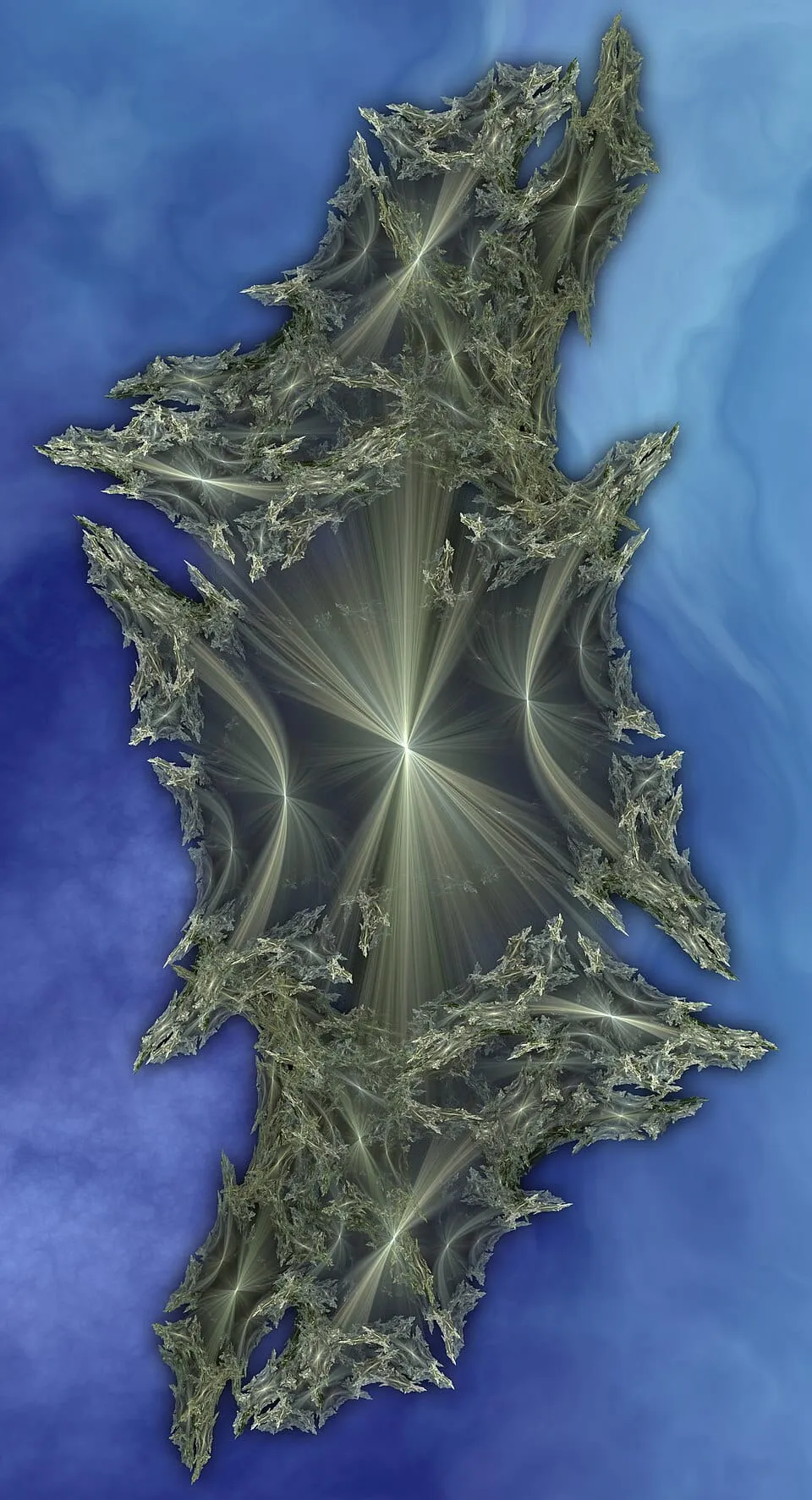
Fractal With Reverse Diagonal Symmetry
Image from Timeastor, Public domain, via Wikimedia Commons.

Back to the top of this Scottish Country Dancing Instructions 'Diagonal Symmetry' page