Dingwall 800
Scottish Country Dance Instruction
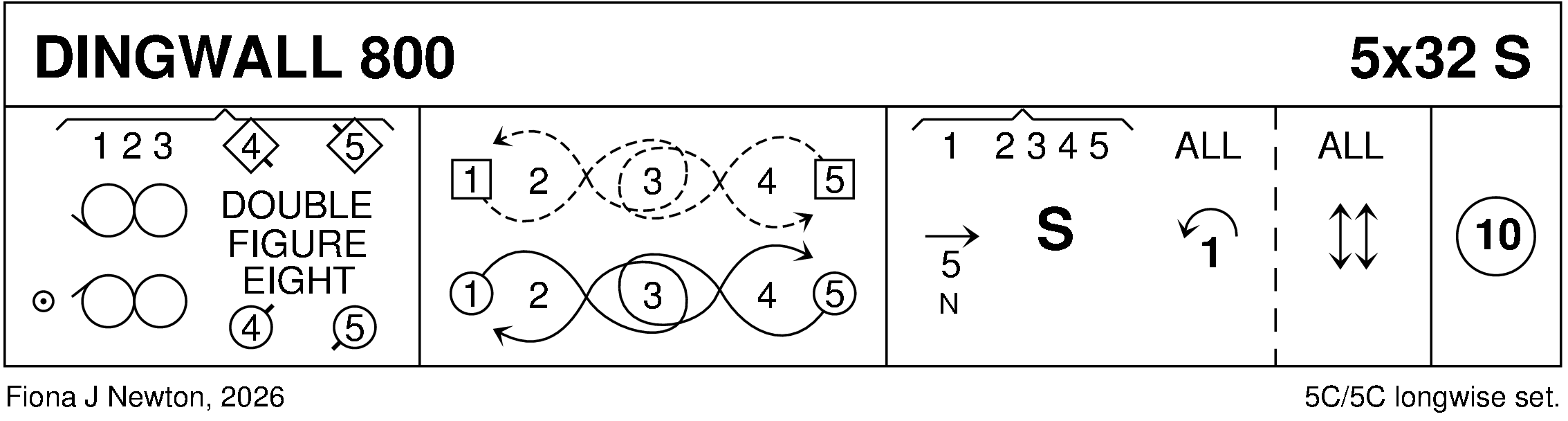
DINGWALL 800 (S5x32) 5C Set Fiona J Newton, 20261- 8 Mirror reels of 3 on sides (1s in/down, 2s out/up, 3s in/up) while 4s+5s dance Double Fig of 8 (4s cross down, 5s dance up sides)
9-16 1s and 5s dance Figs 8 on sides (1s in/down, 5s out/up to start)
17-20 1s dance down and cast into 5th place while 2s+3s+4s+5s set and cast up 1 place. 23451
21-24 All advance (1) + retire (1) twice
25-32 All circle 10H round and back. 23451
(MINICRIB. Dance crib compiled by Charles Upton, Deeside Caledonian Society, and his successors)
Dingwall 800 (S5x32) 32 bar Strathspey for 5 Couples in a 5 Couple Set, devised by Fiona J Newton.
1- 8 1s, 2s and 3s dance mirror reels of 3, 1s in and down, 2s out and up, 3s in and up WHILE 4s and 5s dance a double Fig of 8, 4s crossing down to begin and 5s dance up the sides to begin.
9-16 1s and 5s dance figures of 8 on sides, 1s in front of 2s to begin and 5s dance behind of the 4s to begin.
17-20 1s dance down the middle and cast into 5th place. WHILE 2345 set and cast up one place.
21-24 All advance for 1, retired for 1, twice.
25-32 All circle round and back.
(Dance crib compiled by the deviser, Fiona J Newton, 2026)
Keith Rose's Crib Diagram
Dance Instruction Videos
Dingwall 800 - Scottish Country Dancing Instruction VideoDance Information
This year (2026), Dingwall, in the county of Ross-shire, is celebrating the 800th anniversary of becoming a Royal Burgh.The Dingwall Scottish Country Dance Club will be holding a tea dance in September 2026 as part of the celebrations.
This dance, written by Fiona J Newton, a Dingwall SCD club member, will be included in the programme.
The Dingwall Scottish Country Dance Club was formally established in 1962 with support from the Inverness Branch of the Royal Scottish Country Dance Society, although Scottish country dancing had already become popular locally in the years following the Second World War. The arrival of large numbers of workers and engineers during the construction of the Conon Basin Hydroelectric Project from 1947 helped increase interest in social dancing throughout the area, and local dance clubs became important community meeting places.
During the 1950s classes in Dingwall were organised by the sisters Jessie and Nannie Reid, who taught both children and adults. In nearby Strathpeffer, dancing was taught by Meg Rose of Fodderty Primary School. Dance books once owned by Meg Rose were later passed through successive teachers and included the dance "The Misses Jessie and Nannie Reid of Dingwall", preserving part of the area's dancing history.
One of the club's later instructors was Group Captain Jim Bruce, who was commemorated in the dance "Captain Bruce's Jig". Following his sudden death, the club continued under the direction of Pearl Sinclair from 1973 onwards. Pearl Sinclair taught for twenty-two years and oversaw a period of strong membership and successful rallies. Visiting teachers from across Scotland regularly attended club events, while annual day schools also became an established part of the programme.
Janette Steele became the club teacher after Pearl Sinclair's retirement and continued in the role for the next decade. During this period Scottish country dancing experienced declining attendance in some areas, and the club's annual day school eventually ended as similar events became available elsewhere in the Highlands.
Since 2004 the club has been taught by Fiona Newton. During this time the weekly classes moved from Dingwall to Conon Bridge, while rallies transferred first to Strathpeffer and later to Culbokie. The club continues to hold regular dancing sessions between September and June, together with social events and rallies during the year. Modern sound equipment has replaced older recorded music systems, and profits from tea dances and fundraising activities have been used to support both local and national charities, including Children in Need, WaterAid and Highland community organisations.
Dingwall is a town in the Highland region of Scotland, situated near the head of the Cromarty Firth, approximately 14 miles (23 km) north-west of Inverness.
It is the historic county town of Ross-shire and has been a royal burgh since the 13th century. Over many centuries it developed as a centre of trade, transport and local administration for the surrounding area.
The town's name is derived from the Old Norse word "Þingvöllr", meaning an assembly field or meeting place, reflecting the influence of Viking settlement in the area. Its Gaelic name, Inbhir Pheofharain, refers to the mouth of the River Peffery. Although Dingwall now lies inland, it originally functioned as a coastal harbour and medieval port with access to overseas trade.
Dingwall Castle once stood near the centre of the town and was one of the largest castles in northern Scotland. The castle played a role during the Wars of Scottish Independence and was associated with the Earls of Ross. Tulloch Castle, situated on the edge of the town, contains parts believed to date from the 12th century.
The town is traditionally linked with the Battle of Dingwall in 1411, a conflict associated with Clan Mackay and Clan Donald during the period of the Highland clan wars. In later centuries Dingwall continued to grow as the administrative centre of Ross-shire and was represented in Parliament as part of a district of burghs until the early 20th century.
Modern Dingwall remains an important service and transport centre for surrounding Highland communities. The town lies on both the Far North railway line and the Kyle of Lochalsh route. Road connections link Dingwall with the west Highlands and the north of Scotland, while the opening of the Cromarty Bridge in 1979 reduced heavy through traffic in the town centre.
Ross County Football Club is based in Dingwall and plays its home matches at Victoria Park. The club won the Scottish League Cup in 2016 and attracts supporters from across the Highlands.
The town contains several educational and cultural organisations, including Dingwall Academy, one of the largest secondary schools in the Highlands, and Fèis Rois, which promotes Gaelic language, music and traditional culture. The Highland Theological College, part of the University of the Highlands and Islands, is also located in the town.
Here is a photo I took of the old town hall which houses the museum now, the tower used to be the jail.
My grandfather wrote that an Englishman fell into an underground still in the hills. The owner of the still was sent to the jail. The jailer let him out at night so he could run his other still provided he received some of the whisky!
(Dance information by the deviser, Fiona J Newton, 2026)

The Old Town Hall, Dingwall, 2026
This page uses content under the Creative Commons Attribution-ShareAlike 4.0 International License, along with original copyrighted content and excerpts from Wikipedia and other sources. See our Copyright and Reuse Policy for details.
Text from this original Dingwall article on Wikipedia.
Image copyright Fiona J Newton, all rights reserved, 2026.
Back to the top of this Scottish Country Dancing Instructions 'Dingwall 800' page