Double Trouble Triangles
Scottish Country Dance Instruction
DOUBLE TROUBLE TRIANGLES (R4x48) 4C set Judith Kowalczik RSCDS Book 501- 8 1M+4L set, advance and retire and set while 1L+4M stand (2 bars), set, advance (2 bars) and set. (Bar 5 both couples join RH with partner and retain hands)
9-12 1s+2M and 4s+3L dance RH across, ending 2M in 1st place, 3L in 4th place
13-16 1s+2L and 4s+3M dance LH across, ending 1M behind 1L (above 1st place facing Men's side) 4L behind 4M (below 4th place facing Ladies' side), 2L in 1st place, 3M in 4th place
17-20 1L followed by 1M casts 2 places while 4M followed by 4L casts up 2 places. Bar 20: 1s+4s in line up/down middle BtoB with partner, Men facing up, Ladies down
21-24 4M+2s and 1L+3s circle 3H round to left while 4L+1M ½ turn LH, clap, ½ turn RH. 4s and 1s finish BtoB with partners
25-26 4M+2s and 1L+3s join hands (as 'Crown Triangles') and set while 4L+1M turn 2H ½ way (pas-de-basque)
27-28 4s+1s dance to Right (pas-de-basque) round person behind to change places while 2s+3s set
29-30 1M+2s and 4L+3s set (as 'Crown Triangles') while 4M+1L turn 2H ½ way (pas-de-basque)
31-32 1s and 4s dance to Right (pas-de-basque) round partner to centre facing up (Lady on Man's Left) while 2s+3s set
33-36 1s+4s lead up to top, cast on opposite sides, 1s to 3rd place, 4s to 2nd place
37-40 ½ Figs 8, 4s round 2s and 1s round 3s. 2413
41-48 All ½ turn partner RH, retain hands and set, release hands and pass partners RSh dancing out to own sides, all set
(MINICRIB. Dance crib compiled by Charles Upton, Deeside Caledonian Society, and his successors)
Keith Rose's Crib Diagram

Dance Instruction Videos
Double Trouble Triangles - Scottish Country Dancing Instruction VideoDance Information
The phrase "double trouble" is an English idiom used to describe a situation involving two simultaneous difficulties, complications or sources of concern. The expression is formed from the words "double", meaning twofold, and "trouble", meaning difficulty or distress.One of the earliest recorded uses of the phrase appears in William Shakespeare's play Macbeth, in which the witches chant the line, "Double, double toil and trouble". The modern phrase "double trouble" subsequently entered general English usage as a concise expression for two related problems occurring together.
The term has also been applied to pairs of people, animals or objects whose combined actions create greater difficulty than either would create alone. In popular culture, the phrase has been used as the title of books, films, songs, television programmes and other works.
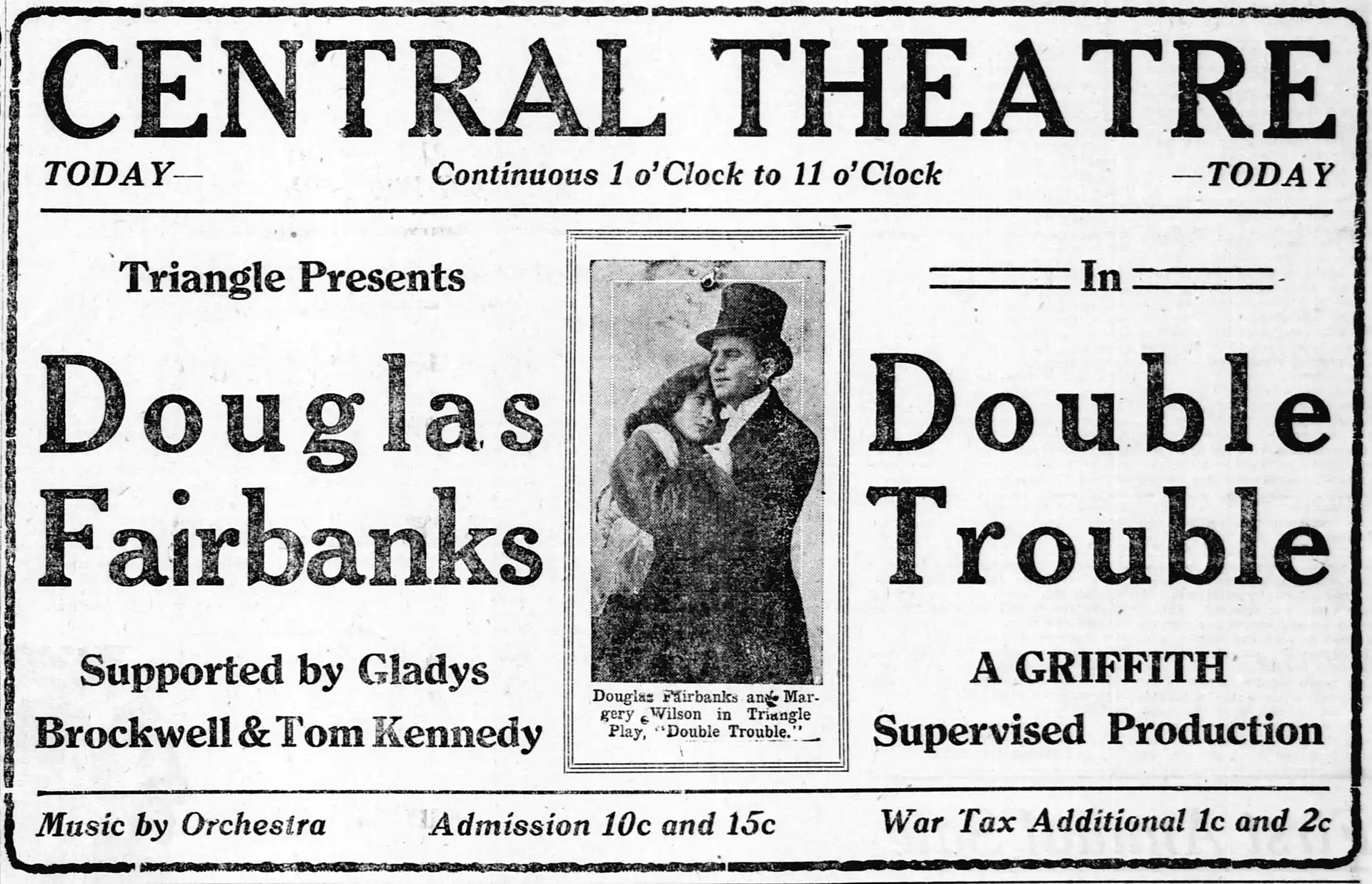
Newspaper Advertisement For "Double Trouble", A Silent Film Comedy, Distributed By Triangle Film Corporation, c. 1915
Image from Triangle Film Corporation, Public domain, via Wikimedia Commons.

Back to the top of this Scottish Country Dancing Instructions 'Double Trouble Triangles' page