Dunnideer Castle
Scottish Country Dance Instruction
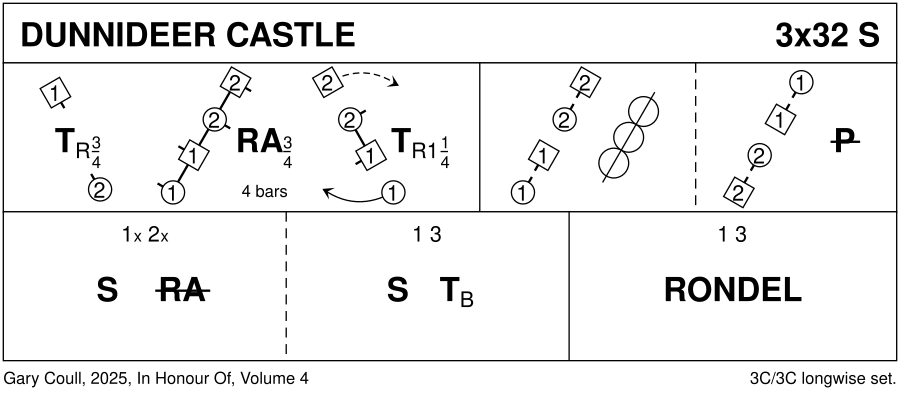
DUNNIDEER CASTLE (S3x32) 3C Set Gary Coull, 2025 In Honour Of Volume 41- 8 1L+2M turn ¾ RH, join NH with partner, all dance ¾ round in diagonal line (4 bars), 1M and 2L dance ½ clockwise to original places while 1L+2M turn RH to end BtoB facing partner on 1st corner diagonal
9-16 1s+2nd corners dance ½ diagonal reel of 4 ending joining 2H with partner (2M and 1L BtoB); 1s+2s dance ½ Poussette. (1)(2)(3)
17-24 1s+2s set, dance ½ RH across; 1s+3s set, turn partner 2H opening out to end 1s facing down, 3s facing up
25-32 1s+3s dance Rondel. 213
(MINICRIB. Dance crib compiled by Charles Upton, Deeside Caledonian Society, and his successors)
Keith Rose's Crib Diagram
Dance Instruction Videos
Dunnideer Castle - Scottish Country Dancing Instruction VideoDance Information
Dunnideer Castle is a ruined tower house situated near Insch in Aberdeenshire, Scotland, occupying the summit of a hill that had already been fortified in prehistoric times.The medieval structure, constructed around the mid-thirteenth century, was built using stone taken from an earlier vitrified hillfort dating to roughly 250 BC. This earlier fortification reflects long-term occupation of the site, with archaeological investigation identifying evidence of Iron Age settlement later adapted for medieval defensive use.
The surviving remains consist of a rectangular stone tower measuring approximately 15 by 12.5 metres, with walls about 1.9 metres thick. The layout suggests a typical tower house arrangement, including a principal hall on the first floor and additional storeys above, while the ground level was likely used for storage. The structure now stands as a roofless shell, but it represents one of the earliest known tower houses on mainland Scotland. The site is protected as a scheduled monument and is managed as part of Scotland's historic environment.
Archaeological work has demonstrated that the surrounding hillfort originally formed a substantial defensive complex, and its reuse in the medieval period illustrates continuity in the strategic importance of the location. In recent years, research and interpretation have been supported by a scale model reconstructing the building's possible appearance in the sixteenth century, based on historical and archaeological evidence. The hilltop position continues to provide extensive views across the surrounding landscape, and the remains are accessible to the public.

Dunnideer Castle Ruins, 2024
This page uses content under the Creative Commons Attribution-ShareAlike 4.0 International License, along with original copyrighted content and excerpts from Wikipedia and other sources. See our Copyright and Reuse Policy for details.
Text from this original Dunnideer Castle article on Wikipedia.
Image copyright JamesGray1811, CC BY 4.0, via Wikimedia Commons.

Back to the top of this Scottish Country Dancing Instructions 'Dunnideer Castle' page