Five Wee Superconductors
Scottish Country Dance Instruction
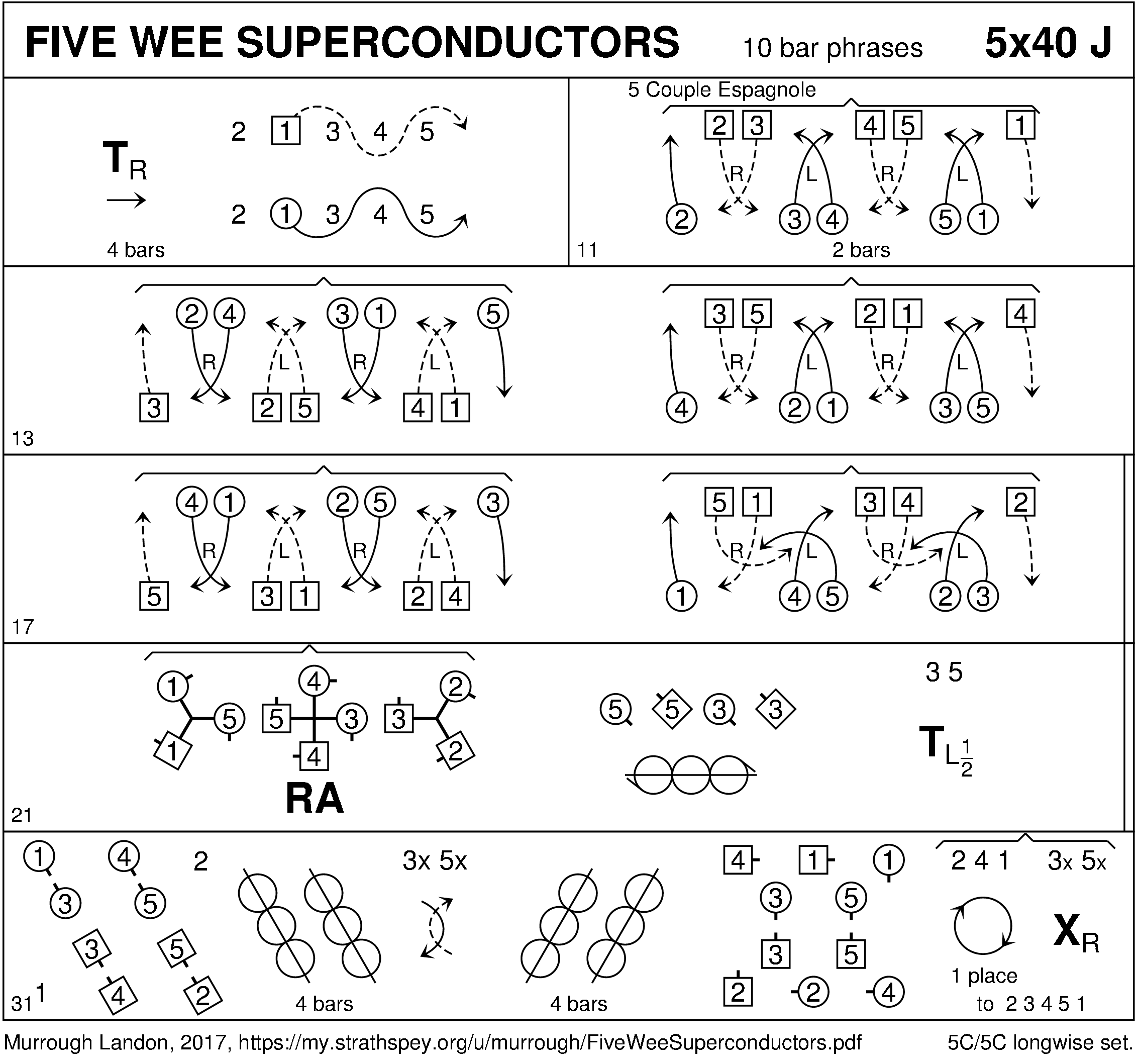
Five Wee Superconductors (J5x40) A challenging 40 bar jig (in four 10 bar phases) for five couples in a longwise set, Murrough Landon (2017).1- 10 1st couple, giving right hands, turn once round in 4 bars moving down to face out in 2nd place on their own sides as 2nd couple step up on bars 3-4; then cast off behind 3rd couple who step up on bars 5-6; dance down to face out in 4th place as 4th couple step up on bars 7-8; and finally cast off to 5th place as 5th couple step up. The order is now 2,3,4,5,1.
11-20 All dance an Extended Espagnole for five couples:
11-12: 2nd with 3rd women, also 4th with 5th women, in the top four places, each lead across and change places right hand as 1st woman, in 5th place, crosses solo.
Meanwhile 2nd man, in 1st place, crosses solo as 3rd with 4th men, also 5th with 1st men, in the bottom four places, each lead across and change places left hand. The order is now 3rd, 2nd, 5th, 4th and 1st women on the men's side and 2nd, 4th, 3rd, 1st and 5th men on the women's side.
13-20: Repeat the pattern of bars 11-12 four more times from new places. But on bars 19-20, 5th and 3rd couples (starting from 1st and 3rd places on women's side and 3rd and 5th places on the men's side) curve left on bar 20, passing their partner left shoulder, to end back to back on the centre line in 2nd and 4th places. 5th and 3rd men face up above their partners who face down. 1st, 4th and 2nd couples end in 1st, 3rd and 5th places on opposite sides.
In principle in each crossing the pairs should lead across side by side for one bar, then cross on the second bar, but this is hard to do well in jig time.
21-24 1st couple with 5th man, 5th woman with 4th couple and 3rd man, also 3rd woman with 2nd couple, each dance right hands across. 5th and 3rd couples end facing their partner on the centre line, men facing down, women facing up.
25-28 5th and 3rd couples dance half a left shoulder reel of four on the centre line.
29-30 3rd and 5th couples, giving left hands, turn their partner just under half way to face their 2nd corner positions on the diagonal.
31-34 3rd and 5th couples dance each half a right shoulder diagonal reel of four with their 2nd corners and pass right shoulder to face their 3rd corner positions.
35-38 3rd and 5th couples each dance half a right shoulder diagonal reel of four with their 3rd corners and pass right shoulder to end facing their partner just in from 2nd and 4th places on opposite sides. The corners face clockwise.
39-40 3rd and 5th couples, giving right hands, cross over to end on their own side. Meanwhile the corners chase one corner position clockwise. The final order is 2,3,4,5,1.
(Dance crib compiled by the deviser, Murrough Landon, CC BY-SA September 2017)
Keith Rose's Crib Diagram
Dance Instruction Videos
Five Wee Superconductors - Scottish Country Dancing Instruction VideoDance Information
A challenging 40 bar jig (in four 10 bar phases) for five couples in a longwise set.The low temperature phenomenon of superconductivity is a quantum effect due to electrons forming pairs to navigate the metal lattice without losing energy.
These "Cooper Pairs" were named after Leon Cooper who first proposed this explanation, together with John Bardeen and John Schrieffer, for which the three were awarded the 1972 Nobel Prize in Physics.
This dance, which is a member of the 10 bar phrase Cooper clan, has five such pairs (or couples) hence the title.
Recommended music: Suggested tune: The Wee Cooper o' Fife (Traditional).
8x40 recording: The Wee Cooper o' Fife (Iain Cathcart and his Band: Dances to Song Tunes).
Or another 10 bar phrase recording with a fairly slow pace.
(Dance information by the deviser, Murrough Landon, CC BY-SA September 2017)
Superconductors are materials that can conduct electricity without electrical resistance when cooled below a characteristic temperature known as the critical temperature.
In this superconducting state, electric current can flow without losing energy as heat, a property that distinguishes superconductors from ordinary conductors.
The phenomenon of superconductivity was discovered in 1911 by Dutch physicist Heike Kamerlingh Onnes while studying mercury at very low temperatures. Since then, many superconducting materials have been identified, including pure elements, alloys and ceramic compounds. Some superconductors operate only a few degrees above absolute zero, while others remain superconducting at significantly higher temperatures.
A second important property of superconductors is the Meissner effect, in which magnetic fields are expelled from the interior of the material as it becomes superconducting. This effect allows magnets to levitate above superconducting materials under suitable conditions and is one of the defining characteristics of superconductivity.
Superconductors are used in a variety of scientific and technological applications. They are essential components of powerful electromagnets used in MRI scanners, particle accelerators and magnetic confinement fusion experiments. Superconducting magnets can produce strong magnetic fields while consuming far less energy than conventional electromagnets.
Research continues into the development of materials that superconduct at higher temperatures. A superconductor that operates at ordinary room temperature and pressure would have significant technological implications, but no material has yet been demonstrated to possess these properties under normal everyday conditions.
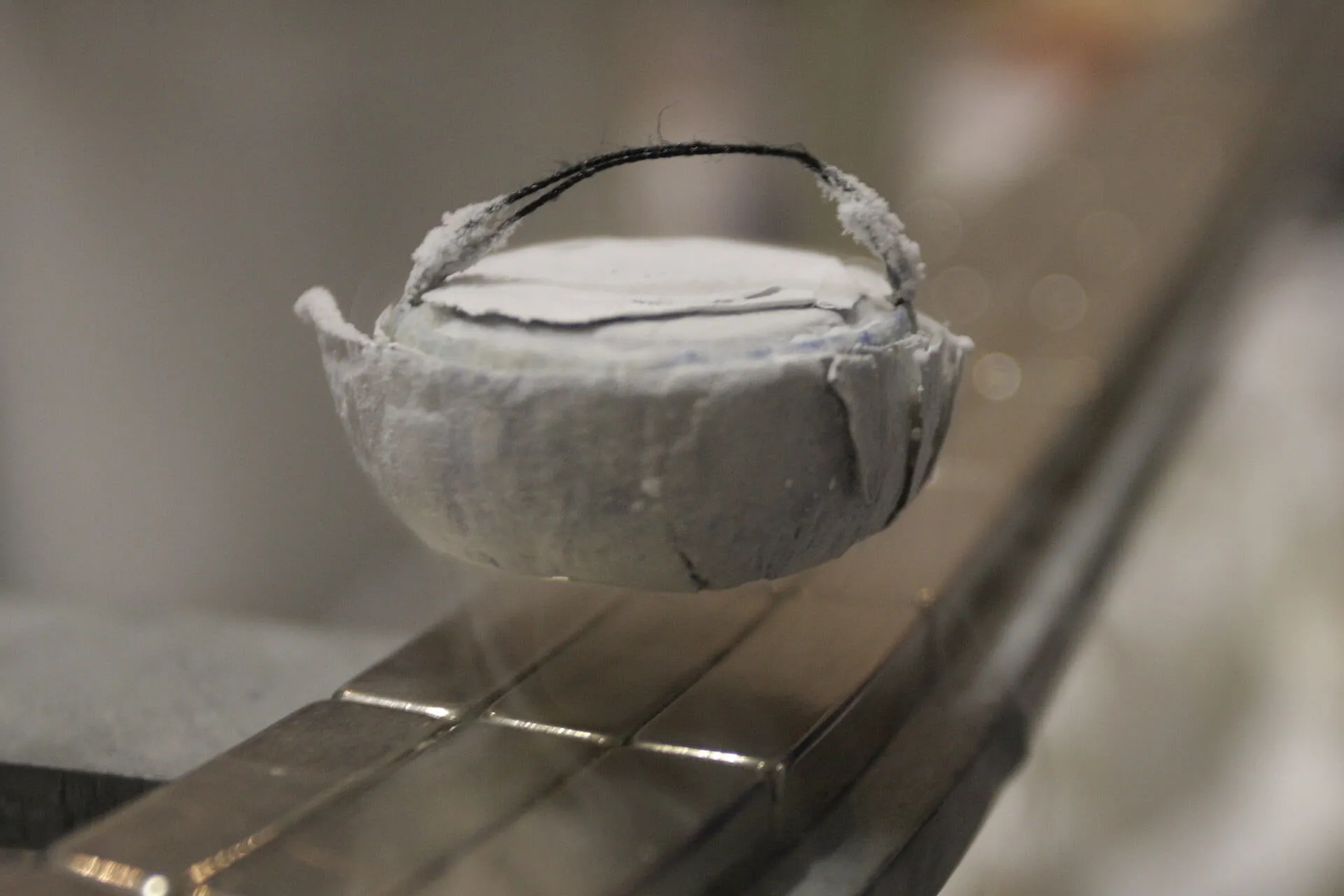
A High-Temperature Superconductor Levitating Above A Magnet.
Published in Five Wee Superconductors, reproduced here with the kind permission of the deviser, Murrough Landon. Licensed under CC BY-SA.
This page uses content under the Creative Commons Attribution-ShareAlike 4.0 International License, along with original copyrighted content and excerpts from Wikipedia and other sources.
Text from this original Superconductivity article on Wikipedia.
Image copyright Henry Mühlpfordt, CC BY-SA 3.0, via Wikimedia Commons.

Back to the top of this Scottish Country Dancing Instructions 'Five Wee Superconductors' page