Florida Street "Cambio Cambio"
Scottish Country Dance Instruction
FLORIDA STREET "CAMBIO CAMBIO" (S8x32) 3C (4C set) Jim Stott Argentine Collection 20201- 4 1L+2M dance towards each other (1 step), pull back RSh and cast while 1M and 2L dance towards each other (1 step), pass LSh and dance out to sides. 213
5- 8 2s+1s circle 4H round to left
9-16 2s+1s+3s ½ turn partner RH, pull back RSh and dance out to opposite sides; 2s+1s+3s circle ½ round to left. Finish 3s at top in centre nearer hands joined, 1s in 2nd place own side, 2s in centre at bottom nearer hands joined
17-24 2s+3s dance ½ R&L then set and link while 1s set, dance DoSiDo and set. 213
25-32 2s+1s+3s dance Grand Chain (2s cross, 1s+3s change places RH on sides to start)
(MINICRIB. Dance crib compiled by Charles Upton, Deeside Caledonian Society, and his successors)
Keith Rose's Crib Diagram

Dance Instruction Videos
Florida Street "Cambio Cambio" - Scottish Country Dancing Instruction VideoDance Information
Calle Florida, or Florida Street, is a pedestrianised commercial street in central Buenos Aires, Argentina.It runs north from Avenida Rivadavia towards Plaza General San Martín and contains shops, shopping arcades, cafés and other businesses. The street appears on a map dating from 1582 and was known as Calle San José during the eighteenth century. Sections were closed to traffic during daytime hours from 1913, and almost the entire street became pedestrianised in 1971.
Galerías Pacífico stands at the junction of Florida Street and Avenida Córdoba. The building was designed by Emilio Agrelo and Roland Le Vacher and opened in 1889 for the Argentine Bon Marché department store. Part of the building housed the Museo Nacional de Bellas Artes from 1896, and the Buenos Aires and Pacific Railway later used part of it as offices.
Florida Street also became a centre for unofficial currency trading. Street money changers, known in Argentina as "arbolitos", approached pedestrians by repeatedly calling "cambio, cambio", meaning "exchange, exchange". The traders directed customers to premises known as "cuevas", where pesos and foreign currency were exchanged outside the official banking system. Currency controls were substantially eased in Argentina in April 2025, reducing the number of street currency traders operating in central Buenos Aires.
Scottish country dance devisor Jim Stott heard the repeated call of "cambio, cambio" while exploring Florida Street.
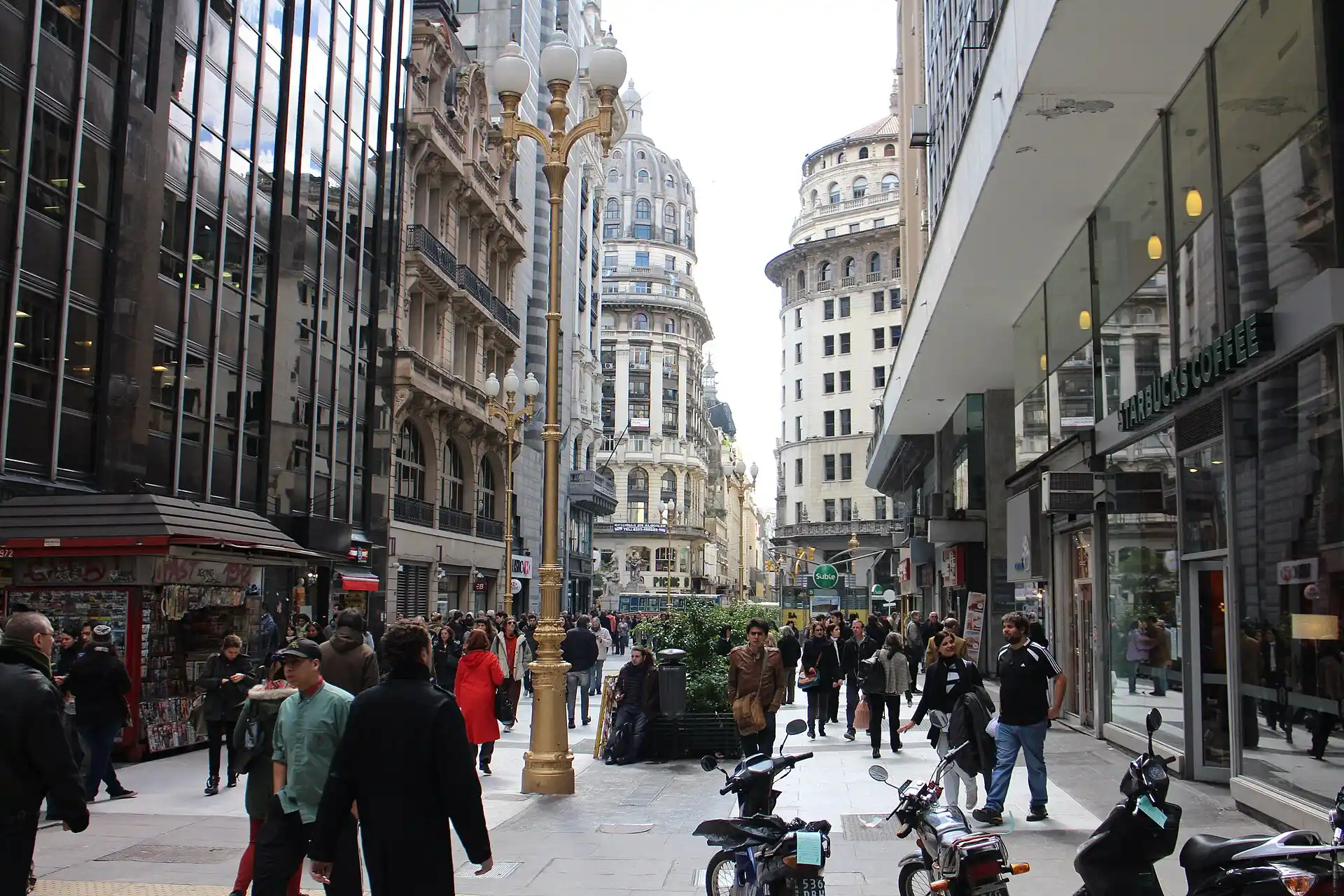
Florida Street, Microcentro, Autonomous City Of Buenos Aires
This page uses content under the Creative Commons Attribution-ShareAlike 4.0 International License, along with original copyrighted content and excerpts from Wikipedia and other sources. See our Copyright and Reuse Policy for details.
Text from this original Florida Street article on Wikipedia.
Image copyright Gobierno de la Ciudad Autónoma de Buenos Aires, CC BY 2.5 AR, via Wikimedia Commons.

Back to the top of this Scottish Country Dancing Instructions 'Florida Street "Cambio Cambio"' page