The Gingerbread Man
Scottish Country Dance Instruction
The Gingerbread Man 32-bar hornpipe for three couples in a four-couple longwise set, Devised By Geraldine and Holger Schuckelt, Published In Riverside Dances, 20141- 8 1st and 2nd couples set and rotate
9-12 1st and 3rd couples dance left hands across once round
13-16 1st man with 2nd couple and 1st woman with 3rd couple dance right hands across once round to finish 1st couple in second place on opposite sides
17-24 All three couples dance a variation of progressive chain (1st couple, giving right hands, cross over; 1st and 3rd couples, giving left hands, cross down/up one place; 1st couple, giving right hands, cross over while 2nd and 3rd couples, giving right hands, cross down/up one place; 1st and 2nd couples, giving left hands, cross up/down one place) to finish 3 (1) 2
25-28 3rd, 1st and 2nd couples chase anticlockwise halfway to finish (2) 1 (3)
29-32 1st couple dance first four bars of a left-hand la baratte (1st couple cross by the left and retain hold with arms fully extended; cross halfway back, raising left arms so that woman can dance under partner's left arm and taking right hand with partner, finishing on the centre line, man behind woman, facing up; continue to cross, releasing left hands and raising right hands so that woman can dance under partner's right arm, finishing in second place on own sides) while 2nd and 3rd couples, giving left hands, cross over on bars 29-30
Repeat, having passed a couple.
(Dance crib compiled by Geraldine and Holger Schuckelt, under the CCA NoDerivatives 4.0 International License, 2017)
Keith Rose's Crib Diagram

Dance Information
Devised in July 2014.Pulsnitz, our local town, is famous for its gingerbread. The dance references both the town and the traditional folk tale in which a boy made of gingerbread is pursued (hence the 'chase') by more and more characters (variation on 'progressive chain') and eventually eaten by a fox (symbolised by the 'baratte' movement at the end).
Recommended music: "Jacky Tarr" (traditional) recorded as: "Fahyda" on "12 Scottish Country Dances devised by Mervyn Short" by Green Ginger.
(Dance information by Geraldine and Holger Schuckelt, under the CCA NoDerivatives 4.0 International License, 2017)
"The Gingerbread Man" (also called "The Gingerbread Boy") is a traditional American fairy tale about a gingerbread figure that runs away from its makers and other pursuers, ultimately being caught by a fox. The story first appeared in print in the May 1875 issue of St. Nicholas Magazine.
In the original version the narrative begins with an elderly, childless woman who bakes a gingerbread man. The pastry figure leaps from the oven and flees, taunting the woman and her husband with the refrain: "Run, run as fast as you can! You can't catch me!" He passes by a variety of farm workers, animals and others who attempt to catch him, but he outruns them all-until he meets a fox, who ultimately tricks and eats him. The gingerbread man exclaims as he is eaten: "I'm quarter gone... I'm half gone... I'm three-quarters gone... I'm all gone!"
Numerous variations of this tale have emerged. Some adapt the ending or change the mode of capture by the fox, while others alter characters or plot elements for children's literature.
This story belongs to a wider family of folk-tales in which a personified food item or a runaway baked good eludes capture. Such variants have been identified across Germany, the British Isles, Eastern Europe and the United States. Examples include the Norwegian "Pannekaken", German "Vom dicken fetten Pfannekuchen", the Russian "Kolobok", the Hungarian "A kis gömböc", and the Czech "Otesánek".
In addition to its traditional form, "The Gingerbread Man" has inspired later works. A musical titled The Gingerbread Man opened on Broadway on Christmas Day 1905 at the Liberty Theatre, and continued in New York and Chicago. In this adaptation the character (called "John Dough") is depicted as the King of Bon Bon Land transformed into gingerbread by a sorcerer.
The gingerbread man figure has also appeared in modern popular culture: for example, as a supporting character in the Shrek films, and as the villain in the "Nursery Crime" series by Jasper Fforde.
My understanding of the story is that it illustrates a playful yet cautionary tale in which something seemingly innocuous (a baked gingerbread man) becomes animated, revels in its freedom, but ultimately meets an unexpected fate. The nature of the tale across cultures and media suggests it has held appeal due to its simple charm and the universal theme of escape and consequence.
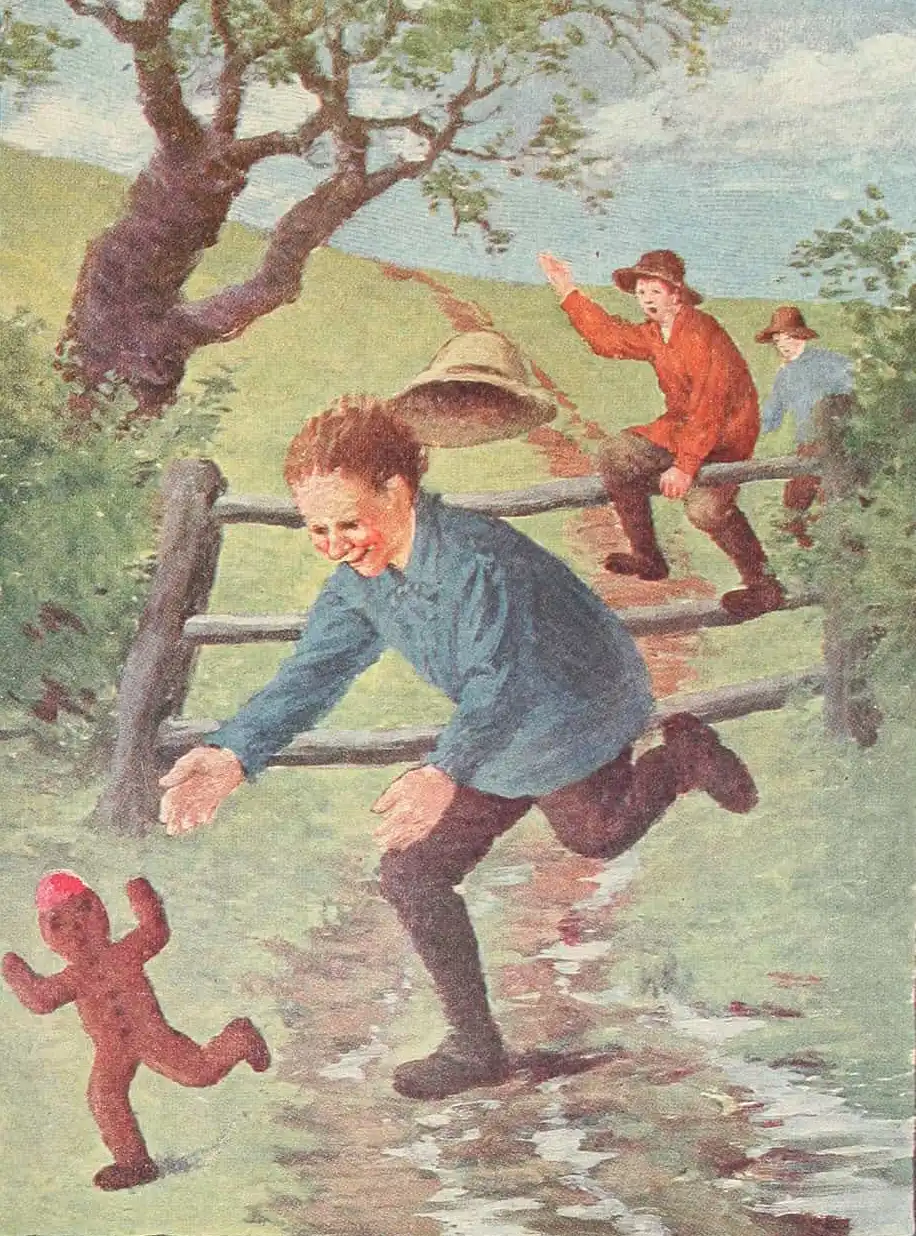
The Gingerbread Man - What Happened Then Stories c. 1918
Published in Riverside Dances, reproduced here under this Creative Commons Attribution - NoDerivatives 4.0 International License.
This page uses content under the Creative Commons Attribution-ShareAlike 4.0 International License, along with original copyrighted content and excerpts from Wikipedia and other sources. See our Copyright and Reuse Policy for details.
Text from this original Gingerbread Man article on Wikipedia.
Image from (cropped) Internet Archive Book Images, No restrictions, via Wikimedia Commons.
_(14750511904).jpg)
Back to the top of this Scottish Country Dancing Instructions 'The Gingerbread Man' page