The Gleniffer Braes
Scottish Country Dance Instruction
The Gleniffer Braes A 32 Bar Reel danced in a three couple longwise set. Wilf Astley 19891- 8 Reels of three across the dance (2nd lady gives left shoulder to 1st man and 2nd man gives left shoulder to 3rd lady to begin the reels).
9-10 2nd couple dance in (using pas-de-basque steps), to finish back to back in the centre, with the lady facing up and the man facing down.
11-16 2nd couple dances crown triangles with the 1st and 3rd couples, finishing with 2nd couple still back to back in the centre of the dance, with the lady facing down and the man facing up. 1st couple now face down and 3rd couple face up on the sides of the dance.
17-20 2nd lady dances down and casts around 3rd man's position into 2nd place on the opposite side whilst her partner dances up and casts around 1st lady's position into 2nd position on the opposite side; meanwhile, 1st and 3rd couples dance half rights and lefts, giving right hands on the sides to start. All finish on the opposite sides of the dance in the order 3,2,1.
21-24 All three couples join hands and circle halfway around to the left, to finish in original places (retain hands on the side lines).
25-26 All set.
27-28 1st couple turn by the right hand to finish facing out; 2nd couple turn by the right hand while moving down the set into 3rd place and finish facing out; 3rd couple cast up into 2nd place and finish facing in and up
(order is now 1,3,2 - see Fig. 1).
29-32 1st, 2nd and 3rd couples dance half reel of three on the sides (to begin the reel 1st couple casts out and down, 3rd couple dances in and up, 2nd couple casts out and up), finishing in the order 2,3,1.
Repeat from new positions.
(Dance crib compiled by the deviser, Wilf Astley, 1989)
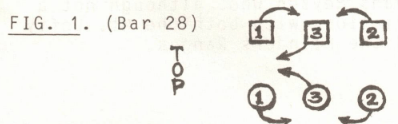
The Gleniffer Braes Figure 1
Dance Notes
2nd and 1st couples continue looping out in order to lead into the reels of three across the dance which will begin the next repetition of the dance (2nd couple loop out and down, 1st couple loop out and up); 3rd couple, now in 2nd place, will begin by passing left shoulder with their first corners.(Dance notes by the deviser, Wilf Astley, 1989)
Dance Information
My wife recalls that when she was young the favourite Sunday afternoon walk for the "Paisley Buddies" was "up the Braes". When you reach the top of the Gleniffer Braes, you can see as far as the River Clyde and beyond to Campsie, also Port Glasgow and the Mistilaw. (W.A.)Later note added by Martin CC Mistilaw is correct. See it here; https://electricscotland.com/history/glasgow/gleniffer.htm
Recommended Music: As for "He Built a Crooked House", or any other suitable 3 x 32 bar reel.
(Dance information by the deviser, Wilf Astley, 1989)
Gleniffer Braes is a range of hills and parkland situated south of Paisley in Renfrewshire, Scotland, forming part of the boundary with North Ayrshire.
The area encompasses Robertson Country Park, which covers approximately 480 acres of moorland and woodland. The park features walking paths, streams, waterfalls, picnic areas, birdwatching sites, and children's play equipment. Visitors can enjoy views of Paisley, the lower Clyde Valley, and Ben Lomond. Notable natural features include the Gleniffer Gorge, eroded by the Gleniffer Burn, and the Craigielinn Waterfall, where icicles are sometimes seen in winter.
The park supports a variety of wildlife typical of woodland and moorland habitats. Bird species commonly observed include skylarks, meadow pipits, kestrels, sparrowhawks, goldcrests, and chaffinches. Mammals such as roe deer, woodmice, voles, and tawny owls are also present. Cattle are used to manage vegetation and maintain open spaces within the park.
Historically, Gleniffer Braes is associated with the 18th and 19th-century weaver poets of Paisley, notably Robert Tannahill and Hugh Macdonald. The Tannahill Walkway and the Bonnie Wee Well commemorate their connection to the area. Lapwing Lodge, originally built in 1910 as a sanatorium for Coats Mill workers, later served as a camping site for the Red Cross and Scouts and is now owned by the West Region Scout Council. The Peesweep Inn, once a local tavern, was converted into a private residence in 1925 and has since been demolished. Additionally, a significant electrical substation, expanded in 2005, occupies the site of former World War II decoy ponds and includes a radio transmitter.
Two standing stones, or menhirs, are located atop the Gleniffer Braes. Stone A measures 1.2 metres in height, width, and 0.9 metres in thickness. Stone B stands 0.8 metres high, 1.5 metres long, and 1.0 metre wide. These stones are believed to have been placed during the time of the Druids.
The park offers several miles of walking paths through its varied terrain, connecting to broader networks such as the Brandy Burn Way and the Fereneze Braes paths. Renfrewshire Council provides a ranger service that offers guided walks. The park is also used by cyclists and horse riders. Recreational activities include picnicking, dog walking, birdwatching, and kite flying. Seasonal events like Easter egg rolling and sledging are popular among visitors.
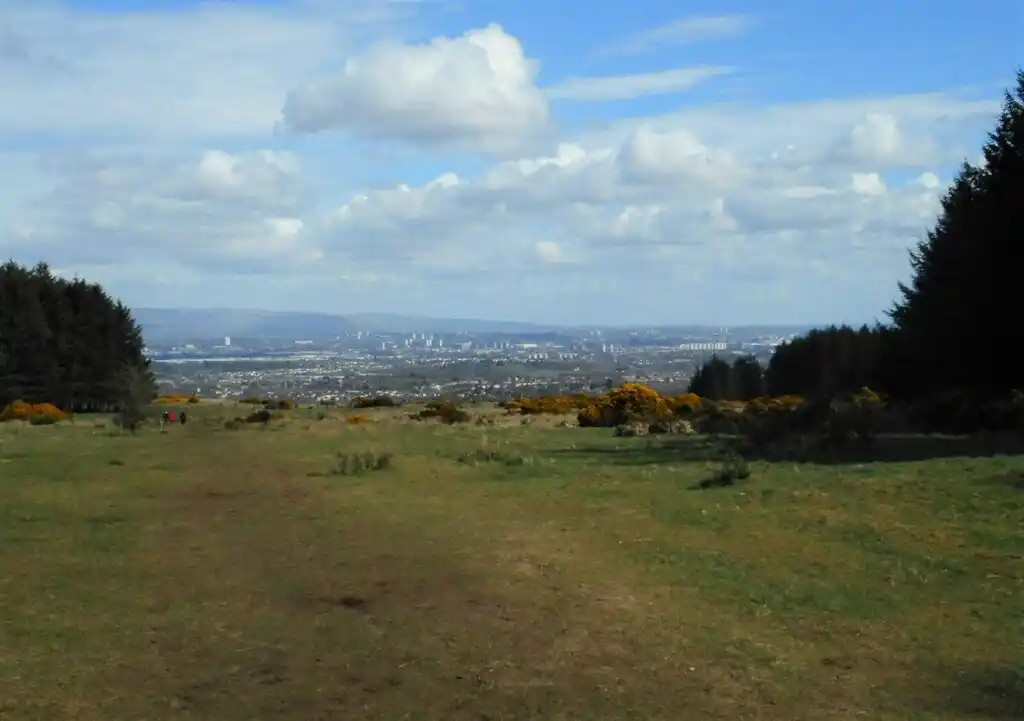
Gleniffer Braes With Paisley In The Distance
Published in The Thistle And Vine, Copyright 2025, reproduced here with the kind permission of the president of RSCDS Adelaide And Districts Branch, Australia, 2025. All rights reserved.
Published in The Thistle And Vine Original, Copyright 1989, reproduced here with the kind permission of the president of RSCDS Adelaide And Districts Branch, Australia, 2025. All rights reserved.
This page uses content under the Creative Commons Attribution-ShareAlike 4.0 International License, along with original copyrighted content and excerpts from Wikipedia and other sources.
Text from this original Gleniffer Braes article on Wikipedia.
Image copyright Richard Sutcliffe under this Creative Commons Licence 2.0.
Back to the top of this Scottish Country Dancing Instructions 'The Gleniffer Braes' page