Hogmanay Strathspey
Scottish Country Dance Instruction
HOGMANAY STRATHSPEY (S3x32) 3C set Mats Melin Scandinavian Dance Book 11- 4 1s turn ¾ 2H, dance out through own place and cast (2s step up (3-4)
5- 8 1s join hands briefly (1L RH+1M LH) and 1L dances under 1M's arm as 1s cross up and cast to 2nd place opposite sides
9-16 1s Petronella turn (touch hands briefly) into lines of 3 across and all set; 1s repeat to 2nd place own side and all set
17-24 1s ½ turn 2H (1 step), open out and dance down nearer hands joined (2 steps), 1s ½ turn 2H (1 step), open out and dance up nearer hands joined (2s step down) and 1s turn 2H remaining in centre, 2s step in ready for...
25-32 1s+2s dance ½ Poussette, 1s remain in centre, 2s retire to 1st place; 1s+3s dance ½ Poussette. 231
(MINICRIB. Dance crib compiled by Charles Upton, Deeside Caledonian Society, and his successors)
Dance Information
This dance was devised for Emma, the wife of the deviser, Mats Melin.Hogmanay is the Scots word for the last day of the old year and is synonymous with the celebration of the New Year in the Scottish manner. It is normally followed by further celebration on the morning of New Year's Day (1 January) and, in some cases, 2 January - a Scottish bank holiday.
In a few contexts, the word Hogmanay is used more loosely to describe the entire period consisting of the last few days of the old year and the first few days of the new year.
The exact origins of Hogmanay remain uncertain, but it is thought to have connections to Norse and Gaelic traditions surrounding the winter solstice. Customs associated with Hogmanay vary across Scotland and typically involve activities such as gift-giving and visiting the homes of friends and neighbors. Of particular significance is the "first-foot", symbolizing the first guest of the new year, a tradition that receives special attention.
The tradition of singing Auld Lang Syne during Hogmanay has gained popularity in numerous countries. Penned by Robert Burns, the Scots poem draws inspiration from traditional and earlier sources.
It is customary to sing the song in a circle, with participants linking arms crossed over one another as the clock marks midnight on New Year's Day or at the end of a Hogmanay dance. Notably, the practice involves linking arms at the start of the final verse before collectively moving into the center as a group.
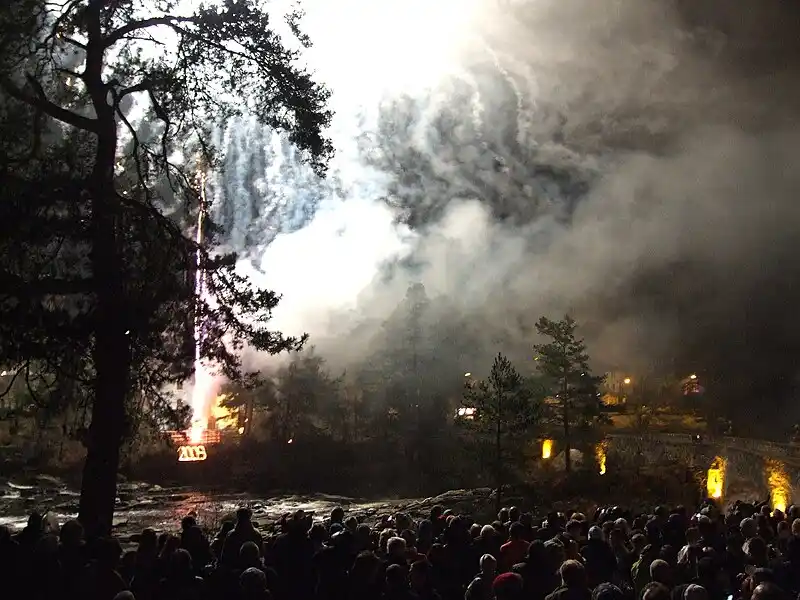
Hogmanay Fireworks Celebrations, Bridge Of Dochart, Killin, Stirling, Scotland
This page uses content under the Creative Commons Attribution-ShareAlike 4.0 International License, along with original copyrighted content and excerpts from Wikipedia and other sources.
Text from this original Hogmanay article on Wikipedia.
Image copyright Vaderw, CC BY-SA 3.0, via Wikimedia Commons.

Back to the top of this Scottish Country Dancing Instructions 'Hogmanay Strathspey' page