Johnsonville Gold
Scottish Country Dance Instruction
Johnsonville Gold 32 bar Strathspey for 3 Couples Rod Downey The Johnsonville CollectionA three couple strathspey in a three couple set.
1- 2 Taking hands, all ladies set advancing to their partners who set back.
3- 4 All the ladies cast left about back to place.
5- 8 Repeat 1-4 this time with the men advancing and casting.
9-12 First couple dance with nearer hands joined between the second couple and cast up around the second couple back to place.
13-16 First couple dance with nearer hands joined between the third couple and cast up around the their couple back to second place, finishing facing up.
17-22 Second, first and third couple dance mirror reels of three. Begin by first couple dancing between the second couple, who dance out and down, and the third couple cast into the reels.
23-24 All take hands on the side and set.
25-32 First and third couple dance La Spirale.
La Spirale is a new progression. (describe here for 1C and 2C)
25-26 First and second couple dance ¾ of a two hand turn to finish in a line of 4 up and down, first man back to back with second lady.
27-28 First man and second lady cast around each other (pulling back RS, beginning tightly and then opening out) to finish first man in second man's place and second lady in first lady's place, while first lady dances clockwise around the outside of the set to second lady's place and similarly second man to first man's place. (These dancers should not cast but dance straight onwards.)
29-32 First and second couples turn their partners with two hands.
Repeat, from new positions.
(Dance crib compiled by the deviser Rod Downey, Johnsonville SCD Club Tutor)
Dance Notes
La Spirale is a new progression. (described here for 1C and 2C)1- 2 First and second couple dance ¾ of a two hand turn to finish in a line of 4 up and down, first man back to back with second lady.
3- 4 First man and second lady cast around each other (pulling back RS, beginning tightly and then opening out) to finish first man in second man's place and second lady in first lady's place, while first lady dances clockwise around the outside of the set to second lady's place and similarly second man to first man's place. (These dancers should not cast but dance straight onwards.)
5- 8 For this dance, 1C and 2C turn partners with 2 hands. (5-6) and, staying in the middle, cast back to place. (Full turn, hesitate and cast.)
Note that in La Spirale, the cast of 1M and 2W should be tight else the covering will be lost.
When teaching this formation, it is often helpful if the first lady retains right hand with first man's left momentarily at the beginning of bar 3, and similarly second man's right with second lady's left.
(Dance notes by the deviser, Rod Downey)
Dance Information
This strathspey, Johnsonville Gold, was devised on 25/8/2016, during Johnsonville Scottish Country Dance Club "golden anniversary" year.Johnsonville Gold is a less vertigo inducing version of The Johnsonville Diamond.
Recommended music is the set used for the "The Slopes of Hlidarendi" by Bob McMurtry in the CD "The Devil's Quandary". (Specifically, "Hallgerd the Beautiful/A Rose By Any Other/Willow" all by Bob McMurtry, as played by D B Grosjean and A Imbrie.) Clearly that CD, track 3, is recommended.
(Dance information from The Johnsonville Collection Of Scottish Country Dances, reproduced here with the kind permission of the deviser, Rod Downey)
Johnsonville is a northern suburb of Wellington, New Zealand, situated approximately seven kilometres from the city centre. It lies at the top of the Ngauranga Gorge and serves as a key junction on State Highway 1, connecting Wellington to Porirua. The area spans 373 hectares and had an estimated population of 12,110 as of mid-2024.
Originally covered in native forest, Johnsonville was settled in the early 1840s. Frank Johnson, one of the first European settlers, established a timber mill and cleared much of the land, which later supported farming activities. The suburb developed steadily, becoming a town district in 1908 and joining Wellington City in 1953.
The arrival of the railway in 1886 marked a turning point, enabling commuter access to central Wellington. Electrification of the line in 1938 further boosted growth. Johnsonville earned the nickname "Cowtown" due to its stockyards and livestock transport, though these facilities were later relocated.
Infrastructure improvements included the installation of electric power in 1909, gas lighting, drainage systems, and water reservoirs. Population growth accelerated throughout the 20th century, with significant increases between 1956 and 1976. State housing developments began in 1938, and by the 1960s, the suburb hosted Wellington's first shopping mall.
Today, Johnsonville comprises four statistical areas and maintains a population density of over 3,200 people per square kilometre. The community is diverse, with a mix of ethnicities and a high proportion of residents born overseas. Educational attainment and income levels are above national averages, and the suburb supports a large commuter population.
Facilities include a shopping centre with 70 retail outlets, two supermarkets, a library, and a community hub. Public transport is centred around the Johnsonville Railway Station and adjacent bus routes. Recreational amenities feature the Keith Spry Pool and Alex Moore Park, which cater to various sports and leisure activities.
Recent developments include the Waitohi community hub, integrating library services, a kindergarten, and expanded pool facilities. Johnsonville continues to evolve as a commercial and residential centre, with plans underway to enhance its town precinct and reinforce its role within the wider Wellington region.
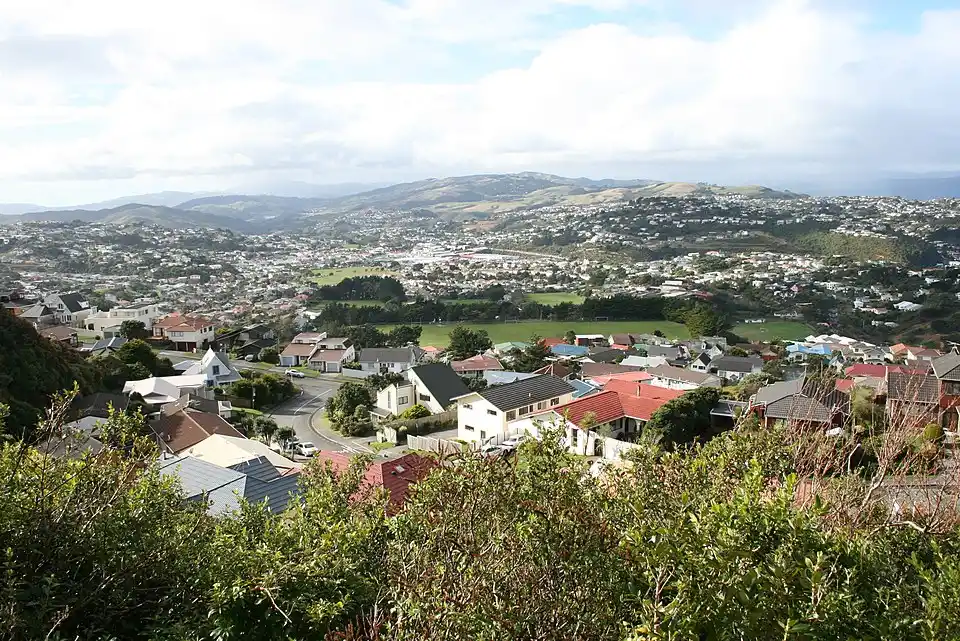
Johnsonville, Wellington, New Zealand
Published in The Johnsonville Collection, reproduced here with the kind permission of the deviser, Rod Downey.
Published in https://homepages.ecs.vuw.ac.nz/~downey/dances/book4.pdf
This page uses content under the Creative Commons Attribution-ShareAlike 4.0 International License, along with original copyrighted content and excerpts from Wikipedia and other sources. See our Copyright and Reuse Policy for details.
Text from this original Johnsonville, New_Zealand article on Wikipedia.
Image copyright DB Thats-Me, CC BY-SA 3.0, via Wikimedia Commons.

Back to the top of this Scottish Country Dancing Instructions 'Johnsonville Gold' page