The Kicking Horse
Scottish Country Dance Instruction
THE KICKING HORSE (R32) Round The Room John Drewry Brodie BookRound the room dance, 2 facing 2
1- 8 Men change places RH, Ladies change places LH and all dance ½ R&L ending with Men turning partners LH into centre to form a line
9-16 All Balance-in-Line, ½ turn partner LH, Balance-in-Line, ½ turn partner LH into prom hold
17-24 All dance clockwise promenade passing both opposite couple and next couple RSh back to original places facing partner
25-32 All ½ turn partner RH and dance ½ RH across with opposite couple, all turn partners RH to face next couple
(MINICRIB. Dance crib compiled by Charles Upton, Deeside Caledonian Society, and his successors)
Dance Instruction Videos
The Kicking Horse - Scottish Country Dancing Instruction VideoDance Information
Drewry explained that he created this dance for a group of dancers in Alberta, Canada, who had invited him to teach at Banff Springs.He noted, however, that he was unaware at the time that Kicking Horse Pass, the name he originally selected for the dance, is actually located across the provincial border in British Columbia.
Kicking Horse Pass is a mountain pass situated on the border between Alberta and British Columbia, within the Canadian Rockies. It lies within both Banff and Yoho National Parks and is part of the Continental Divide.
The pass reaches an elevation of 1,627 metres (5,338 feet) and serves as a critical corridor for transportation, traversed by both the Trans-Canada Highway and the Canadian Pacific Railway.
The pass was first documented by European explorers in 1858 during the Palliser Expedition, led by Captain John Palliser. The name "Kicking Horse" originates from an incident involving expedition member James Hector, who was kicked by his horse while attempting to retrieve another that had fallen into the river. This event led to the naming of both the pass and the adjacent Kicking Horse River.
In the 1880s, the Canadian Pacific Railway selected Kicking Horse Pass as the route for its transcontinental line, despite the challenging terrain. The original railway segment, known as "The Big Hill", featured a steep gradient of 4.5%, making it the steepest stretch of main-line railway in North America at the time. To mitigate safety concerns and operational difficulties, the Spiral Tunnels were constructed and opened in 1909, reducing the gradient to a more manageable 2.2%.
The Trans-Canada Highway was later developed through the pass, with the highest point reaching 1,643 metres (5,390 feet). Over the years, significant upgrades have been made to improve safety and traffic flow, including the completion of a four-lane expansion in August 2024.
Recognising its historical and engineering significance, Kicking Horse Pass was designated a National Historic Site of Canada in 1971. Today, it remains a vital transportation link and a notable landmark within Canada's national park system.
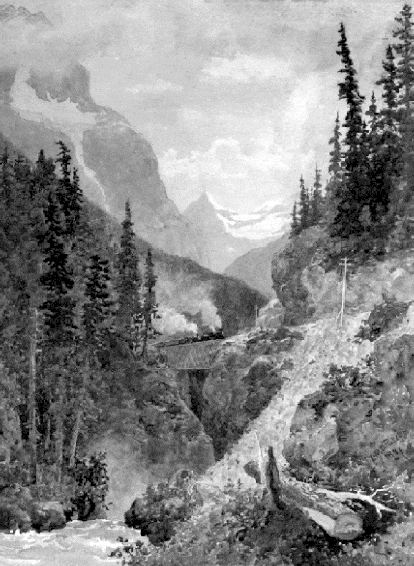
"Kicking Horse Pass" O'Brien, Lucius Richard, (1832-1900), Painting, c. 1887
This page uses content under the Creative Commons Attribution-ShareAlike 4.0 International License, along with original copyrighted content and excerpts from Wikipedia and other sources.
Text from this original Kicking Horse Pass article on Wikipedia.
Image from (cropped) O'Brien, Lucius Richard, 1832-1900, Public domain, via Wikimedia Commons.

Back to the top of this Scottish Country Dancing Instructions 'The Kicking Horse' page