King Neptune
Scottish Country Dance Instruction
KING NEPTUNE (R8x32) 3C (4C set) Barry Skelton Dolphin Book1- 8 1s turn RH and cast 1 place (2s step up); 1s dance up between 2s and cast to 2nd place own side
9-16 1L+2s and 1M+3s dance RH across; 1s dance the Snake:
1M followed by 2s and 1L by 3s cross diagonally passing LSh to change ends and 1s end with 1L followed by 1M facing down. 312
17-20 1s dance Alternating Tandem ½ reel of 3 across with 2s (RSh to 2M in 3rd place)
21-24 1s dance Alternating Tandem ½ reel of 3 across with 3s (RSh to 3L in 1st place). 1s end facing 1M's 1st corner person (3rd corner position)
25-28 1s dance Alternating Tandem ½ reel of 3 on 1st corner diagonal. 1s end facing 1M's 2nd corner person (4th corner position)
29-32 1s dance Alternating Tandem ½ reel of 3 on 2nd corner diagonal and 1s end in 2nd place own side. 213
(MINICRIB. Dance crib compiled by Charles Upton, Deeside Caledonian Society, and his successors)
Dance Information
Neptune is a deity from Roman mythology, recognised as the god of both freshwater and the sea.Initially associated with inland water sources, his role expanded over time to encompass the oceans, aligning him with the Greek god Poseidon. Neptune is commonly depicted holding a trident and is often shown riding a chariot drawn by sea creatures.
In Roman religious tradition, Neptune is one of the major gods, known as the Dii Consentes. He is the brother of Jupiter, the king of the gods, and Pluto, the god of the underworld. Their parents are Saturn and Ops. Neptune's consort is Salacia, a goddess associated with saltwater, and together they are said to have a son named Triton.
Neptune's influence extends beyond water; he is also linked to horses and is sometimes referred to as Neptune Equester. This association led to his worship by those involved in horse racing and equestrian pursuits. Festivals such as Neptunalia were held in his honour, particularly during the summer months, to seek his favour and protection.
The planet Neptune, discovered in 1846, was named after this Roman god, reflecting its deep blue colour reminiscent of the sea. This naming continues the tradition of associating celestial bodies with mythological figures.
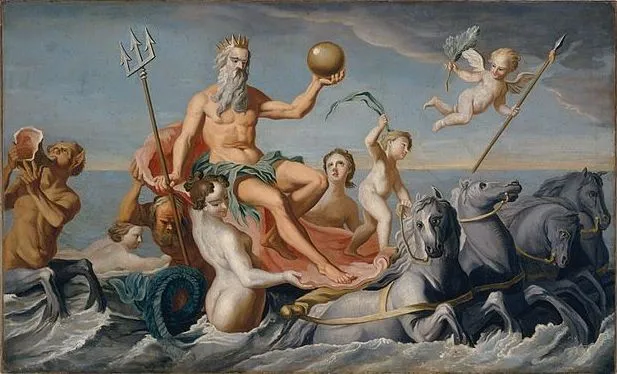
King Neptune
"The Return Of Neptune" John Singleton Copley (1738-1815), Oil On Canvas, c. 1754
This page uses content under the Creative Commons Attribution-ShareAlike 4.0 International License, along with original copyrighted content and excerpts from Wikipedia and other sources.
Text from this original Neptune (mythology) article on Wikipedia.
Image from John Singleton Copley, public domain, via Wikimedia Commons.

Back to the top of this Scottish Country Dancing Instructions 'King Neptune' page