Kinning Park
Scottish Country Dance Instruction
KINNING PARK (J8x48) 3C (4C set) Alasdair Brown Dunnington Collection 11- 8 1s cross down RH, cast to right, dance down/up to meet partner and turn RH 1½ times
9-16 1s dance RSh reels of 3 across (1M with 2s and 1L with 3s) and end facing 1st corners
17-24 1s dance ½ Corner Chain with 1st corners:
1s+1st corners change places RH, 1st corners turn LH in centre and return to places giving RH to 1s who turn LH in centre to 1L facing 2s and 1M facing 3s
25-32 1s dance RH across (1L with 2s and 1M with 3s) and changing places dance LH across with other couple 1s end facing 2nd corners
33-40 1s dance ½ Corner Chain with 2nd corners:
1s+2nd corners change places RH, 2nd corners turn LH in centre and return to places giving RH to 1s who turn LH in centre to end 2nd place own sides
41-48 2s+1s+3s circle 6H round and back
(MINICRIB. Dance crib compiled by Charles Upton, Deeside Caledonian Society, and his successors)
Dance Information
Kinning Park, located on the southern bank of the River Clyde in Glasgow, Scotland, approximately one mile west of the city centre, has undergone significant transformations over the years. Originally a rural village, it evolved into a bustling industrial hub by the mid-19th century.In 1871, Kinning Park was established as a police burgh, making it the smallest such burgh in Scotland at just 108 acres. During its 34-year existence, the burgh had its own council, elections, coat of arms, provosts, town hall, council chambers, fire brigade, police force, and police court. The inaugural council in 1871 was notable for being one of the first examples of working-class representation in Scotland, with five "working men" candidates elected under the guidance of activist Andrew Boa. In 1905, following a residents' ballot, Kinning Park was annexed to Glasgow.
Economically, from 1850 onwards, Kinning Park developed into a centre for various industries, including engineering, bread and biscuit baking, soap-making, and paint-making. The Kinning Park Co-Operative Society, founded in 1871 by Andrew Boa, played a significant role in the local economy, operating retail and manufacturing premises until 1952.
Kinning Park also holds a place in Scotland's sporting history. The area was home to a 19th-century sports ground used for cricket and football. Clydesdale Cricket Club played there from 1849, hosting matches against visiting English teams. The ground later became the home of Rangers F.C. from 1876 until their move to the first Ibrox Park in 1887. Notably, the venue hosted the 1881 Scottish Cup Final between Queen's Park and Dumbarton.
Today, Kinning Park is a district characterised by small industrial units and community spaces. It is served by the Kinning Park subway station, the closest to the surface on Glasgow's subway circle. The area is also near Pacific Quay, home to the headquarters of BBC Scotland and Scottish Television, as well as the Glasgow Science Centre and IMAX Cinema.
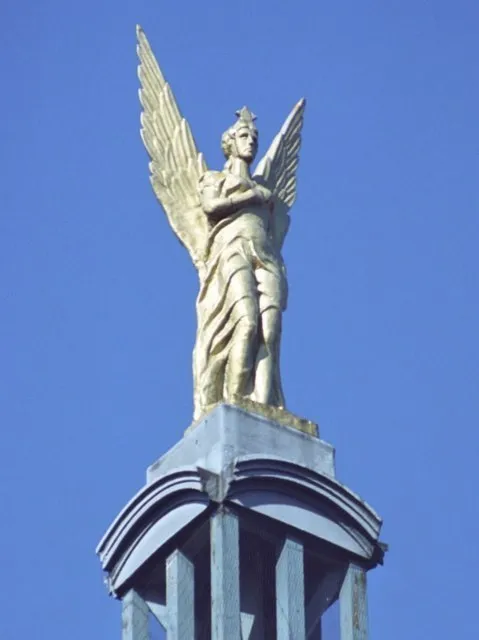
The Govan Angel
Located Within Kinning Park, Glasgow, Scotland
This page uses content under the Creative Commons Attribution-ShareAlike 4.0 International License, along with original copyrighted content and excerpts from Wikipedia and other sources.
Text from this original Kinning Park article on Wikipedia.
Image copyright Lairich Rig under this Creative Commons Licence 2.0.
Back to the top of this Scottish Country Dancing Instructions 'Kinning Park' page