Libberton's Wynd
Scottish Country Dance Instruction
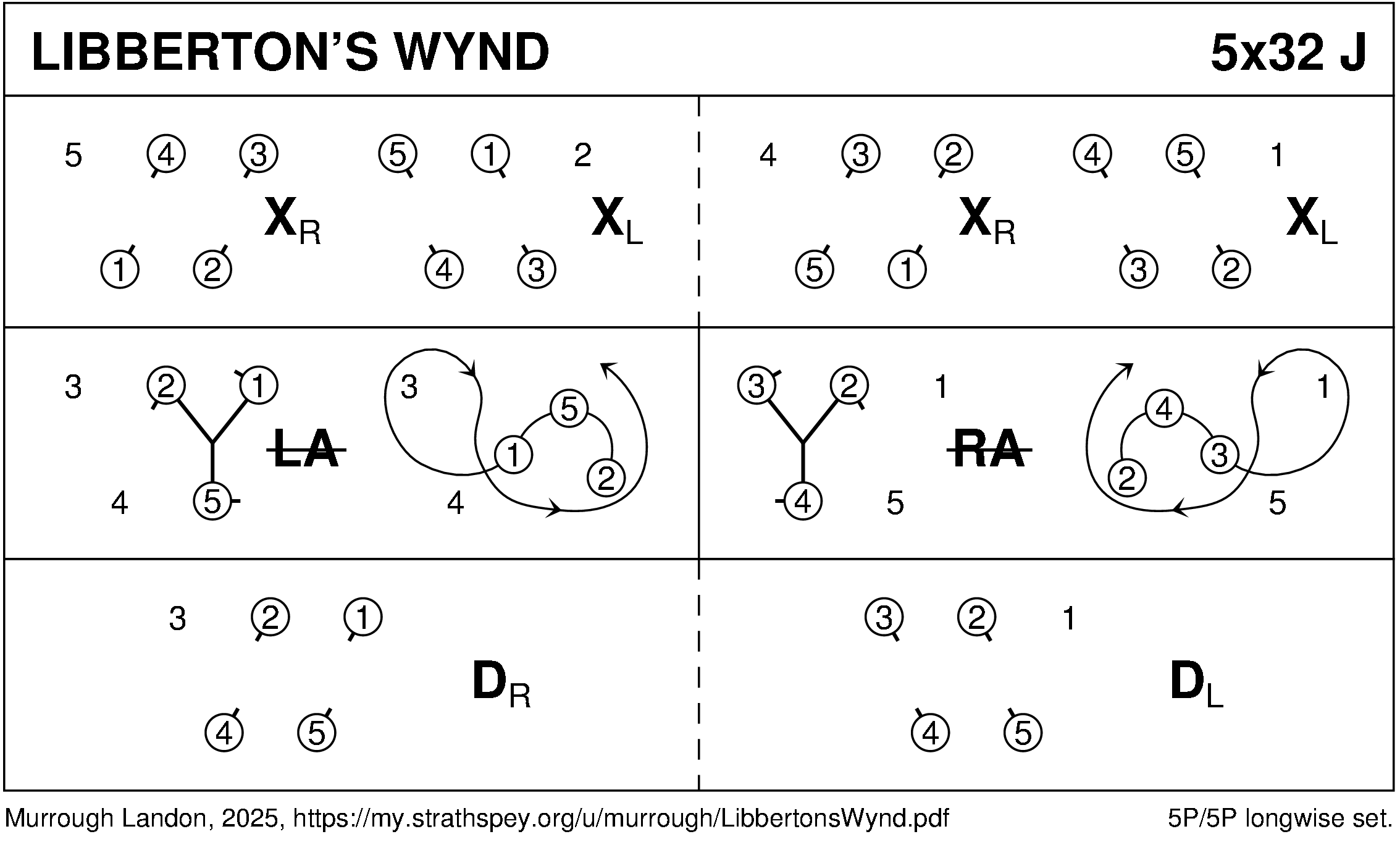
Libberton's Wynd (J5x32) A 32 bar jig for five dancers of arbitrary gender in a longwise set, Murrough Landon April 2025They are numbered anticlockwise with two dancers, 1 and 2, down the men's side facing the gaps in a line of three dancers, 3, 4 and 5, up the women's side (see diagrams in .pdf, linked below).
1- 4 Dancers 1 and 4, also 2 and 3, each change places giving right hands (diagonally right). Dancers 4 and 5, also 3 and 1, each change places giving left hands (diagonally left).
5- 8 Repeat the crossing pattern of bars 1-4 from new places:
Dancers 5 and 3, also 1 and 2, each change places giving right hands (diagonally right).
Dancers 3 and 4, also 2 and 5, each change places giving left hands (diagonally left).
The order is now 4, 5; 1, 2, 3. Dancer 2 is now the active dancer.
9-16 Dancer 2 dances half left hands across with 5 and 1 (2 bars). 1 is now in the centre. Then dancer 1, followed by 5 and 2, dances up between 3 and 4, right shoulder round 3, through the centre and curves round to the left. All end in the same places as at bar 9.
17-24 Dancer 2 dances half right hands across with 4 and 3 (2 bars). 3 is now in the centre. Then dancer 3, followed by 4 and 2, dances down between 1 and 5, left shoulder round 1, through the centre and curves round to the right. All again end as at bar 9.
25-32 Dancers 4 and 2, also 5 and 1, each dance back to back starting right shoulder. Dancers 4 and 3, also 5 and 2, each dance back to back starting left shoulder. The final order is 4, 5; 1, 2, 3.
(Dance crib compiled by the deviser, Murrough Landon, CC BY-SA April 2025)
Keith Rose's Crib Diagram
Dance Instruction Videos
Libberton's Wynd - Scottish Country Dancing Instruction VideoDance Information
The set shape and numbering are taken from Higher Math by Linda Lieberman. For bars 9-32 the dancer in the middle of the women's side is the active dancer.Libberton's Wynd was an old street in Edinburgh which was demolished when the George IV Bridge was built in the 1830s. A vestige of it was recently discovered behind the National Library of Scotland as reported in this BBC news article: https://www.bbc.co.uk/news/articles/cly2l119zlpo.
Recommended music: Suggested tune: Mr and Mrs Alex Ross (John MacGregor).
Suitable recording: Five Penny Ness (Jim Lindsay and his SDB: Sunday Class Highlights Vol 1).
(Dance information by the deviser, Murrough Landon, CC BY-SA April 2025)
Libberton's Wynd was a steep, narrow street in Edinburgh's Old Town, running downhill from the Lawnmarket to the Cowgate.
Like many medieval wynds, it formed part of the dense network of lanes that connected the Royal Mile with the lower parts of the city. The name reflects the Scottish term "wynd", meaning a narrow passage or lane leading from a main street.
For centuries, Libberton's Wynd was a busy part of Edinburgh, lined with tall tenement buildings that housed residents, shops and taverns. At its upper end stood the city's public gallows, making the area well known as the site of numerous public executions. Large crowds often gathered there to witness these events.
The wynd was also home to John Dowie's Tavern, one of Edinburgh's most famous eighteenth-century hostelries. The tavern attracted a wide range of patrons, including writers, artists, lawyers and other notable figures of the period. Despite its modest size, it became one of the best-known meeting places in the city.
Major changes to Edinburgh during the nineteenth century led to the disappearance of the street. Construction of George IV Bridge between the late 1820s and 1830s required the demolition of Libberton's Wynd and several neighbouring streets. The new route provided a direct crossing over the Cowgate valley and improved access between different parts of the city.
Although the street itself no longer exists, parts of its structure survived hidden beneath later buildings. Archaeological investigations and restoration work have revealed sections of the old wynd, providing a rare glimpse of Edinburgh's medieval street layout. Today, Libberton's Wynd remains an important reminder of the character and history of the city's Old Town.
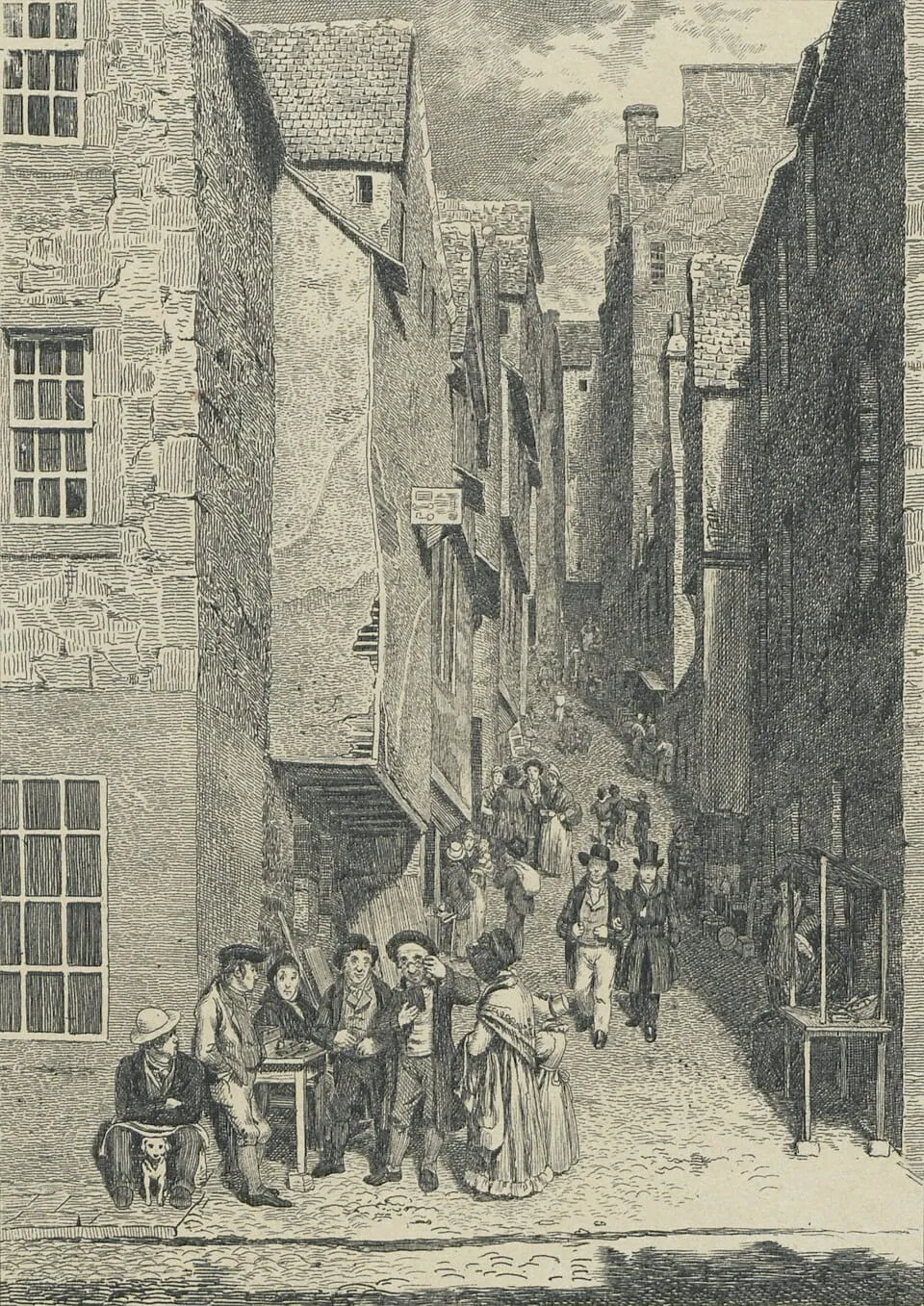
"Libberton Wynd From The Cowgale" Walter Geikie (1795–1837), Engraving On Paper, c. 1795–1837
Published in Libberton's Wynd, reproduced here with the kind permission of the deviser, Murrough Landon. Licensed under CC BY-SA.
This page uses content under the Creative Commons Attribution-ShareAlike 4.0 International License, along with original copyrighted content and excerpts from Wikipedia and other sources.
Text from this original Libberton's Wynd article on Wikipedia.
Image from Walter Geikie, Public domain, via Wikimedia Commons.

Back to the top of this Scottish Country Dancing Instructions 'Libberton's Wynd' page