The Lightning Conductor
Scottish Country Dance Instruction
THE LIGHTNING CONDUCTOR (J8x32) 3C (4C set) Diane Rooney Cheshire 40th Anniversary1- 8 1s+2s Set and Rotate
9-16 1M+2s also 1L+3s dance RSh reels of 3 across (1s RSh to 2nd corner to start). 1s end facing 1st corners
17-24 1s dance Corner pass and turn with 1st corners; pass RSh and dance pass and turn with 2nd corners and pass RSh to 2nd place own side
25-32 2s+1s+3s circle 6H round and back. 213
(MINICRIB. Dance crib compiled by Charles Upton, Deeside Caledonian Society, and his successors)
Keith Rose's Crib Diagram

Dance Instruction Videos
The Lightning Conductor - Scottish Country Dancing Instruction VideoDance Information
This dance was devised by Diane (Di) Rooney and is dedicated to her partner, Roger Gurtner.Diane Rooney is the Branch Teacher of the RSCDS Cheshire Branch, and Roger is a regular attendee at branch classes, where he is known for his friendly manner and good humour.
Members often direct light-hearted blame for mistakes towards Roger, who invariably responds with just a wry smile.
A lightning rod, known in British English as a lightning conductor, is a metal conductor installed on a structure to reduce damage from a lightning strike. The rod forms part of a lightning protection system and is connected to the ground by a low-resistance conductor. If lightning strikes the structure, the electrical current is intended to pass through the conductor to earth instead of through the building. Lightning rods are commonly manufactured from copper or aluminium, although other conductive materials may also be used.
Benjamin Franklin described the principle of the lightning rod in 1749 during his investigations into electricity and proposed using a pointed metal rod connected to the ground to protect buildings from lightning. Franklin's design was widely adopted in North America and Europe during the eighteenth century. In 1754, the Czech priest and scientist Prokop Diviš erected a grounded metal rod at Přímětice, near Znojmo, as part of his experiments on atmospheric electricity.
A complete lightning protection system normally includes one or more air terminals, down conductors and earth electrodes. Modern systems are designed to provide a controlled path for lightning current to reach the ground while reducing the risk of fire, structural damage and electrical hazards within the protected building. The location and number of air terminals are determined by recognised engineering methods rather than by the earlier assumption that a single rod protects a fixed cone-shaped area.
The term "lightning conductor" is also used figuratively to describe a person or object that attracts criticism, controversy or other problems, thereby drawing them away from others in much the same way that a lightning rod provides a preferred path for a lightning discharge.
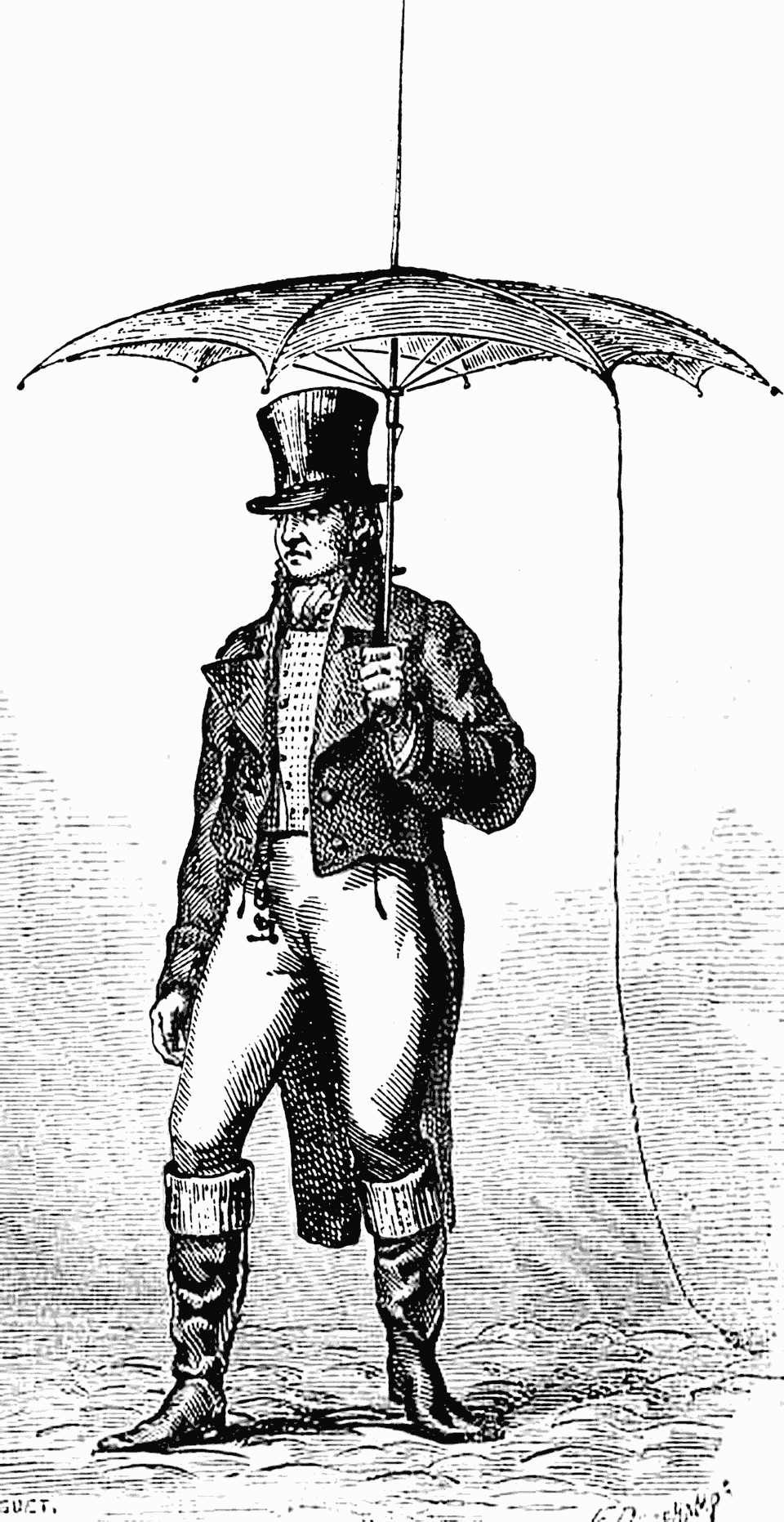
Umbrella Fitted With Lightning Conductor, Engraving, c. 1867
This page uses content under the Creative Commons Attribution-ShareAlike 4.0 International License, along with original copyrighted content and excerpts from Wikipedia and other sources.
Text from this original Lightning Rod article on Wikipedia.
Image from Émile Deschamps and L. Guiguet, Public domain, via Wikimedia Commons.

Back to the top of this Scottish Country Dancing Instructions 'The Lightning Conductor' page