LIGO And Virgo
Scottish Country Dance Instruction
LIGO And Virgo (R5x32) A 32 bar reel for five couples in a longwise set, Murrough Landon September 20191- 4 1st and 5th couples each set to their partner. Then 1st man and 5th woman cast inwards to 2nd and 4th places as 1st woman and 5th man, starting slightly to their left, make a petronella turn to end in facing lines across in 1st and 5th places between 2nd and 4th couples who step out to the ends on bars 3-4.
5- 8 LIGO (or L-shape) set and link:
2nd and 1st women with 2nd, 1st and 3rd men, also 4th and 5th men with 3rd, 5th and 4th women set taking hands in two L shapes. 2nd man and 4th women, at the vertices in 1st man's and 5th woman's places, face in diagonally with arms at right angles.
2nd woman and 4th man (with left hands free) dance diagonally across to 3rd place while the other four in each L shape pull right shoulders back and cast clockwise to the next side and form a new L shape with 2nd man and 4th woman again at the vertices, but now in 1st woman's and 5th man's places.
9-12 All repeat the LIGO set and link figure from their new places. 2nd woman and 4th man again dance across diagonally to the other end of each L shape (now into 5th woman's place and 1st man's place respectively) while the others cast to the next side clockwise. 1st woman and 5th man pass left shoulder to end back to back with each other in the centre in 3rd place facing up and down respectively. 1st man and 5th woman end in 2nd and 4th places on the opposite sides.
13-16 1st and 5th couples each dance clockwise about half way around their partner by the right shoulder, then birl (or turn with the right hand) once round - or possibly more - to end facing their 4th corner position.
17-20 1st and 5th couples each dance half a reel of four on the 2nd diagonal, starting by passing those in their 4th corner position right shoulder. On bar 20 1st and 5th couples quickly half turn with the left hand (or with left elbow grip) so the men face down and the women face up on the centre line.
21-24 1st and 5th couples dance half a reel of four on the centre line, starting by passing their partner left shoulder. They end on the centre line facing the opposite sides.
25-28 All dance right hands across: 4th couple with 5th woman, 5th man and 1st woman with 3rd couple and 1st man with 2nd couple.
29-32 5th and 1st couples each turn their partner three quarters with the left hand then cast off one place as 3rd and 2nd couples step up. The final order is 4,3,5,2,1.
(Dance crib compiled by the deviser, Murrough Landon, CC BY-SA September 2019)
Dance Instruction Videos
LIGO And Virgo - Scottish Country Dancing Instruction VideoDance Information
LIGO and Virgo are gravitational wave detectors. This dance is a five couple adaptation of Gravitational Waves with two L-shape detectors working together.No more Nobel prizes though: the two dancing couples just finish their stint on the experiment with teapots and hand over to the next shift.
Recommended music: Suggested tune: Einstein's Prediction.
An 8x32 recording of this is available (but there is no 5x32 recording).
(Dance information by the deviser, Murrough Landon, CC BY-SA September 2019)
LIGO and Virgo are large scientific instruments designed to detect gravitational waves, tiny distortions in space-time predicted by Albert Einstein's General Theory of Relativity in 1916.
Gravitational waves are produced when massive objects such as black holes or neutron stars accelerate, particularly during collisions and mergers.
LIGO, the Laser Interferometer Gravitational-Wave Observatory, operates two detectors in the United States, located in Louisiana and Washington State. Virgo is a similar detector located near Pisa in Italy. These observatories use laser interferometry to measure changes in distance thousands of times smaller than the diameter of a proton. By comparing signals from multiple detectors, scientists can confirm that a detected signal is of cosmic origin rather than local interference.
On 14 September 2015, LIGO made the first direct detection of gravitational waves, observing the merger of two black holes more than a billion light-years from Earth. The discovery was announced in February 2016 and provided the first direct evidence that gravitational waves exist. It also marked the first direct observation of a black hole merger.
Since then, LIGO and Virgo have detected numerous gravitational-wave events, including collisions between black holes and between neutron stars. In 2017, the detection of merging neutron stars was observed both through gravitational waves and across the electromagnetic spectrum by telescopes around the world. This event provided valuable information about the origin of heavy elements such as gold and platinum and demonstrated the power of multi-messenger astronomy.
The LIGO and Virgo collaborations involve thousands of scientists, engineers and researchers from many countries. Their observations have opened a new way of studying the universe, allowing astronomers to investigate cosmic events that may be difficult or impossible to observe using light alone.
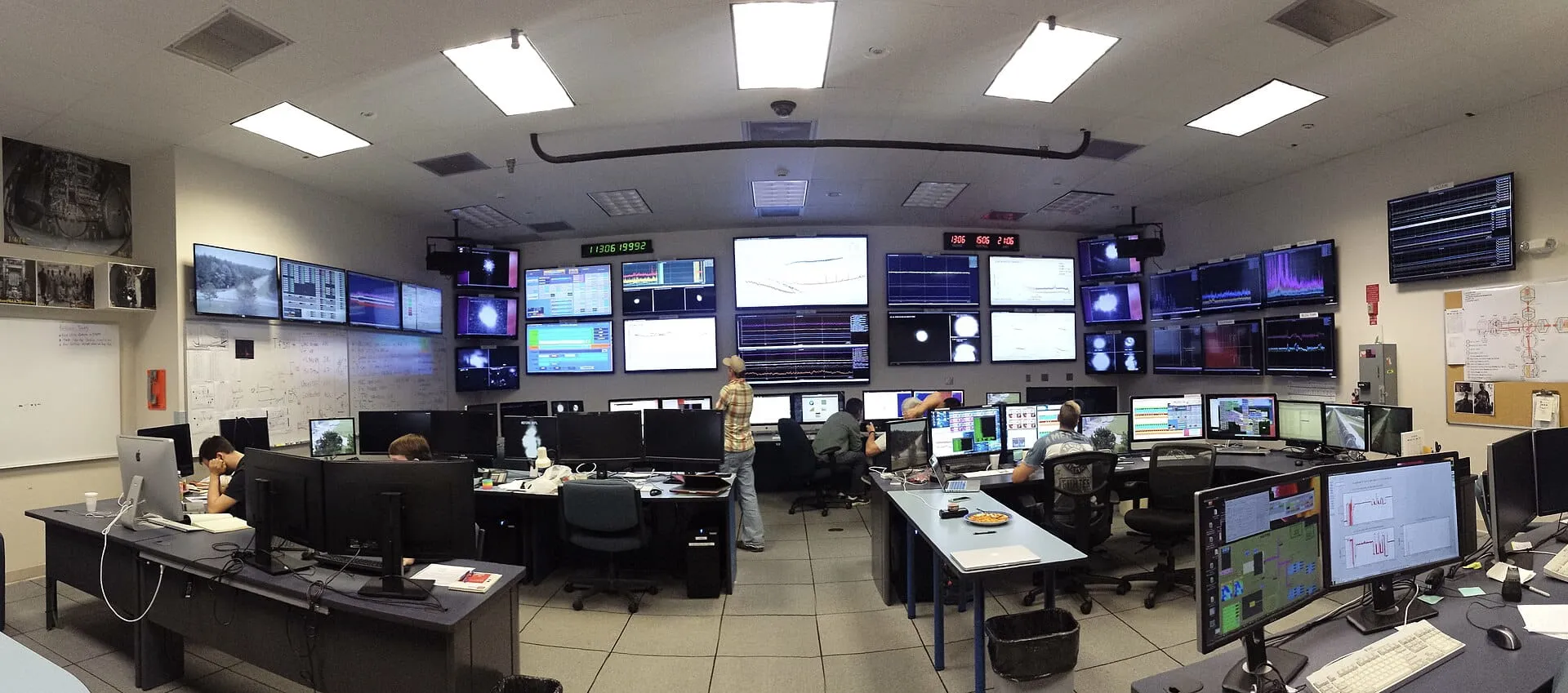
The LIGO Livingston Control Room, 2015
Published in LIGO And Virgo, reproduced here with the kind permission of the deviser, Murrough Landon. Licensed under CC BY-SA.
This page uses content under the Creative Commons Attribution-ShareAlike 4.0 International License, along with original copyrighted content and excerpts from Wikipedia and other sources.
Text from this original LIGO article on Wikipedia.
Text from this original Virgo Interferometer article on Wikipedia.
Image copyright Amber Stuver, CC BY-SA 4.0, via Wikimedia Commons.

Back to the top of this Scottish Country Dancing Instructions 'LIGO And Virgo' page