Madge Wildfire's Strathspey (Sir Walter Scott Book)
Scottish Country Dance Instruction
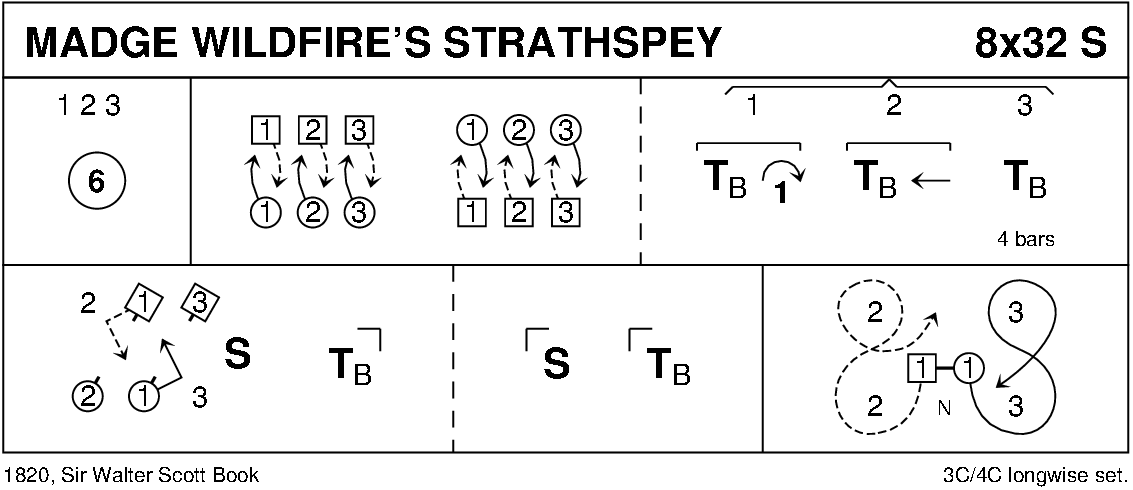
Madge Wildfire's Strathspey (Sir Walter Scott Book) (S8x32) 3C (4C set) 32 bar Strathspey for 3 Couples in a 4 Couple Set, devised by Unknown, published in Sir Walter Scott, The Heart of Midlothian Book.1- 8 1st, 2nd, and 3rd couples take hands and circle to the left and back to place
9-16 All cross passing right shoulders, all cross passing right shoulders back; 1st couple turn both hands and cast down to 2nd place
while 2nd couple turn both hands and dance up to 1st place
while 3rd couple turn partner with both hands to finish in place. 213
17-24 1st couple set advancing towards 1st corners; turn 1st corners with both hands and face 2nd corners
Set to and turn 2nd corners with both hands. 1st couple finish on centre line, 1st man facing men's side, 1st lady on partner's right
25-32 1st couple, nearer hands joined, dance out and cast back to centre line facing ladies' side; dance out again and cast back to 2nd place. 213
(WEECRIB)
If you are the deviser of this dance, or the current copyright holder, and would like your crib included here, you can Submit A Crib directly, or Contact Us.
Keith Rose's Crib Diagram
Dance Instruction Videos
Madge Wildfire's Strathspey (Sir Walter Scott Book) - Scottish Country Dancing Instruction VideoDance Information
Also see the dance Madge Wildfire's Strathspey (RSCDS Book 9), a variant as originally published by the RSCDS, in book 9, in 1934.This variation of the dance was reconstructed by the RSCDS in 2021 to mark the 250th anniversary of Sir Walter Scott's birth (15 August 1771), in Edinburgh, Scotland.
Madge Wildfire, a tragic and mentally unstable character in Sir Walter Scott's "The Heart of Midlothian", embodies themes of social injustice and lost innocence while playing a pivotal role in Jeanie Deans' journey to save her sister.
Sir Walter Scott's The Heart of Midlothian was first published in 1818 as part of the Tales of My Landlord series. This series was presented as being written by an imaginary author, Jedediah Cleishbotham, a schoolmaster and parish clerk in the fictional town of Gandercleugh. Scott used this narrative device to distance himself from the work, as he initially published many of his novels anonymously.
The novel was released by the prominent Edinburgh publishing house Archibald Constable and Co., with Longman, Hurst, Rees, Orme, and Brown distributing it in London. It appeared in four volumes and was an immediate success, cementing Scott's reputation as one of the leading novelists of the time.
The Heart of Midlothian is set in early 18th-century Scotland and draws its title from the Old Tolbooth prison in Edinburgh, which played a significant role in Scottish history and serves as a symbol in the novel. The book explores themes of justice, morality, and social change, with its central narrative focusing on the trial of Effie Deans and her sister Jeanie's quest for her pardon.
The work received widespread acclaim for its rich characterisation, historical accuracy, and compelling storytelling. It remains one of Scott's most celebrated novels and a cornerstone of Scottish literature.
Madge Wildfire, whose real name is Margaret Murdockson, is a tragic and complex character in the novel. Once a beautiful and spirited young woman, Madge descends into madness following a life marked by scandal and tragedy. Her mental instability and erratic behaviour make her a memorable figure in the novel, serving both as a source of dark humour and as a poignant reminder of lost innocence.
Madge plays a pivotal role in the story, particularly in assisting Jeanie Deans during her perilous journey to London. Jeanie is on a mission to seek a royal pardon for her sister Effie Deans, who has been wrongfully accused of child murder. Throughout this journey, Madge's unpredictable nature and seemingly nonsensical ramblings provide critical insights into her past and the world she inhabits. Despite her mental state, Madge proves to be a valuable, albeit unconventional, ally to Jeanie.
Madge's relationship with her mother, Margaret Murdockson (also referred to as Dame Murdockson), is central to her character arc. Her mother is depicted as a cruel and manipulative woman involved in criminal activities, including the kidnapping of children. This relationship profoundly affects Madge, contributing to her instability and tragic fate. Madge's connection to the central conflict of Effie Deans' trial is also significant, as her mother's nefarious actions intersect with the mystery surrounding Effie's missing child.
The portrayal of Madge is marked by her tendency to wander aimlessly while singing ballads. These songs often reflect her inner turmoil and hint at the sorrowful events of her life. Her madness is both a source of pity and a commentary on the harsh societal conditions that shaped her. Ultimately, Madge's life ends violently when she is killed by an angry mob, a grim conclusion that underscores the brutality and lack of compassion in the society depicted in the novel.
Madge Wildfire's character serves as a lens through which Sir Walter Scott explores themes of social injustice, mental health, and morality. Her tragic story, interwoven with the lives of Jeanie and Effie Deans, adds depth and emotional resonance to The Heart of Midlothian, making her one of the most memorable characters in the novel.
In the heart of Edinburgh, Scotland's capital city, lies "The Heart of Midlothian", a heart-shaped mosaic made from coloured granite setts embedded in the pavement.
This mosaic marks the site of the 15th-century Old Tolbooth, which was demolished in 1817. The Old Tolbooth served as the town's administrative centre, a prison, and a location for public executions. The building is famously featured in Sir Walter Scott's 1818 novel, The Heart of Midlothian.
The mosaic is named after the historical county of Midlothian of which Edinburgh was the county town.

The Heart Of Midlothian Mosaic, Edinburgh, Scotland
This page uses content under the Creative Commons Attribution-ShareAlike 4.0 International License, along with original copyrighted content and excerpts from Wikipedia and other sources. See our Copyright and Reuse Policy for details.
Text from this original Sir Walter Scott article on Wikipedia.
Text from this original The Heart of Midlothian article on Wikipedia.
Image copyright Kim Traynor, CC BY-SA 3.0, via Wikimedia Commons.
