Market Square
Scottish Country Dance Instruction
MARKET SQUARE (R64) Sq.Set Dorothy Bell Donaghadee and Starters Collection1- 8 All circle 8H round and back
9-16 Ladies dance RH across and turn partner RH
17-24. Men dance LH across and turn partner LH into prom hold
25-32. All Promenade clockwise once round
33-40. 1s+3s in prom hold pass RSh and dance round to right behind 4s/2s back to places
41-48. 2s+4s repeat
49-56. 1s+3s advance and retire, 2s+4s advance and retire
57-64 Ladies with partners on their left dance RH across once round
Note: This dance is frequently danced as a S64+R64 medley
(MINICRIB. Dance crib compiled by Charles Upton, Deeside Caledonian Society, and his successors)
Keith Rose's Crib Diagram

Dance Instruction Videos
Market Square - Scottish Country Dancing Instruction VideoDance Information
The concept of a Market Square dates back to medieval times and has played a pivotal role in the development of towns and cities across Europe and beyond.A Market Square is traditionally an open space at the heart of a town or village, designed for the trading of goods and services. These squares served as central hubs for commerce, social interaction, and even civic and cultural events, making them essential to the community's daily life. Often located near important roads or crossroads, Market Squares were accessible to both local merchants and travellers, and the location of the market would be a key factor in the success of a town's economy.
The layout of a Market Square was usually open and flexible, allowing for stalls and temporary structures to be set up for selling goods ranging from fresh produce and livestock to textiles and pottery. In larger towns or cities, Market Squares could host large-scale markets with multiple vendors, and sometimes, permanent buildings such as market halls were added. The square itself became a focal point not only for economic exchange but for civic life, where town meetings, festivals, public executions, and celebrations would take place.
Over time, the role of the Market Square evolved with changes in trade practices, urban planning, and transportation. In many places, the rise of supermarkets and shopping malls led to a decline in the importance of traditional market squares as commercial centres. However, in some towns and cities, these historic spaces have been preserved or repurposed for modern use, hosting farmers' markets, cultural events, and gatherings. The Market Square remains a symbol of community and local identity, reflecting both the economic and social life of the area.
Today, many modern towns still have a designated "Market Square" or central public space that honours this historic concept, even if the trading of goods is no longer its primary function. In these spaces, people still come together to connect, whether for shopping, socialising, or celebrating local heritage.
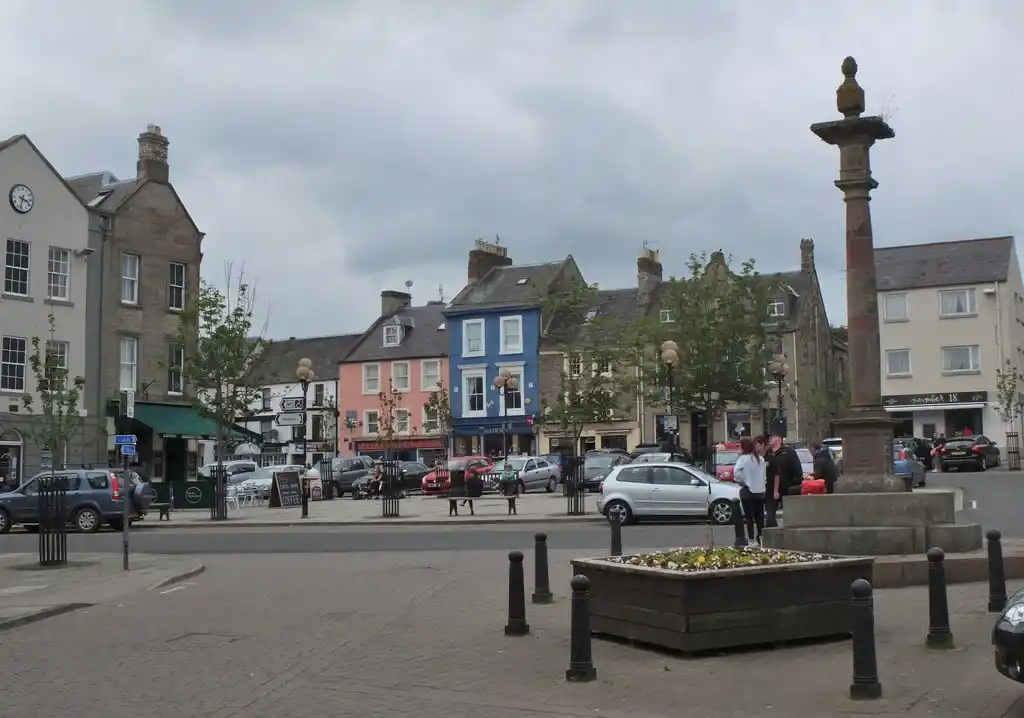
Market Square, Duns, Scotland
This page uses content under the Creative Commons Attribution-ShareAlike 4.0 International License, along with original copyrighted content and excerpts from Wikipedia and other sources. See our Copyright and Reuse Policy for details.
Text from this original Market Square article on Wikipedia.
Image copyright Jim Barton under this Creative Commons Licence 2.0.
Back to the top of this Scottish Country Dancing Instructions 'Market Square' page