The Round Tower
Scottish Country Dance Instruction
THE ROUND TOWER (S5x32) 5C Sq.Set Macushla Lamb Southsea 50Square set, 5s in centre, 5L facing up, 5M facing down
1- 8 1s+2+3s+4s circle 8H round and back while 5s set, ½ turn RH, set and ½ turn LH to end 5L facing 1s and 5M facing 3s
9-10 5L+1L and 5M+3M change places RH
11-12 5L+1M, 5M+3L, 1L+3M turn LH
13-14 5L+1L and 5M+3M change places RH
15-16 1L+1M and 3L+3M turn LH while 5L+5M turn ¾ LH to 5L facing 2L, 5M facing 4M
17-18 5L+2L and 5M+4M change places RH
19-20 5L+2M, 5M+4L, 1L+4M turn LH
21-22 5L+2M and 5M+4M change places RH
23-24 2s and 4s turn LH while 5s turn ¾ LH to end 1M followed by 1L facing 1s
25-32 All couples in tandem (Man leading) change places passing RSh as follows: 5s+1s, 1s+4s, 4s+3s, 3s+2s
Repeat with new couple (2s) in centre
(MINICRIB. Dance crib compiled by Charles Upton, Deeside Caledonian Society, and his successors)
Keith Rose's Crib Diagram

Dance Information
The Round Tower stands at the entrance to Portsmouth Harbour in Hampshire and forms part of the historic defences of Portsmouth.The structure is a Grade I listed building and is owned by Portsmouth City Council. The present tower occupies a site that previously held a wooden defensive tower constructed during the reign of Henry V in the early fifteenth century. A defensive chain stretched across the harbour entrance from the tower and could be raised to obstruct hostile vessels.
The original timber structure was replaced by a stone tower during the 1490s. The cylindrical building was designed to defend the harbour entrance and formed part of Portsmouth's coastal fortifications. During the late seventeenth century, engineer Bernard de Gomme oversaw the construction of additional ramparts and batteries that connected the Round Tower with nearby defensive works, including the Square Tower. Further alterations took place during the Napoleonic Wars, when the interior was rebuilt with a central stone column and brick vaulting to support heavier guns mounted above.
Between 1847 and 1850 the upper part of the tower was rebuilt and adapted as a gun platform. Quick-firing artillery was later installed on the roof as coastal defence technology developed. The tower remained part of Portsmouth's defensive system until the mid-twentieth century. Portsmouth City Council acquired the structure in 1958, and subsequent restoration work was carried out during the late twentieth century.
The Round Tower is constructed of stone and consists of three storeys divided by external string courses. Several historic gun ports survive on the harbour-facing sides of the building. The interior contains nineteenth-century brick vaulting supported by a central stone column. The roof remains accessible and provides views across Portsmouth Harbour, the Solent, Gosport and the Isle of Wight.
In the twenty-first century the tower became part of the Hotwalls Studios development in Old Portsmouth and is used for exhibitions, events and public access.
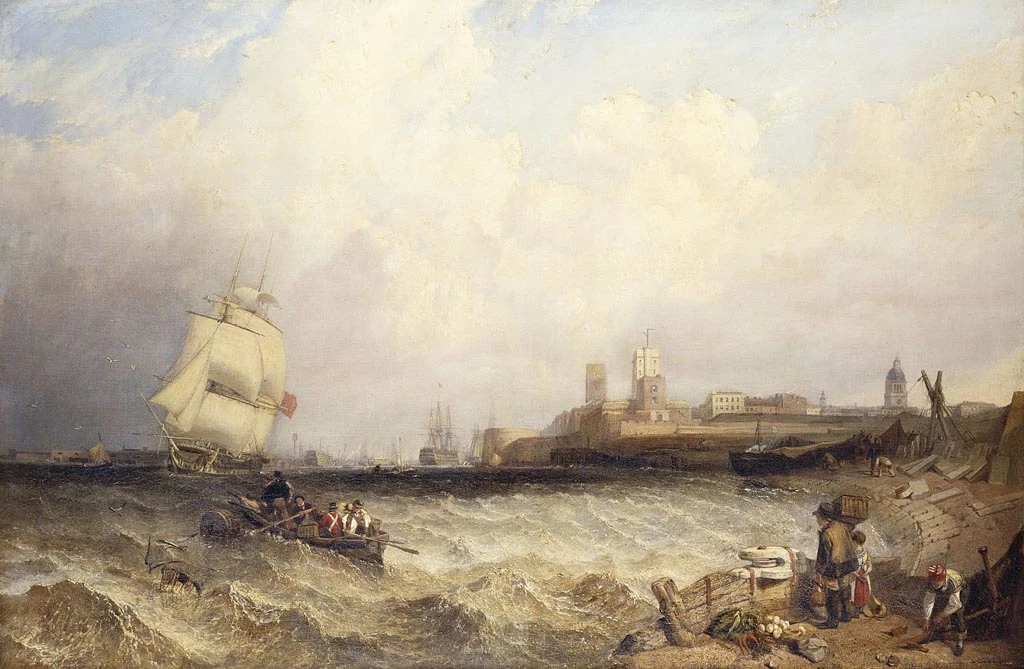
"Portsmouth Harbour ", Clarkson Frederick Stanfield (1793–1867), Oil On Canvas, c. 1831
(The Round Tower Is Visible In The Centre)
This page uses content under the Creative Commons Attribution-ShareAlike 4.0 International License, along with original copyrighted content and excerpts from Wikipedia and other sources.
Text from this original Round Tower Portsmouth article on Wikipedia.
Image from Clarkson Frederick Stanfield, Public domain, via Wikimedia Commons.
_-_Portsmouth_Harbour_-_RCIN_404789_-_Royal_Collection.jpg)
Back to the top of this Scottish Country Dancing Instructions 'The Round Tower' page