Sturt's Desert Pea
Scottish Country Dance Instruction
STURT'S DESERT PEA (J8x32) 3C (4C set) Neville Pope Sturt's Desert Pea1- 8 1s dance in and down nearer hands joined, cast up round 2s; 1s dance in and down nearer hands joined below 3s, cast up to 2nd place (2s step up 7-8). 213
9-16 1s turn RH while 2s+3s advance and retire; 2s+1s+3s dance DoSiDo
17-24 3s followed by 1s+2s lead down the middle, 2s lead up. On bar 23, all curve out to place, Men pulling back LSh, Ladies RSh. 213
25-32 2s+1s+3s advance and retire; 1s turn ½ way 2H on bars 26-27. Repeat to finish on own sides. 213
(MINICRIB. Dance crib compiled by Charles Upton, Deeside Caledonian Society, and his successors)
Sturt's Desert Pea 8x32 Jig, Neville Pope
1- 8 1st couple dance in and down (nearer hands) and cast up around 2nd couple. 1st couple dance in and down (nearer hands) below 3rd couple, casting up to 2nd place. 2nd couple step up on bars 7-8.
9-16 1st couple turn with RH while 2nd and 3rd couples advance for 2 and retire for 2. 2nd, 1st and 3rd couples dance back to back.
17-24 2nd, 1st and 3rd couples lead down the middle, turning on 4 to lead up, 3rd couple leading down, 2nd couple leading up.
All curve out to place on bar 24, men pulling back left shoulder and ladies right shoulder.
25-32 2nd, 1st and 3rd couples advance for two and retire for two, 1st couple turning half-way with both hands on bars 26-27. Repeat, finishing on own sides.
Repeat from new position
(Dance crib compiled by the deviser, Neville Pope, March 2007, revised April 2008)
Keith Rose's Crib Diagram

Dance Information
Sturt's Desert Pea (Swainsonia formosa) is the state flower of South Australia.Most of the dance represents the multiple leaflets on a single stem. Bars 9-12 and the last 8 bars represent the bright red flower, long and narrow, tapered at the ends with a black circular section in the middle.
Recommended music: Any good jig, but not too fast.
Recommended Recording: CD 2 track 11 (Selection of Jigs) from Celtic Fire in the Music by Bobby Brown: My Lovely Miss Muffet - The Craigellachie Lasses - Traditional Jig - Move Up to Me.
(Dance information copyright, reproduced here with the kind permission of the deviser, Neville Pope, 2010)
Swainsona formosa, commonly referred to as Sturt's Desert Pea, is a flowering plant native to mainland Australia, excluding Victoria.
It thrives in arid regions, particularly in Western Australia, South Australia, the southern parts of the Northern Territory, western New South Wales, and Queensland. The plant typically grows in red sandy or loamy soils, often found in mulga woodlands, near creek lines, and on stony hills.
This species is a prostrate or low-growing herbaceous plant, either annual or short-lived perennial, with stems that can extend up to two metres. Its leaves are composed of about 15 elliptic to egg-shaped leaflets, and the plant is covered with soft, downy hairs. The flowers are typically deep red with a distinctive black, bulbous centre known as the 'boss'. Each flower measures approximately 9 centimetres in length and is arranged in clusters of two to six. While the classic coloration is red with a black boss, natural variations include red with pink bosses and pure white forms.
The plant's flowering period varies depending on rainfall but generally occurs from July to March. Its seeds possess a hard coat, allowing them to remain dormant for extended periods until conditions are favourable for germination. To cultivate the plant, growers often scarify the seeds or soak them in hot water to encourage sprouting.
Swainsona formosa was first collected by English explorer William Dampier in 1699. The plant was formally described in 1832 by George Don as Donia formosa. Over time, it underwent several taxonomic reclassifications, with the current accepted name, Swainsona formosa, established by Joy Thompson in 1990.
In 1961, Sturt's Desert Pea was officially designated as the floral emblem of South Australia. The plant holds cultural significance and is featured in various forms of artwork and literature. Additionally, it has appeared on Australian postage stamps issued in 1968, 1971 and 2005 (note: this dance was devised just two years later, in 2007).
While not considered at risk in the wild, Swainsona formosa is protected in South Australia, where collecting the plant or its flowers from Crown Land without a permit is illegal. Seeds of the species are stored in Kew's Millennium Seed Bank as a conservation measure.
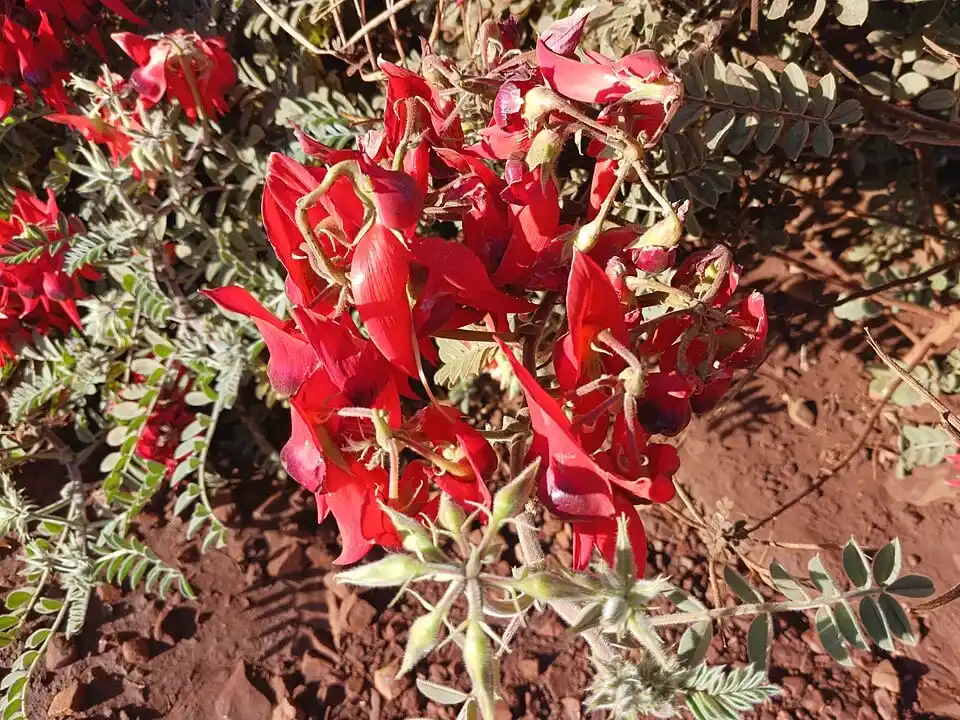
Sturt's Desert Pea, Pilbara Region, Western Australia
Published in Sturt Desert Pea Book 2024, copyright, reproduced here with the kind permission of the deviser, Neville Pope, 2024.
This page uses content under the Creative Commons Attribution-ShareAlike 4.0 International License, along with original copyrighted content and excerpts from Wikipedia and other sources.
Text from this original Swainsonia Formosa article on Wikipedia.
Image copyright Calistemon, CC BY-SA 4.0, via Wikimedia Commons.
_in_the_Pilbara_region_of_Western_Australia,_June_2023_03.jpg)
Back to the top of this Scottish Country Dancing Instructions 'Sturt's Desert Pea' page