The Trillium
Scottish Country Dance Instruction
The Trillium (M3x64) bar medley strathspey and reel for 3 couples in a circle, Duncan Keppie and Elizabeth McMahon1-8 CIRCLE AND BACK
9-16 REEL of 4 in strathspey tempo (substitute REEL OF 3 in reel tempo) around the circle and back, starting by passing partner by the right shoulder, end reel by giving partner right hand to turn ¾ ending with men in middle facing partner on the periphery,
17-28 TRILLIUM: MEN DANCE THE TRILLIUM pattern starting by dancing around partner by the right and back to centre. then give right hands in passing to repeat around next woman (anticlockwise around the set), and repeat around next woman,
29-32 ½ TURN PARTNER and SET: change places with partner by the right hand and set,
33- 44 WOMEN DANCE THE TRILLIUM pattern starting by dancing around partner by the right and back to centre, then give right hands in passing to repeat around next man (anticlockwise around the set), and repeat around next man,
44-48 ¾ TURN PARTNER and SET: turn partner ¾ by the right hand into periphery and set to partner.
REPEAT TWICE with new partner, men have new partner on their right hand
REPEAT THRICE IN REEL TEMPO
(Dance crib compiled by the devisers, Duncan Keppie and Elizabeth McMahon, 2025)
Dance Information
This dance was devised to celebrate the 75th Anniversary of the Peterborough Scottish Country Dancers in 2025. The white trillium serves as the emblem and official flower of the Canadian province of Ontario.Trillium is a genus of woodland flowering plants in the family Melanthiaceae. These perennial herbs grow from underground rhizomes and are native to temperate regions of North America and eastern Asia, although the greatest concentration of species occurs in eastern North America, particularly the southern Appalachian Mountains. Around 40 to 50 species are generally recognised, depending on the classification used.
The plants are easily recognised by their distinctive arrangement of parts in groups of three. A single stem rises from the rhizome and carries a whorl of three leaf-like bracts, above which sits a solitary flower. The flower typically has three sepals, three petals, six stamens and three stigmas. Petal colours vary between species and may be white, pink, red, purple, yellow or green. In some species the flower is held on a stalk, while in others it sits directly above the bracts.
Most trilliums are plants of deciduous woodland, where they grow in rich, moist soils and partial shade. They emerge in spring, flower before the forest canopy becomes fully developed, and then continue storing energy in their rhizomes for future growth. The seeds carry fleshy structures called elaiosomes, which attract ants. The ants transport the seeds, helping to spread the plants to new locations.
Several species are well known. White trillium (Trillium grandiflorum) produces large white flowers that often become pink with age and is the floral emblem of the Canadian province of Ontario as well as the official wildflower of the US state of Ohio. Pacific trillium (Trillium ovatum) is the most widespread species in western North America. Other species display red, purple or mottled flowers and foliage, creating considerable diversity within the genus.
Although trilliums have a long history of use in traditional herbal medicine, particularly in North America, some species contain biologically active compounds and should not be used without appropriate expertise. Historically, certain species were associated with treatments related to childbirth and bleeding, which gave rise to common names such as birthroot and birthwort.
Many trillium species are sensitive to habitat disturbance because they grow slowly and may take several years to reach flowering size. Habitat loss, over-collection and changes to woodland environments have placed some species at risk. As a result, a number of trilliums are protected in parts of their natural range, and conservation efforts focus on preserving the mature woodland habitats on which they depend.
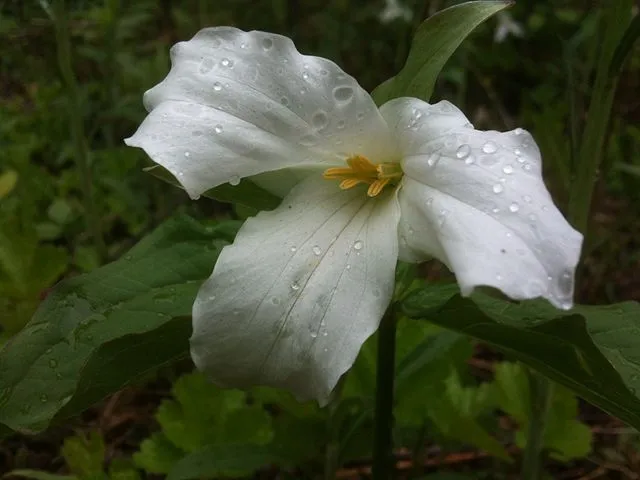
White Trillium
Published in The Trillium, reproduced here with the kind permission of the devisers, Duncan Keppie and Elizabeth McMahon, 2026.
This page uses content under the Creative Commons Attribution-ShareAlike 4.0 International License, along with original copyrighted content and excerpts from Wikipedia and other sources.
Text from this original Trillium article on Wikipedia.
Image copyright JackFrost2121, CC BY-SA 3.0, via Wikimedia Commons.

Back to the top of this Scottish Country Dancing Instructions 'The Trillium' page