Wallace's Revolution
Scottish Country Dance Instruction
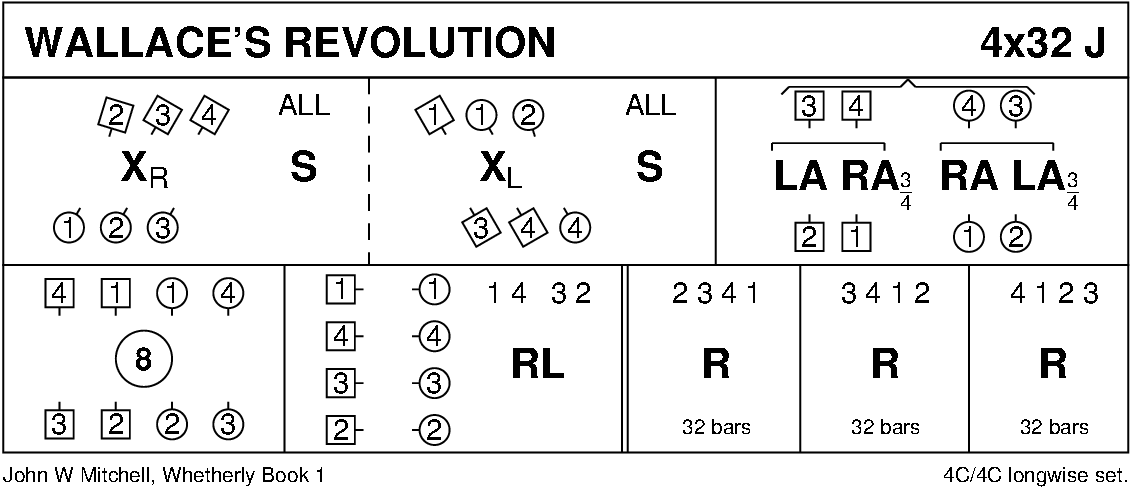
Wallace's Revolution A thirty-two bar Jig for four couples in a longwise set, devised by John W Mitchell, Published in Whetherly Book 1.1- 2 First man and second lady cross, giving right hand in passing; second man and third lady do the same, as do third man and fourth lady.
3- 4 All join hands on the side and set.
5- 6 First lady and third lady cross, giving left hand in passing; first man and fourth lady do the same, as do second man and fourth man.
7- 8 All join hands on the side and set.
9-16 The four men, now at the foot of the set, dance right hands across in a wheel for four bars, turning on the fifth bar, and dancing back with the left hand for three bars. Meanwhile, the four ladies, at the top, dance left hands across in a wheel for four bars, turning on the fifth bar, and dancing right hands across for three bars. Positions are now, from the top on the ladies' side: fourth lady, first lady, first man and fourth man; and on the men's side: third lady, second lady, second man and third man.
17-24 Eight hands round to the left in a circle and back to the right. The circle ends with the men retaining right hands to finish in a line across the room, facing up, and the ladies in a line across, facing down: first and second couples release own partner's hand to open out into these lines.
25-32 First and fourth couples dance rights and lefts; second and third couples do the same.
The dance finishes in the lines across in the order 2, 3, 4, 1. It is repeated from new positions with original second couple leading.
At the end of the first repeat all four couples are on the opposite sides, with original third couple at the foot, ready to lead the second repeat.
At the end of the second repeat, the men are facing down the room and the ladies up, with original fourth couple ready to lead.
Thus the whole set revolves through ninety degrees on each repeat, to finish with all dancers in their original places.
(Dance crib reproduced from The Whetherly Book of Scottish Country Dances, revised and republished by Alison Mitchell)
Dance Notes
This dance has an unusual progression in which the entire set rotates through 90 degrees with each repetition.After four repetitions, all four couples return to their original positions and the set resumes its original orientation.
Keith Rose's Crib Diagram
Dance Instruction Videos
Wallace's Revolution - Scottish Country Dancing Instruction VideoDance Information
Wallace's Revolution was devised by John Wallace Mitchell (1931–2012) and published in 1967 in the first volume of The Whetherly Book of Scottish Country Dances.The original collection was published by Wallace Mitchell And Co. of Hove, Sussex, in 1967. A revised edition was issued by Alison Mitchell in 2020, with dance diagrams prepared by Keith Rose.
In the introduction to the 2020 republication of The Whetherly Book, Alison Mitchell suggested that the title referred to William Wallace, the Scottish military leader who fought against English rule during the First War of Scottish Independence.
She also recorded that Wallace was the maiden surname of John Mitchell's mother and that it formed part of his own name.
William Wallace (c. 1270–1305) was a Scottish knight and military commander who fought against the forces of King Edward I of England during the First War of Scottish Independence. His birthplace is uncertain, although Elderslie in Renfrewshire is traditionally identified as his home.
In May 1297, Wallace led an attack at Lanark in which the English sheriff, William de Heselrig, was killed. On 11 September 1297, Wallace and Andrew Moray commanded Scottish forces that defeated an English army at the Battle of Stirling Bridge. Wallace subsequently became Guardian of Scotland, governing in the name of the deposed King John Balliol.
On 22 July 1298, Wallace's army was defeated by Edward I at the Battle of Falkirk. Wallace resigned his position as Guardian but continued his opposition to English rule. He travelled to France in 1299 to seek assistance and later returned to Scotland.
Wallace was captured near Glasgow in August 1305 and taken to London, where he was convicted of treason. He was executed at Smithfield on 23 August 1305. His head was displayed on London Bridge, and his body was quartered.
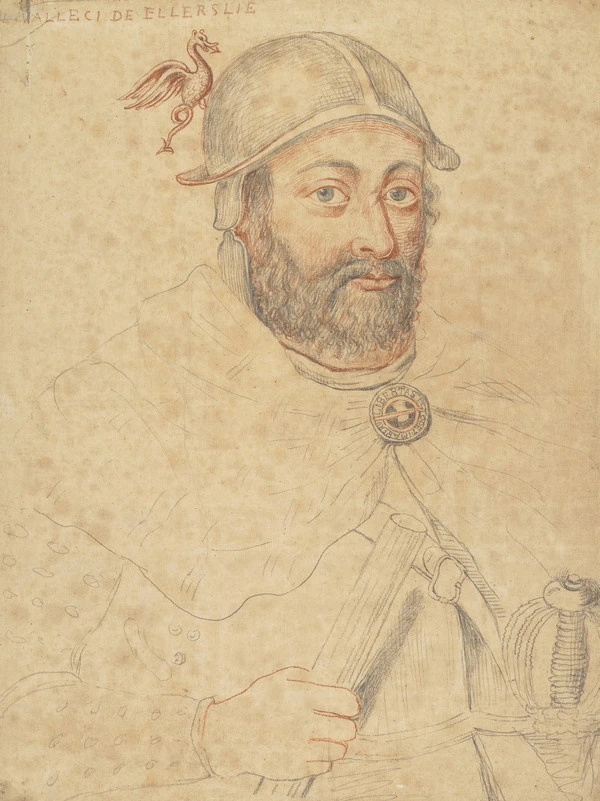
First Known Depiction Of Sir William Wallace By The 11th Earl Of Buchan
Published in The Whetherly Book Of Scottish Country Dances Number 1, by John W Mitchell, revised and republished by Alison Mitchell. Instructions reproduced under the Creative Commons Attribution-NoDerivatives 4.0 International Licence (CC BY-ND 4.0).
This page uses content under the Creative Commons Attribution-ShareAlike 4.0 International License, along with original copyrighted content and excerpts from Wikipedia and other sources. See our Copyright and Reuse Policy for details.
Text from this original William Wallace article on Wikipedia.
Image from 11th Earl of Buchan, David Stuart Erskine,, Public domain, via Wikimedia Commons.

Back to the top of this Scottish Country Dancing Instructions 'Wallace's Revolution' page