Water Beetle
Scottish Country Dance Instruction
WATER BEETLE (J8x32) 3C (4C set) Yukio Kajino1- 8 2s dance reels of 3 across (to start 2s pull RSh back, cast 2M up/2L down), while 1s and 3s pass partner LSh. End 1M in middle at top facing down, 3L in the middle at bottom facing up, 2M in 1M's place, 2L in 3L's place)
9-16 1s+2L and 3s+2M dance reels of 3 on sides (To start 1M passes 2L (1st corner) RSh and 3L passes 2M (1st corner) RSh) At the end 1M and 3L curve into 2nd place on opposite sides
17-20 2s (1st corners) pass RSh, dance round to 2nd place own sides while 1s+3s nearer hands joined set and chase clockwise to own sides. 321
21-24 All turn RH to finish 2H joined in middle of set ready for...
25-32 3s+2s+1s dance Poussette:
3rd, 5th and 7th time through new 3rd couple cross up into reels of 3, couple in 3rd place dance down to 4th place
(MINICRIB. Dance crib compiled by Charles Upton, Deeside Caledonian Society, and his successors)
Dance Information
A water beetle is a general term for any beetle species that has adapted to life in water during some stage of its life cycle.While most water beetles inhabit freshwater environments, a few marine species can be found in the intertidal or littoral zones. Globally, there are around 2,000 species of true water beetles.
Many water beetles carry an air bubble, known as the elytra cavity, beneath their abdomen. This air bubble serves as a respiratory supply and prevents water from entering their spiracles. Some species have evolved a different adaptation - a modified exoskeleton that forms a plastron, or "physical gill", enabling direct gas exchange with the surrounding water.
Certain families of water beetles possess fringed hind legs that aid in swimming, though this adaptation is not universal. In most cases, water beetle larvae are aquatic, although some species transition to a terrestrial lifestyle as adults.
Water beetles exhibit diverse feeding behaviours and can be herbivores, predators, or scavengers. Herbivorous water beetles consume aquatic vegetation, such as algae or leaves, and may also extract sap from nearby plant stems. Scavenger beetles feed on decomposing organic material, which may include aquatic plants, faeces, or the remains of small deceased organisms.
Predatory species, such as the great diving beetle, hunt and feed on various prey, including worms, tadpoles, and occasionally small fish.
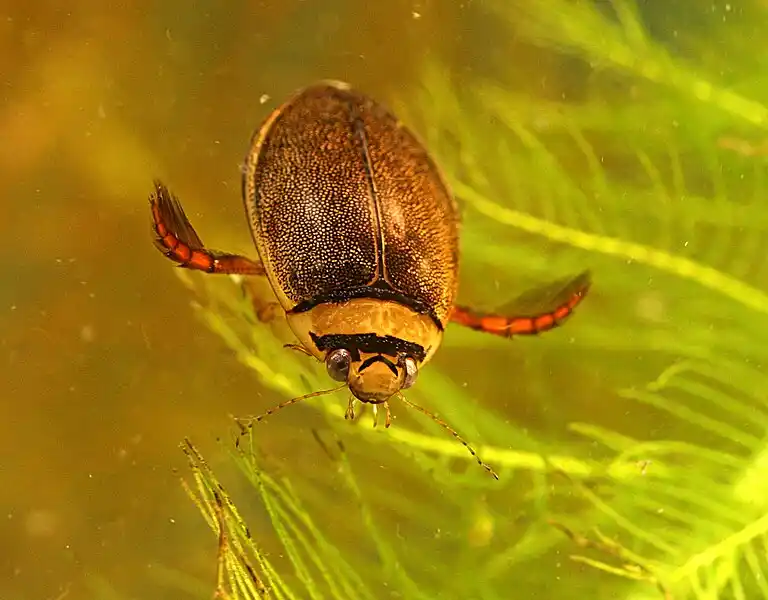
Water Beetle (Graphoderus Bilineatus)
This page uses content under the Creative Commons Attribution-ShareAlike 4.0 International License, along with original copyrighted content and excerpts from Wikipedia and other sources. See our Copyright and Reuse Policy for details.
Text from this original Water Beetle article on Wikipedia.
Image copyright Yerpo, CC BY-SA 4.0, via Wikimedia Commons.

Back to the top of this Scottish Country Dancing Instructions 'Water Beetle' page