A Waverley Fugue
Scottish Country Dance Instruction
A Waverley Fugue32 bar Jig for 3 Couples in a 4 Couple Set, devised by Tim Bolton-Maggs (2023), Published in Reels and Rainbows.
If you are the deviser of this dance, or the current copyright holder, and would like your crib included here, you can Submit A Crib directly, or Contact Us.
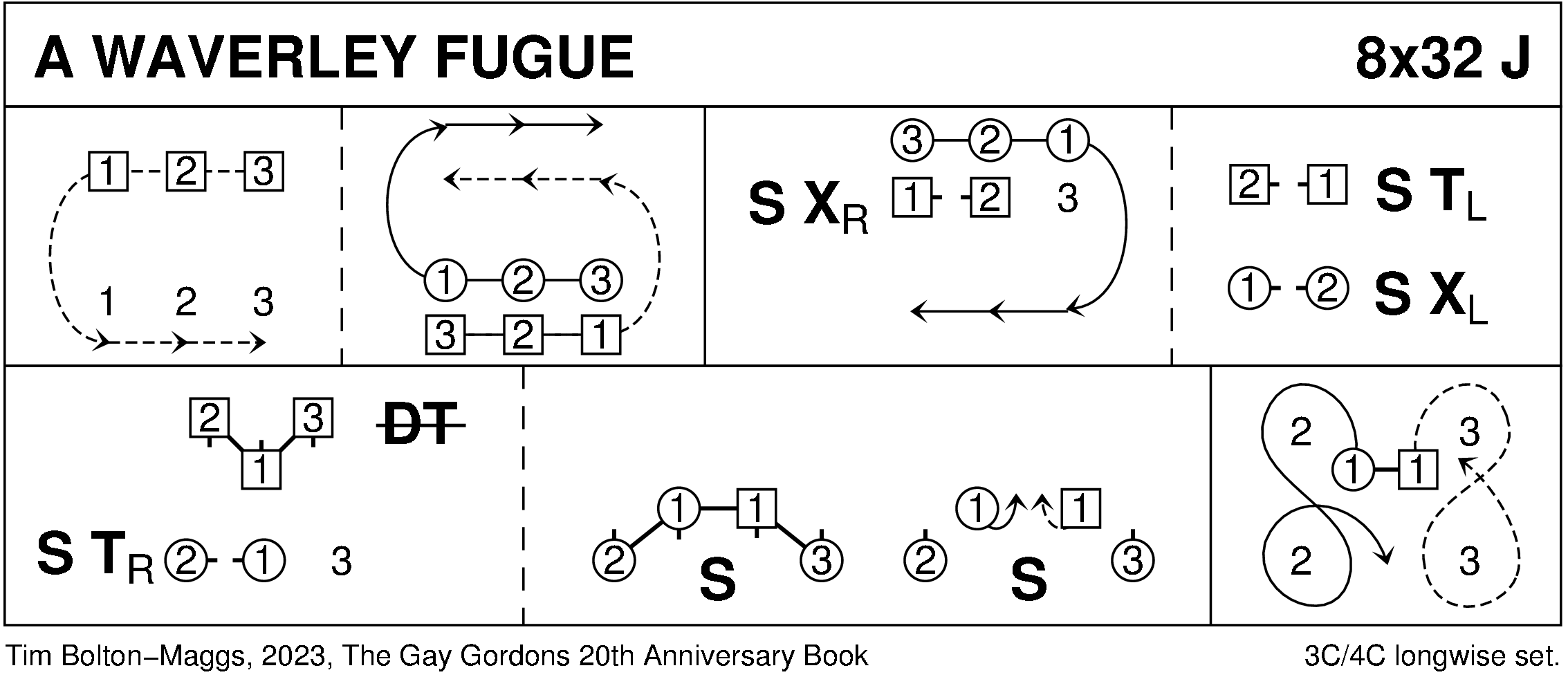
Keith Rose's Crib Diagram
Dance Instruction Videos
A Waverley Fugue - Scottish Country Dancing Instruction VideoA fugue (pronounced "fyoog") is recognised both as a musical structure and, in earlier centuries, as a form of dance. In music it is defined by counterpoint, where a theme known as the subject is introduced by one voice and then imitated by others at different pitches, producing a layered and intricate texture. The typical outline includes an exposition, in which the subject is first heard, a middle section that explores variations and modulations, and a conclusion that returns to the tonic key. This form became central to Baroque composition, with Johann Sebastian Bach creating some of the most enduring examples, though later composers such as Beethoven and Brahms also employed fugues in their works.
The word fugue comes from the Latin 'fuga', meaning flight, a reference to the way musical lines seem to pursue one another. Its development can be traced back to earlier imitative styles such as the ricercare of the sixteenth century, which gradually evolved into the fugue by the seventeenth century. Unlike a canon, which requires exact imitation, the fugue allows greater flexibility, with the subject reappearing in different keys and often accompanied by a countersubject designed to complement the main theme. This makes the fugue one of the most demanding forms of composition, valued for its precision and complexity.
The term was also applied to certain dances of the seventeenth and eighteenth centuries. These choreographies reflected the imitative qualities of the musical fugue, with dancers entering in sequence and repeating or varying movements introduced by others, creating a visual counterpart to the musical form. Although less common today, this dual usage shows how the fugue was understood not only as a compositional technique but also as a broader artistic idea of imitation and pursuit across different disciplines.
This page uses content under the Creative Commons Attribution-ShareAlike 4.0 International License, along with original copyrighted content and excerpts from Wikipedia and other sources.
Text from this original Fugue article on Wikipedia.
Back to the top of this Scottish Country Dancing Instructions 'A Waverley Fugue' page