Wee Barra
Scottish Country Dance Instruction
WEE BARRA (R4x48) Sq.Set M Barlow/Ponteland Class Another Newcastle Collection1- 8 Men pass partner RSh, then dance on to next Lady and pass LSh and dance on to next Lady and dance round her RSh
9-16 All dance grand chain.
17-20 1s+3s dance ½ Ladies' chain
21-24 2s+4s dance ½ Ladies' chain (All now back with original partner)
25-28 1s+3s dance ½ R&L
29-32 2s+4s dance ½ R&L (All now back to original place)
33-40 Men dance RH across and LH back while Ladies set, face clockwise and dance on one place (2 steps), set turning on the spot for 4 bars (Men now in original place with new partner)
41-44 All dance 8H round to the left for 6 steps, on bar 44 cross right foot over left, pivot left and chase back to places
45-48 All dance anti-clockwise to the new place for the Ladies and original place for the Men
(MINICRIB. Dance crib compiled by Charles Upton, Deeside Caledonian Society, and his successors)
Keith Rose's Crib Diagram

Dance Instruction Videos
Wee Barra - Scottish Country Dancing Instruction VideoDance Information
"Wee Barra" is an affectionate Scottish expression meaning "small Barra", often used to refer fondly to the island Barra, known in Scottish Gaelic as Barraigh, an island in the Outer Hebrides of Scotland.It lies near the southern end of the island chain and is connected by a causeway to the neighbouring island of Vatersay. The main settlement is Castlebay, a village centred around a natural harbour on the island's south-east coast.
The island covers about 60 square kilometres and is formed largely from ancient Lewisian gneiss, among the oldest rocks found in Britain. The landscape varies considerably between coasts. The eastern side is rocky and indented with small bays, while the west is known for wide sandy beaches and machair, a fertile grassland created from shell sand. The highest hill is Heaval, which rises to about 383 metres above sea level.
People have lived on Barra since prehistoric times. Archaeological discoveries on the island include standing stones, chambered cairns, Iron Age brochs and ancient burial sites. Finds made during road construction and coastal erosion have shown evidence of settlement dating back several thousand years.
For many centuries Barra was closely associated with Clan MacNeil. Their stronghold, Kisimul Castle, stands on a rocky islet in Castlebay and remains one of the island's best-known landmarks. The castle dates from the medieval period and historically controlled access to the harbour.
Scottish Gaelic continues to play an important role in island life. Both Gaelic and English are widely spoken, and Barra has long been recognised as one of the stronger remaining Gaelic-speaking communities in Scotland. The island's culture includes traditional music, storytelling and local festivals connected with Hebridean heritage.
Barra's economy traditionally depended on fishing, crofting and livestock farming. Tourism is now also important, with visitors attracted by the scenery, wildlife and beaches. The island is additionally known for Barra Airport, whose scheduled flights use a beach at Traigh Mhòr as a runway at low tide. It is widely described as the only airport in the world where regular passenger services land on a tidal beach.
The population of Barra was recorded as 1,209 in the 2022 census. Ferry services connect the island with other parts of the Hebrides and mainland Scotland, including Oban and South Uist. Despite its remote location, Barra remains an active community with schools, churches, shops and transport links serving residents throughout the year.
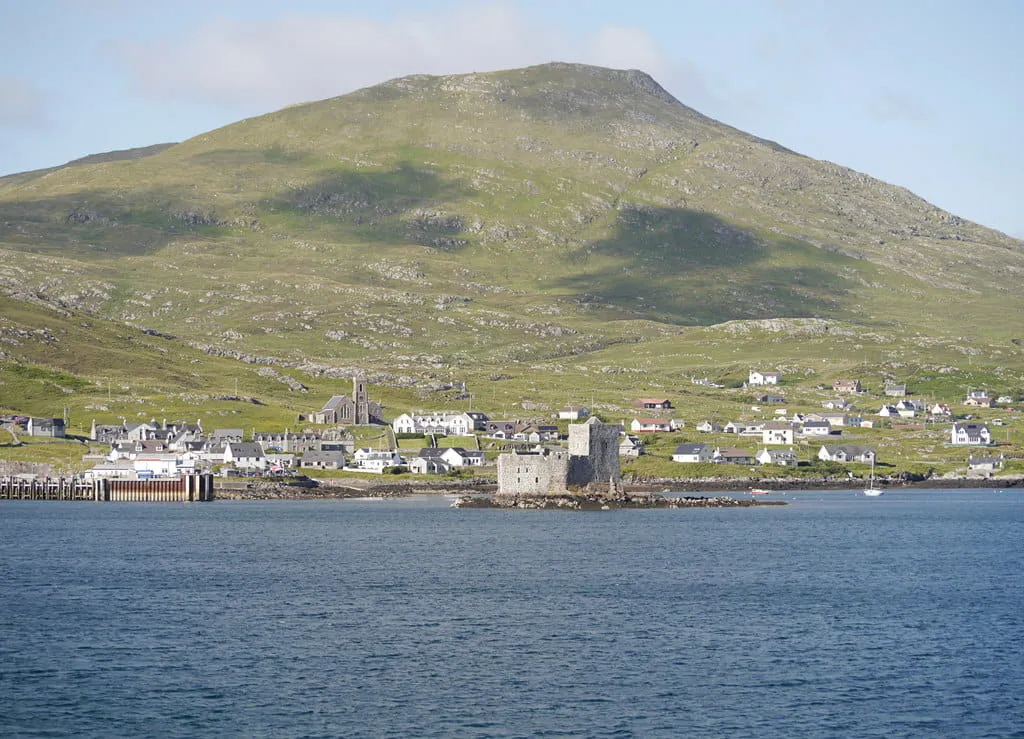
Castlebay, Barra. The Main Pier Is To The Left, Caisteal Chiosamuil Centre, And Heabhal Rising Up Behind The Village.
This page uses content under the Creative Commons Attribution-ShareAlike 4.0 International License, along with original copyrighted content and excerpts from Wikipedia and other sources.
Text from this original Barra article on Wikipedia.
Image copyright Craig Wallace under this Creative Commons Licence 2.0.
Back to the top of this Scottish Country Dancing Instructions 'Wee Barra' page