The White Rose Of Scotland
Scottish Country Dance Instruction
THE WHITE ROSE OF SCOTLAND (S8x32) 3C (4C set) Elma Taylor Thistle Book1- 8 1s set, cast 1 place (2s step up), cross RH cast 1 place Lady up and Man down turning in to face 1st corners
9-16 1s dance ½ diagonal reel of 4 with 1st corners and ½ reel of 4 with 2nd corners to end facing 3rd corner (position)
17-24 1s dance ½ diagonal reel of 4 with 3rd corners and ½ reel of 4 with 4th corners. 1s end in centre Lady facing up and Man down
25-32 2s+1L circle 3H round to left as 1M+3s circle 3H round to left, 1s swop places and circle to the right
(MINICRIB. Dance crib compiled by Charles Upton, Deeside Caledonian Society, and his successors)
Keith Rose's Crib Diagram

Dance Information
The White Rose of Scotland, often associated with the Jacobite cause, carries a nuanced historical significance deeply rooted in the country's tumultuous past. During the Jacobite uprisings in the 17th and 18th centuries, this emblematic white flower became a symbol of loyalty to the exiled Stuart monarchy.The Jacobites, followers of the exiled James II and his descendants, sought to restore the Stuart dynasty to the thrones of Scotland and England. The White Rose of Scotland emerged as a clandestine emblem, signaling support for the Jacobite cause in a covert manner. Displaying or wearing a white rose became a subtle yet powerful expression of allegiance to the Stuarts.
The symbolism of the White Rose in the Jacobite context is perhaps most famously associated with the 1745 uprising led by Charles Edward Stuart, also known as Bonnie Prince Charlie. As he marched through Scotland, the White Rose adorned the attire of many who rallied to his banner.
Though the Jacobite cause ultimately faced defeat at the Battle of Culloden in 1746, the White Rose of Scotland endures as a poignant reminder of a complex and passionate chapter in Scottish history. Today, the white rose continues to evoke the spirit of those who ardently supported the Stuart monarchy during a time of political upheaval and change.
This famous white flower, specifically the wild white rose known as Rosa Spinosissima (Scotch rose), became associated with Scotland over the centuries. Often found in the country's landscape, the White Rose of Scotland is featured prominently in folklore, poetry, and historical references.
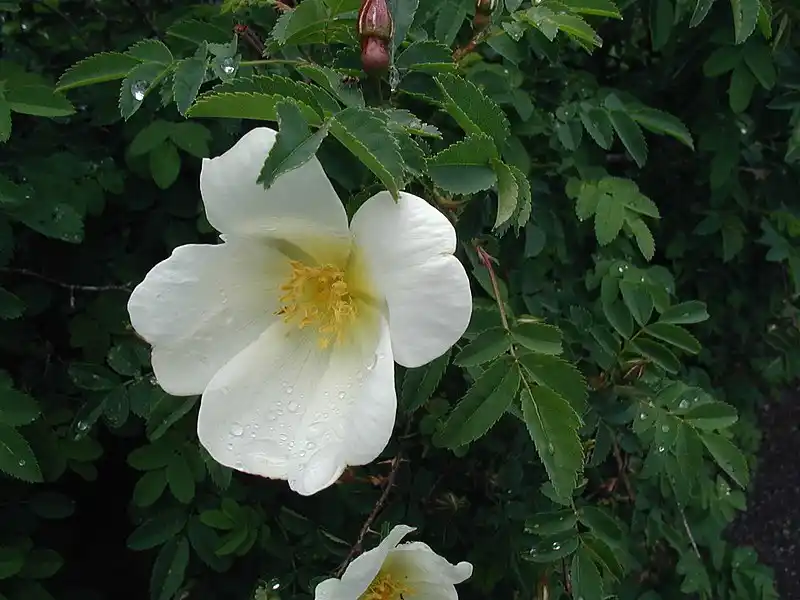
Rosa Spinosissima, The White Rose Of Scotland
Image copyright Sten, CC BY-SA 3.0, via Wikimedia Commons.

Back to the top of this Scottish Country Dancing Instructions 'The White Rose Of Scotland' page