The Wuppertal Schwebebahn
Scottish Country Dance Instruction
The Wuppertal Schwebebahn (The Wuppertal Monorail) (J4x32) 32 bar jig for four couples in a longwise set, Devised By Murrough Landon, 2025.1- 2 1st couple turn three quarters giving right hands and end facing down in tandem, 1st man leading, as 2nd, 3rd and 4th couples step in slightly and raise both arms to form arches. The arches may remain open at the top so that 1st couple do not need to stoop.
3- 6 1st man, followed by 1st woman, dances down under the three sets of arches, then casts up round 4th man (almost through 4th place) to 3rd place behind the men's side. 2nd, 3rd and 4th couples step up and out to the sides on bars 5-6 ending in 1st, 2nd and 3rd places. The women lower their arms, but the men now make arches on the sides.
7-12 1st man, followed by 1st woman, dances in and up under the arch made by 3rd and 4th men, then out and up through the arch made by 2nd and 3rd men. 1st couple then cast round 2nd man and dance down to end facing the women's side. 1st man faces the gap between 3rd and 4th women, 1st woman faces the gap between 2nd and 3rd women. For 1st couple the phrasing of bars 1-12 is roughly: turn for 2, down for 2, cast for 2, in for 2, out for 2, down for 2.
13-16 1st couple, with 2nd, 3rd and 4th women, set as in double double triangles. 1st couple then set pulling right shoulder back to face the men's side as 2nd, 3rd and 4th women set.
17-24 1st woman and 1st man dance reels of three across with 2nd and 3rd couples. They start by passing 2nd and 3rd men right shoulder and end facing the gaps on the men's side.
25-28 1st couple, with 2nd, 3rd and 4th men, set as in double double triangles. 1st couple then set pulling right shoulder back to face the women's side as 2nd, 3rd and 4th men set.
29-32 1st couple each dance out separately under arches made by 2nd, 3rd and 4th women. Then 1st man casts off round 4th woman and crosses over while 1st woman dances in and down under the arch made by 3rd and 4th women. 1st couple end in 4th place on their own sides. The final order is 2,3,4,1.
(Dance crib compiled by the deviser, Murrough Landon, CC BY-SA May 2025)
Keith Rose's Crib Diagram

Dance Instruction Videos
The Wuppertal Schwebebahn - Scottish Country Dancing Instruction VideoDance Information
This is for the Wuppertal Thistle and Shamrock Dancing Club who kindly invited me to teach their class when I visited Wuppertal.The choreography was inspired by a trip on the unique Wuppertal Schwebebahn (pronounced roughly as VOOP-per-tarl SHVAY-ber-BARN). This is a 13 km long monorail system that mostly runs above the river Wupper.
The little two-coach trains are suspended from A-frame supports, here represented by 1st couple dancing under a series of arches - though the line does not wind nearly as much as is illustrated in bars 7-10.
The service is operated by Wuppertaler Stadtwerke, abbreviated as WSW, hence the W shapes of the double double triangles either side of the S shapes of the reels of three across.
Recommended music: Suggested tune: The Bingley Five Rise Locks (Ian Findlay); suitable recording The Goat Fell Gallop (Atlantic Firth: Ready And...).
(Dance information by the deviser, Murrough Landon, CC BY-SA May 2025)
The Wuppertal Schwebebahn is a suspended monorail located in Wuppertal, Germany. It is the world's oldest electric elevated railway with hanging cars, having entered public service in 1901.
The system is around 13.3 kilometres long and runs mostly above the River Wupper, supported by a steel framework. For much of its route, the track is positioned approximately 12 metres above the river, with a shorter section above city streets.
The railway includes 20 stations along its route, and the full journey takes around 30 minutes from end to end. Trains typically consist of articulated carriages that are about 24 metres in length. Each carriage is designed to carry both seated and standing passengers, with the total capacity per unit exceeding 170. The maximum speed is 60 kilometres per hour, though average operating speeds are lower due to regular stops.
Originally built to overcome the challenges of narrow, steep terrain in the Wupper valley, the Schwebebahn was chosen as a solution where conventional railways were impractical. It was developed using a patented suspension design that allowed trains to run beneath a single rail. The track is entirely separated from other traffic, ensuring smooth operation without interference from road or pedestrian systems.
Throughout its long history, the Schwebebahn has seen various upgrades and periods of maintenance. It has continued to operate in modern times with updated signalling and newly designed carriages introduced in the 21st century. Despite a few incidents during its operation, including a derailment in 1999, the system has maintained a strong safety record overall.
A historic carriage known as the Kaiserwagen, originally used by the German Emperor during the railway's early years, has been preserved and is still in use for special rides. The Schwebebahn remains a fully functioning part of the city's public transport network and continues to carry tens of thousands of passengers each day.
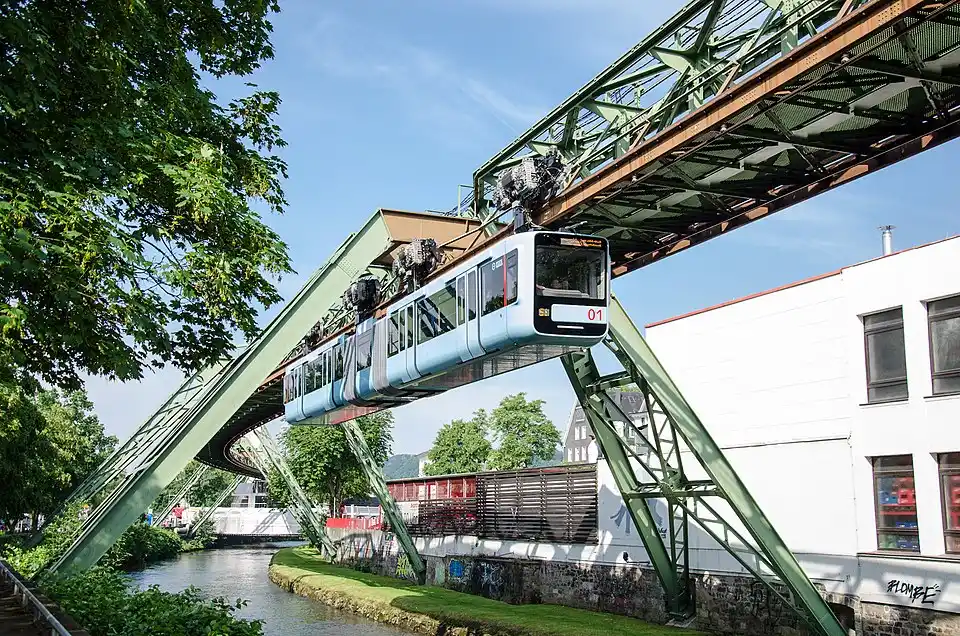
Wuppertal Schwebebahn On The Open Line Between The "Adlerbrücke" And "Alter Markt" Stations
Published in The Wuppertal Schwebebahn, reproduced here with the kind permission of the deviser, Murrough Landon. Licensed under CC BY-SA.
This page uses content under the Creative Commons Attribution-ShareAlike 4.0 International License, along with original copyrighted content and excerpts from Wikipedia and other sources. See our Copyright and Reuse Policy for details.
Text from this original Wuppertal Schwebebahn article on Wikipedia.
Image copyright Max Grobecker, CC BY-SA 2.0, via Wikimedia Commons.

Back to the top of this Scottish Country Dancing Instructions 'The Wuppertal Schwebebahn' page