The Fairy Dance
Scottish Country Dance Instruction
THE FAIRY DANCE (R8x32) 3C (4C set) RSCDS Book 31- 8 1L+2L+3L circle 3H round to left on own sides, 1M+2M+3M circle 3H round to left
9-16 1s lead down the middle and back ending facing 1st corners
17-24 1s set and turn 1st corners, set and turn 2nd corners ending in 2nd place opposite sides
25-32 1s set twice and turn RH 1½ times to places
(MINICRIB. Dance crib compiled by Charles Upton, Deeside Caledonian Society, and his successors)
Keith Rose's Crib Diagram

Dance Instruction Videos
The Fairy Dance - Scottish Country Dancing Instruction VideoDance Information
The Fairy Dance is traditionally performed to Nathaniel Gow's celebrated reel Largo's Fairy Dance. While Gow's original title referred specifically to Largo, the tune later became widely known simply as The Fairy Dance, and both names are now used interchangeably.Nathaniel Gow, born in 1763 as the fourth son of the fiddler Niel Gow, composed this reel for the Fife Hunt in 1802. It was subsequently published in 1809 in Niel Gow's Fifth Collection of Strathspeys, Reels, etc for the Pianoforte, Harp, Violin and Violincello. The tune also appeared in W. M. Cahusac's Annual Collection of 24 Country Dances in 1809, complete with instructions for dancing, described there as being performed at Court, Bath, and public assemblies. This confirms that the melody was already in formal dance use by the first decade of the nineteenth century.
The composition soon gained prominence and is regarded as one of Gow's best-known works, well established in the Scottish dance-music repertoire of the early nineteenth century.
Around the late 1820s, Caroline Eliza Scott (1777-1853) wrote The Fairy Dance - Poem. Her poem consists of five verses, the opening of which sets out the imagery she develops throughout, describing fairies moving lightly across the grass, their green garments sparkling beneath the moonlight.
The fairies are dancing - how nimbly they bound!
They flit o'er the grass-tops, they touch not the ground;
Their kirtles of green are with diamonds bedight,
All glittering and sparkling beneath the moonlight.
The tune and the poem are parallel treatments of a similar theme in music and verse, but there is no evidence of any direct link between them. Gow's 'Largo's Fairy Dance' is a celebrated reel from 1802, while Scott's 'The Fairy Dance' is a poem published decades later. They share imagery but not origin or purpose.
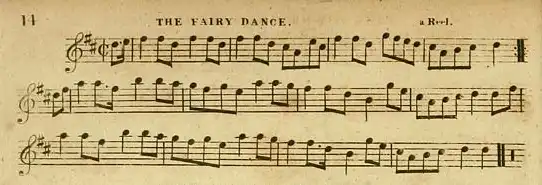
The Fairy Dance, From Glen Collection Of Printed Music, Composite Music Volume, Page 14, c. 1818-1825
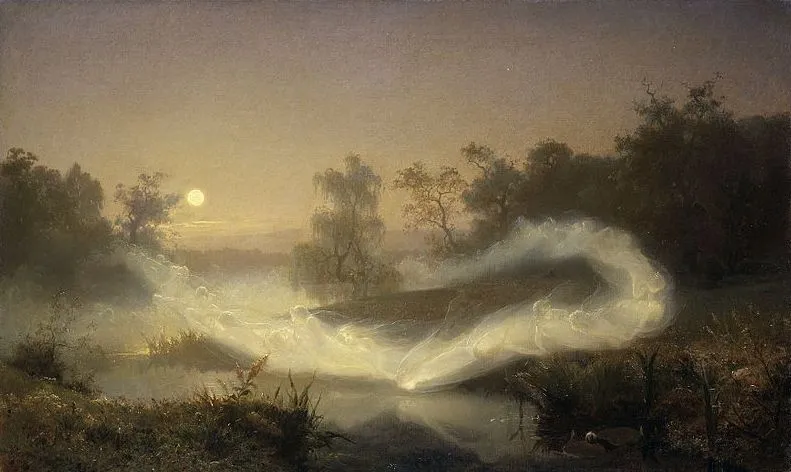
"Dancing Fairies" August Malmström (1829-1901), Oil On Canvas, c. 1866
Upper Image from (cropped) National Library Of Scotland, licensed under Creative Commons BY-SA 4.0.
Lower Image from August Malmström, public domain, via Wikimedia Commons.

Back to the top of this Scottish Country Dancing Instructions 'The Fairy Dance' page