The Fairy Dance
Scottish Poem By Caroline Eliza Scott
The Fairy Dance is a poem written by the Scottish author and poet Catherine Eliza Richardson, ne Caroline Eliza Scott (1777-1853), around the late 1820s.Catherine Eliza Richardson, born Catherine Eliza Scott on 24 November 1777 in Canonbie, Dumfriesshire, was a Scottish novelist and poet. She was the daughter of James Scott, a landowner and justice of the peace, and Phoebe Dixon.
In 1799 she travelled to India, where she married her cousin Gilbert Geddes Richardson, a mariner and East India Company captain. The couple had five children before Gilbert's death in 1805. Richardson returned to Scotland to raise her family, later spending time in London before settling permanently in Canonbie in 1821. She remained there until her death on 9 October 1853. She was acquainted with Thomas Carlyle, who described her as a gentlewoman once notable as a novelist.
Her earliest known work is the four-volume novel Adonia - A Desultory Story, published anonymously in 1801. She contributed poetry to the London Weekly Review between 1827 and 1829 and went on to publish three collections of verse. Her first, Poems, appeared in 1828 by subscription and was reprinted twice within a year. A second series followed in 1834, and in 1836 she published Grandmamma's Sampler; with some other Rhymes for Children.
Related Scottish Country Dances
The Fairy DanceThe Fairy Dance By Caroline Eliza Scott
The fairies are dancing - how nimbly they bound!
They flit o'er the grass-tops, they touch not the ground;
Their kirtles of green are with diamonds bedight,
All glittering and sparkling beneath the moonlight.
Hark, hark to their music! how silvery and clear -
'Tis surely the flower-bells that ringing I hear, -
The lazy-wing'd moth, with the grasshopper wakes,
And the field-mouse peeps out, and their revels partakes.
How featly they trip it! how happy are they
Who pass all their moments in frolic and play,
Who rove where they list, without sorrows or cares,
And laugh at the fetters mortality wears!
But where have they vanish'd? - a cloud's o'er the moon,
I'll hie to the spot, - they'll be seen again soon -
I hasten - 'tis lighter, - and what do I view?
The fairies were grasses, the diamonds were dew.
Yes, yes, they are fairies - the sight is most rare,
Their voices of sweetness are filling the air;
I'll listen - they're talking of love and delight,
And they whisper of pleasures that last through the night.
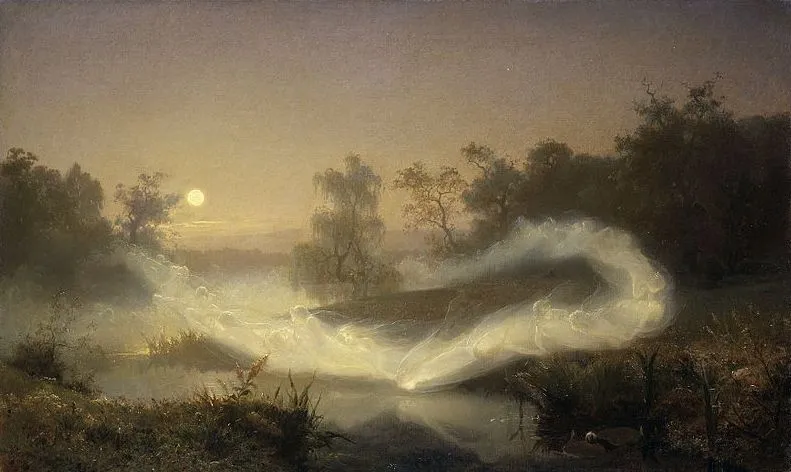
"Dancing Fairies" August Malmström (1829-1901), Oil On Canvas, c. 1866
The Online Scots Dictionary Translate Scots To English.
Published in https://fairycolumbine.wordpress.com/2008/07/01/the-fairy-dance-by-carolina-eliza-scott/
This page uses content under the Creative Commons Attribution-ShareAlike 4.0 International License, along with original copyrighted content and excerpts from Wikipedia and other sources. See our Copyright and Reuse Policy for details.
Image from August Malmström, public domain, via Wikimedia Commons.
