The Guns Of Fort Scratchley
Scottish Country Dance Instruction
THE GUNS OF FORT SCRATCHLEY (R1x96) 5C Set Ros McKie Hunter Valley Book 21- 8 1s+2s dance double Fig of 8 (1s cross down and 2s dance up to start)
9-12 1s cross RH, cast (2s step up bars 11-12). 21345
13-16 1s+3s set, 1s cast while 3s dance up nearer hands joined to 2nd place to finish facing out. 23145
17-24 *2s start* while 1s cross down to dance reel of 3 with 4s+5s. 4s+5s also cross diagonally down when they reach the top of the reel
25-32 1s+4s set and dance ½ RH across, 1s+5s set and dance ½ LH across
*New top couple start every 16 bars. Repeat until 1s back in 1st place, they stand for 16 bars while 5s continue bar 17-32 ending in 5th place*
(MINICRIB. Dance crib compiled by Charles Upton, Deeside Caledonian Society, and his successors)
The Guns Of Fort Scratchley 96-bar reel for five couples in a five-couple longwise set. Ros McKie
1- 8 1st and 2nd couples dance a double figure of eight, 1st couple crossing down, 2nd couple dancing up to begin.
9-12 1st couple, giving right hands, cross over and cast off one place. 2nd couple step up on bars 11 and 12.
13-16 1st couple and 3rd couple set. 1st couple cast off one place while 3rd couple, giving nearer hands, dance up one place and finish facing out in second place.
2nd couple, who are now in top place, dance bars 1-16 while the original 1st couple, who are now in third place, dance bars 17-32.
17-24 1st couple cross diagonally down to dance a reel of three with 4th and 5th couples. 4th and 5th couples also cross diagonally down when they reach the top of the reel.
25-28 1st and 4th couples set and dance right hands across half way round.
29-32 1st and 5th couples set and dance left hands across half way round.
A new couple begins every 16 bars until the original 1st couple reach the top of the set again.
(Dance crib compiled by the deviser, Ros McKie)
Keith Rose's Crib Diagram

Dance Instruction Videos
The Guns Of Fort Scratchley - Scottish Country Dancing Instruction VideoDance Information
Fort Scratchley in Newcastle, New South Wales, Australia, was established in 1882 as a coastal defence installation, designed to protect the Hunter River and surrounding settlements from potential naval threats.Its elevated position on Flagstaff Hill made it an ideal site for heavy artillery, and over the decades the fort became notable for the variety of guns it housed. The original armament included three nine-inch rifle muzzle-loading guns and four 80-pounder cannons, which reflected the technology of the late nineteenth century. These were later replaced and upgraded as advances in weaponry demanded more effective coastal defence systems.
By the late 1880s, the fort was equipped with disappearing guns, including three six-inch breech-loading weapons and an eight-inch breech-loader, which could be lowered behind protective walls after firing. Towards the end of the nineteenth century, the 80-pounders were removed and replaced with quick-firing Nordenfelt machine guns, designed to counter faster and more manoeuvrable vessels. In 1911, the disappearing guns were themselves replaced with two six-inch breech-loading Mark VII guns, which became the fort's principal armament for much of the twentieth century. These weapons were capable of long-range fire and played a central role in the fort's defensive capacity.
The guns of Fort Scratchley were fired in combat only once, on 8 June 1942, when a Japanese submarine shelled Newcastle during the Second World War. The two six-inch Mark VII guns returned fire, marking the only occasion in which the fort's artillery was used against an enemy. During this period, the fort was also fitted with searchlight stations and reinforced with blast walls to strengthen its defensive role. After the war, the site continued to serve as a base for coastal artillery units until the army withdrew in 1972. The guns were briefly relocated as memorials but were returned to their original positions in 1978 following public pressure.
Today, the restored six-inch Mark VII guns remain in place and are occasionally fired for ceremonial purposes, alongside a Nordenfelt machine gun that has also been restored to working order. Other weapons once stationed at the fort, including 68-pounders and an eight-inch disappearing gun, were dispersed to different locations across Australia.
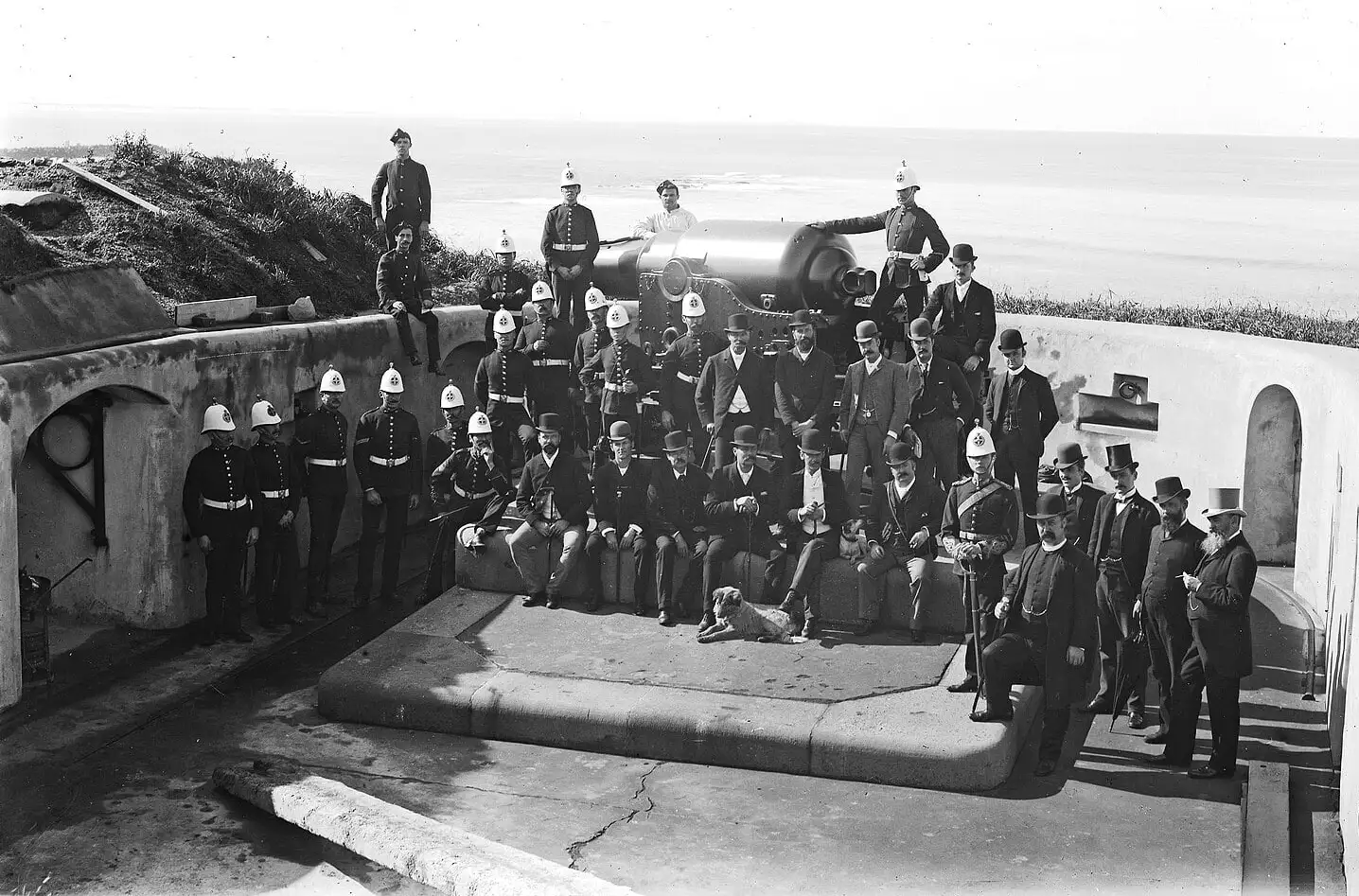
Fort Scratchley, Newcastle, New South Wales, Australia, c. 1890
Published in Hunter Valley Dances Book 2, reproduced here with the kind permission of Allyn Douglass, Secretary RSCDS Hunter Valley Branch.
This page uses content under the Creative Commons Attribution-ShareAlike 4.0 International License, along with original copyrighted content and excerpts from Wikipedia and other sources.
Text from this original Fort Scratchley article on Wikipedia.
Image from (cropped) Ralph Snowball, Public domain, via Wikimedia Commons.

Back to the top of this Scottish Country Dancing Instructions 'The Guns Of Fort Scratchley' page