Interference Patterns
Scottish Country Dance Instruction
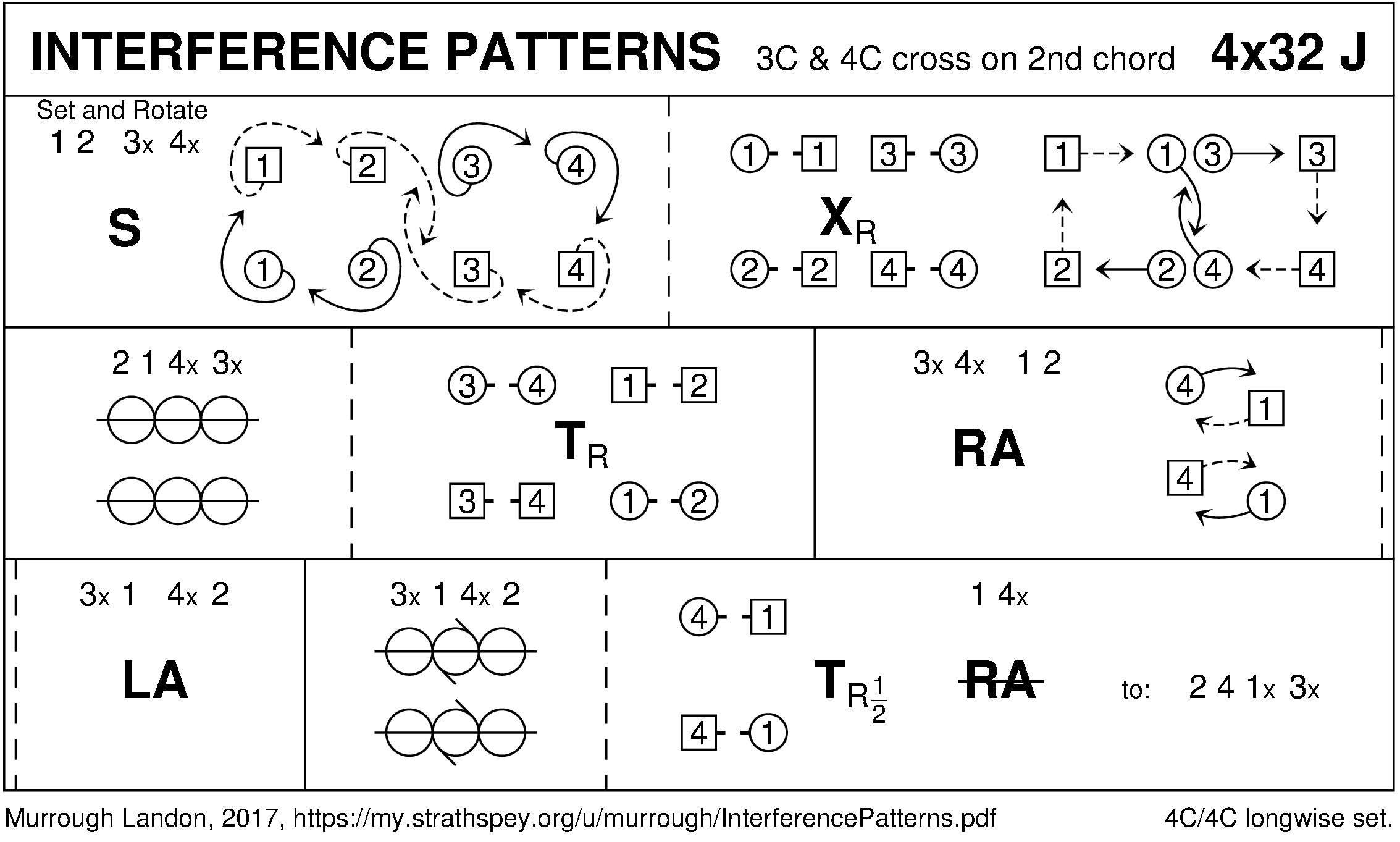
Interference Patterns (J4x32) A 32 bar jig for four couples in a longwise set, Murrough Landon October 2017The dance starts with two chords: 3rd and 4th couples cross to the opposite side on the second chord.
1- 8 1st and 2nd couples, also 3rd and 4th couples, each dance Set and Rotate. On bars 3-4 2nd and 3rd women sweep past each other right shoulder, then on bars 7-8 1st and 4th men do the same. All end facing up and down on the sides.
9-12 All dance half reels of four on the sides, starting by passing right shoulder and end facing the same person up and down on the sides.
13-16 All turn the facing person once round on the sides with the right hand, moving into the centre and end by joining right hands across.
17-20 2nd with 1st couples, also 4th with 3rd couples, each dance right hands across. All drop hands a little early and 1st and 4th couples lengthen their steps. 4th man and 1st woman, also 4th woman and 1st man, each pass right shoulder, the two women also passing left shoulder in the centre, to swap places up and down (between 2nd and 3rd places).
21-24 2nd with 4th couples, also 1st with 3rd couples, each dance left hands across. All end facing up and down on the sides.
25-28 All dance half reels of four on the sides, starting by passing left shoulder. After their last right shoulder pass 4th and 1st couples end facing each other up and down on the sides.
29-30 4th and 1st couples half turn on the sides with the right hand, moving into the centre.
31-32 1st and 4th couples dance half right hands across to end in the order 2,4,1,3 with 1st and 3rd couples on the opposite side.
(Dance crib compiled by the deviser, Murrough Landon, CC BY-SA October 2017)
Keith Rose's Crib Diagram
Dance Instruction Videos
Interference Patterns - Scottish Country Dancing Instruction VideoDance Information
Thanks to Jonathan Lewis for suggesting that two Set and Rotate figures interfere with each other. I did not want this for Homemade Jam but in compensation it is required here.Recommended music: Suggested tune: Kathleen's Jig (Alastair C Hunter).
Suitable recording: A Glint in the Eye (Marian Anderson and her Band: Platinum 70th Anniversary Dances - Belfast Branch).
(Dance information by the deviser, Murrough Landon, CC BY-SA October 2017)
An interference pattern is produced when two or more waves overlap and combine.
Depending on how the waves align, they can reinforce one another, known as constructive interference, or partially or completely cancel one another, known as destructive interference. The resulting arrangement of bright and dark regions, or areas of stronger and weaker wave amplitude, is called an interference pattern.
Interference patterns can be observed with many types of waves, including light waves, sound waves and water waves. One of the best-known examples is the Young's double-slit experiment, in which light passing through two closely spaced slits produces a series of alternating bright and dark bands on a screen. This experiment provided strong evidence that light behaves as a wave.
Interference patterns are also observed in modern technologies and scientific instruments. They are fundamental to interferometers, including the gravitational-wave detectors LIGO and Virgo Collaboration, which detect extremely small changes in distance by measuring changes in laser interference patterns.
So "interference patterns" is not merely a descriptive phrase; it is a standard scientific term used throughout optics, acoustics, quantum physics and many other fields, like Scottish Country Dancing.
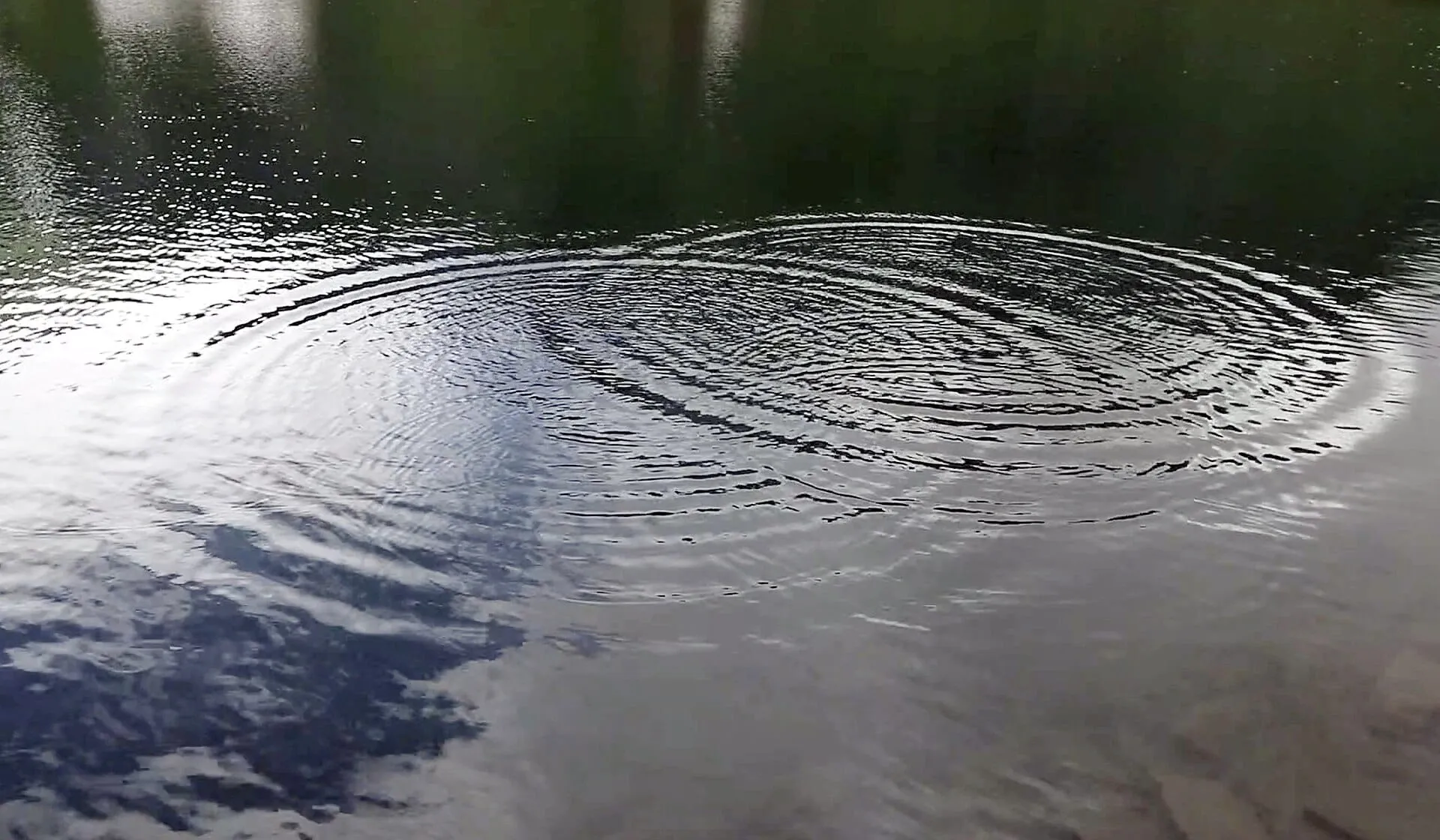
Interfering Surface Waves On A Lake
Published in Interference Patterns, reproduced here with the kind permission of the deviser, Murrough Landon. Licensed under CC BY-SA.
This page uses content under the Creative Commons Attribution-ShareAlike 4.0 International License, along with original copyrighted content and excerpts from Wikipedia and other sources.
Text from this original Wave Interference article on Wikipedia.
Image copyright Markus Pössel, CC BY 4.0, via Wikimedia Commons.

Back to the top of this Scottish Country Dancing Instructions 'Interference Patterns' page